
Discover the role of applied analytics in business, key types, real-world applications, and challenges in this comprehensive guide for professionals and corporations.
The Essential Guide to the Role of Applied Analytics
The Essential Guide to the Role of Applied Analytics
More than eighty percent of American companies now rely on applied analytics to guide business decisions and sharpen their competitive edge. As organizations race to interpret growing volumes of complex data, understanding core concepts like predictive modeling and technology integration becomes vital. This guide unpacks what applied analytics really means, explores its main categories and workflows, and reveals how American leaders are turning raw information into powerful business intelligence.
Table of Contents
- Defining Applied Analytics And Core Concepts
- Categories Of Applied Analytics Solutions
- Key Processes In Applied Analytics Workflows
- Real-World Business Applications And Examples
- Benefits, Challenges, And Best Practices
Key Takeaways
| Point | Details |
|---|---|
| Applied Analytics Definition | A sophisticated method for turning raw data into strategic insights using advanced techniques from multiple disciplines. |
| Categories of Solutions | Applied analytics solutions include Descriptive, Diagnostic, Predictive, and Prescriptive analytics, each serving a distinct purpose. |
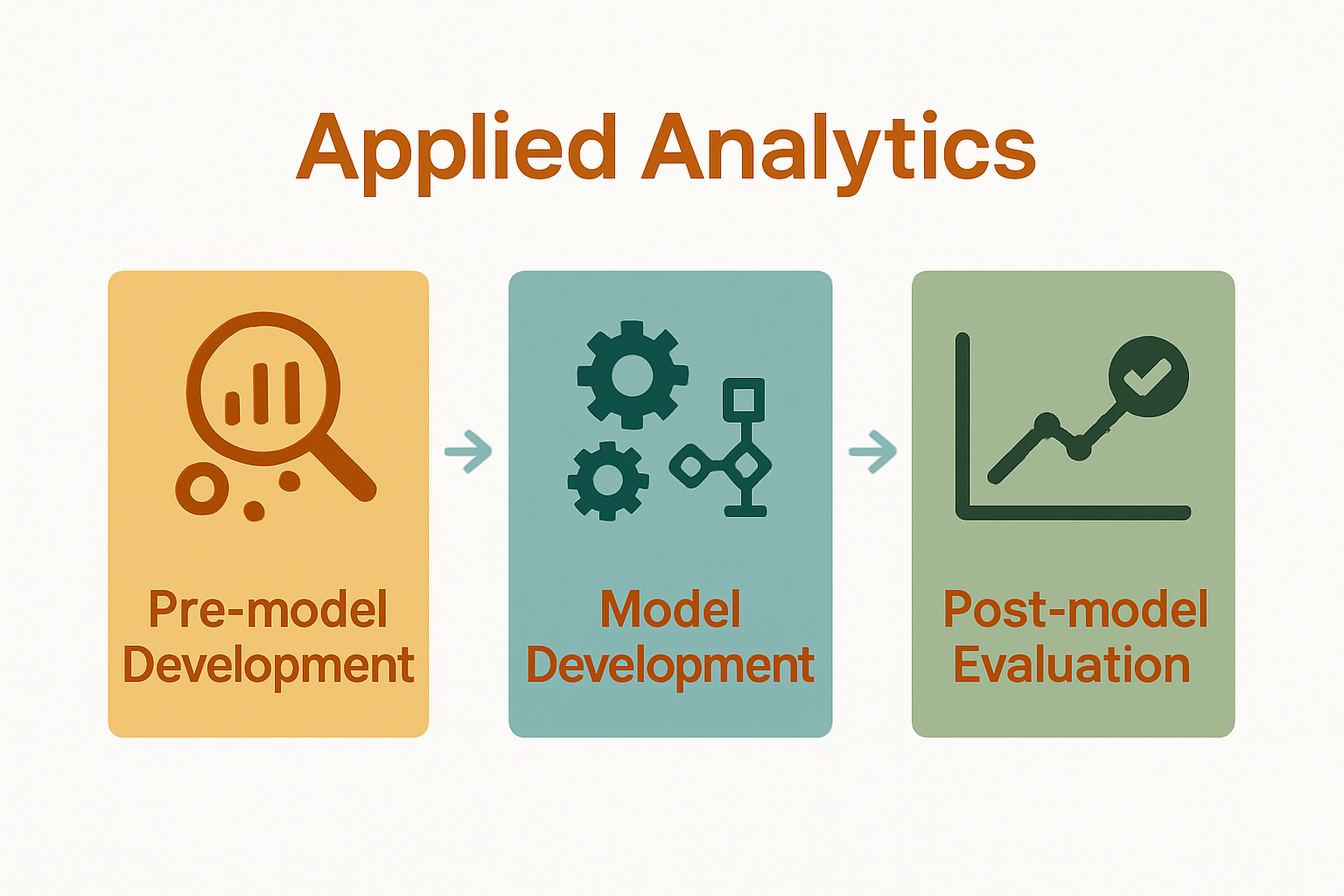
| Key Processes | Applied analytics workflows consist of Pre-Model Development, Model Development, and Post-Model Evaluation stages to refine data insights. |
| Real-World Applications | Applied analytics transforms various industries, enhancing decision-making in Healthcare, Finance, Retail, Manufacturing, and Education. |
Defining Applied Analytics and Core Concepts
Applied Analytics represents a sophisticated approach to transforming raw data into actionable strategic insights using advanced computational techniques and statistical methods. By integrating research methodologies from multiple disciplines, this field enables organizations to make data-driven decisions with unprecedented precision.
At its core, applied analytics combines elements from statistics, computer science, and business intelligence to solve complex real-world problems. Researchers analyzing information systems perspectives highlight several critical components that define this discipline:
- Technology Integration: Utilizing advanced software and computational tools
- Methodological Rigor: Applying systematic research approaches
- Practical Applications: Translating analytical findings into strategic actions
- Results-Oriented Perspective: Focusing on measurable business outcomes
Professionals practicing applied analytics must develop multidisciplinary skills that bridge theoretical knowledge with practical implementation. This requires proficiency in data manipulation, statistical modeling, machine learning algorithms, and strategic interpretation. The ultimate goal remains consistent: transforming complex datasets into clear, meaningful insights that drive organizational performance and competitive advantage.
Categories of Applied Analytics Solutions
Applied Analytics Solutions encompass diverse methodological approaches designed to extract meaningful insights from complex datasets. Research examining decision support models reveals that organizations can strategically categorize these solutions based on specific technological capabilities and business requirements.
The primary categories of applied analytics solutions include:
- Descriptive Analytics: Analyzing historical data to understand past performance
- Diagnostic Analytics: Investigating why specific events or trends occurred
- Predictive Analytics: Forecasting future outcomes using statistical algorithms
- Prescriptive Analytics: Recommending actionable strategies based on data insights
Each category serves a unique purpose in transforming raw information into strategic intelligence. Comprehensive analytics frameworks enable businesses to select appropriate solutions that align with their specific organizational objectives. These solutions leverage advanced technologies like machine learning, statistical modeling, and artificial intelligence to convert complex data streams into clear, actionable recommendations that drive competitive advantage and informed decision-making.

Key Processes in Applied Analytics Workflows
Applied Analytics Workflows represent a systematic approach to transforming raw data into actionable strategic insights. Visual analytics techniques for machine learning reveal complex processes that span multiple stages of data exploration and interpretation, providing a comprehensive framework for analytics professionals.
The key processes in applied analytics workflows can be organized into three critical stages:
- Pre-Model Development Stage
- Data collection and initial exploration
- Cleaning and preprocessing raw datasets
- Identifying potential analytical approaches
- Model Development Stage
- Algorithm selection and implementation
- Statistical modeling and feature engineering
- Iterative testing and validation
- Post-Model Evaluation Stage
- Performance assessment
- Insights generation
- Strategic recommendation formulation
Utility-oriented pattern mining techniques emphasize the importance of identifying meaningful patterns that drive actionable business intelligence. Successful applied analytics workflows require practitioners to maintain a dynamic, iterative approach that allows continuous refinement of analytical models and strategies. By integrating advanced technologies and rigorous methodological frameworks, organizations can transform complex data streams into precise, impactful decision-making tools.
Real-World Business Applications and Examples
Applied Analytics drives transformative solutions across diverse industries by converting complex data into strategic insights. Learning analytics approaches in higher education demonstrate how data-driven methodologies can address critical challenges and optimize organizational performance.
Key real-world business applications include:
- Healthcare: Predictive patient risk assessment and treatment optimization
- Finance: Fraud detection and personalized investment strategies
- Retail: Customer behavior prediction and targeted marketing campaigns
- Manufacturing: Predictive maintenance and supply chain optimization
- Education: Student performance tracking and early intervention systems
Cloud-based analytics platforms enable businesses to implement sophisticated data analysis techniques that drive competitive advantage. By leveraging advanced algorithms and machine learning technologies, organizations can transform raw data into actionable intelligence, making informed decisions that significantly impact operational efficiency, customer experience, and strategic planning. The power of applied analytics lies in its ability to uncover hidden patterns, predict future trends, and provide nuanced insights that traditional analysis methods cannot achieve.
Benefits, Challenges, and Best Practices
Applied Analytics presents a complex landscape of opportunities and potential obstacles for organizations seeking data-driven transformation. Machine learning algorithms in academic performance prediction reveal critical insights into navigating these technological challenges effectively.
Key benefits of applied analytics include:
- Enhanced decision-making capabilities
- Improved operational efficiency
- Predictive insights for strategic planning
- Risk mitigation and management
- Personalized customer experiences
However, organizations must also address significant challenges:
- Data privacy and security concerns
- Complex technological infrastructure requirements
- High initial implementation costs
- Skill gap in advanced analytical capabilities
- Ethical considerations in data usage
Strategic student segmentation techniques highlight best practices for successful analytics implementation. Successful organizations typically adopt a comprehensive approach that includes continuous learning, robust data governance, interdisciplinary collaboration, and a culture of data-driven decision-making. By maintaining flexibility, investing in talent development, and prioritizing ethical data use, businesses can maximize the transformative potential of applied analytics while mitigating potential risks.
Master the Essentials of Applied Analytics to Drive Real Business Value
Applied Analytics challenges professionals to turn complex data into clear, actionable insights. Common obstacles include mastering statistical modeling, machine learning algorithms, and strategic interpretation to address real-world problems effectively. If you are eager to overcome the skill gaps and technological complexities highlighted in “The Essential Guide to the Role of Applied Analytics,” the path to success begins with the right education and hands-on experience.
Unlock your potential with tailored professional training designed to bridge theory and practice. Explore foundational and advanced courses through our Uncategorized Archives – Ambeone where industry-relevant knowledge in artificial intelligence, data science, and applied analytics converge to prepare you for today’s data-driven marketplace.
Take the next step toward transforming how organizations leverage data by joining instructor-led training programs at Ambeone. Gain practical skills, achieve recognized certifications, and become an expert who creates measurable business impact. Visit our site now to begin your journey and secure your place in the future of analytics.
Frequently Asked Questions
What is applied analytics?
Applied analytics is the process of transforming raw data into actionable insights using advanced computational techniques and statistical methods to support data-driven decision-making within organizations.
What are the main categories of applied analytics solutions?
The primary categories include descriptive analytics (understanding past performance), diagnostic analytics (investigating why certain events occurred), predictive analytics (forecasting future outcomes), and prescriptive analytics (recommending actionable strategies based on data insights).
What are the key processes in applied analytics workflows?
Applied analytics workflows consist of three stages: the pre-model development stage (data collection and exploration), the model development stage (algorithm selection and modeling), and the post-model evaluation stage (performance assessment and insights generation).
What are some real-world applications of applied analytics?
Applied analytics is used in various fields, including healthcare for patient risk assessment, finance for fraud detection, retail for customer behavior predictions, and manufacturing for predictive maintenance.
Recommended
- Applied Analytics Explained: Key Concepts and Uses
- The Essential Guide to Applications of Applied Analytics – Ambeone
- How to Implement Analytics Training for Real Impact – Ambeone
- Business Analytics Definition: Complete Guide and Examples
- 2025 Guide to Insurance Analytics: Transform Your Decisions – Digital Insurance Platform | IBSuite Insurance Software | Modern Insurance System


