
Business analytics definition, types, key processes, real-world applications, and common misconceptions in this comprehensive, expert guide for professionals.
Business Analytics Definition: Complete Guide and Examples
Business Analytics Definition: Complete Guide and Examples
More than 90 percent of american companies collect raw data, but only a small fraction turn it into real business value. In a world packed with spreadsheets and dashboards, business analytics stands out as the tool that reveals patterns, predicts risks, and guides strategic moves. Whether you run a startup or work for a large enterprise, seeing through the myths and understanding what business analytics offers will help you make decisions that actually move the needle.
Table of Contents
- Defining Business Analytics And Misconceptions
- Major Types Of Business Analytics Explained
- Core Processes And Key Methodologies
- Real-World Applications In Modern Businesses
- Common Challenges And Pitfalls To Avoid
Key Takeaways
| Point | Details |
|---|---|
| Understanding Business Analytics | Business analytics transforms raw data into strategic insights through various analytical approaches, enhancing decision-making. |
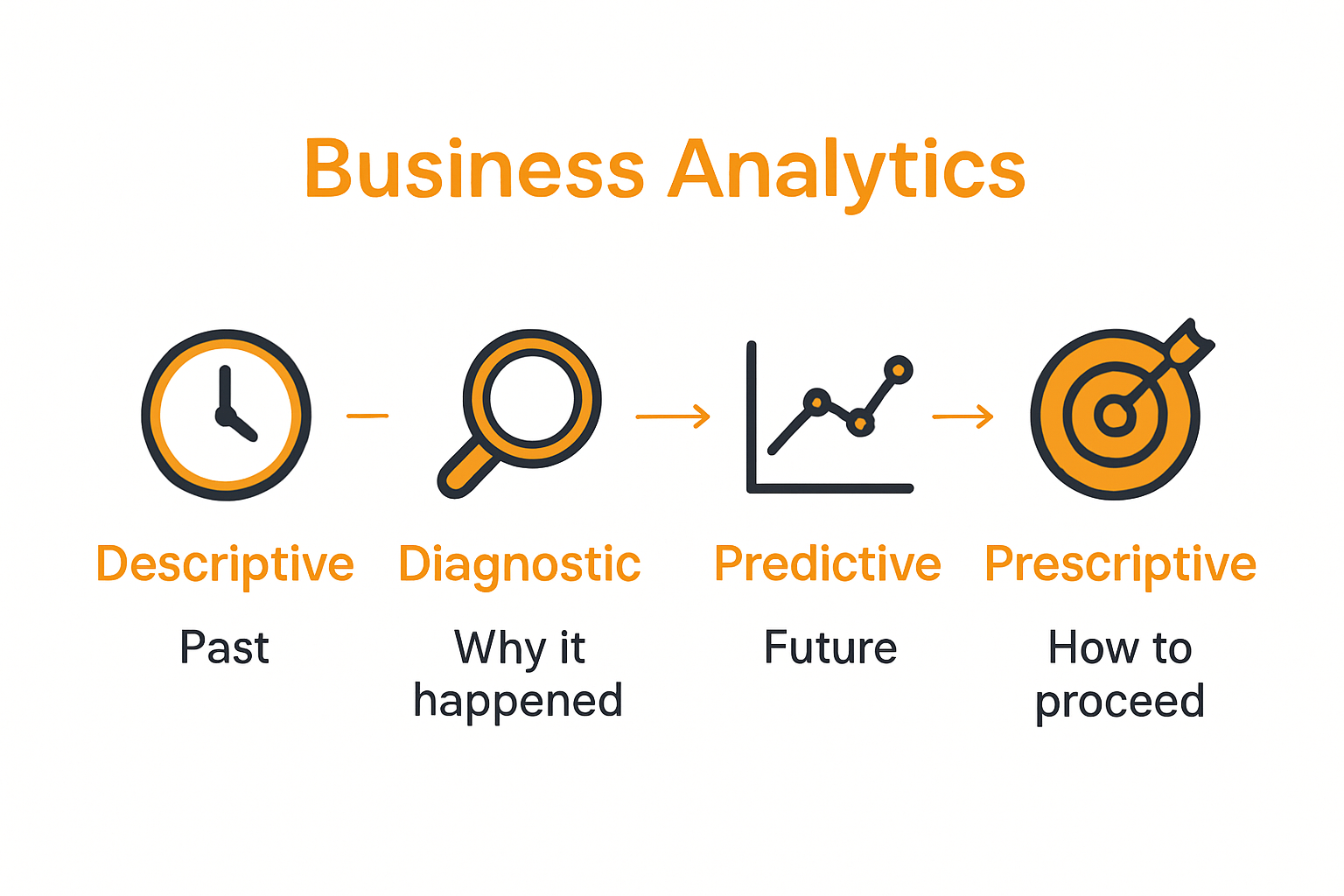
| Four Types of Analytics | Key categories include Descriptive, Diagnostic, Predictive, and Prescriptive analytics, each serving a unique purpose in data interpretation. |
| Strategic Alignment and Data Quality | Effective analytics requires alignment with business objectives and high data quality to ensure accurate insights and actionable strategies. |
| Widespread Applicability | Business analytics can be utilized by organizations of all sizes across various industries to drive performance and identify opportunities. |
Defining Business Analytics and Misconceptions
Business analytics represents a sophisticated approach to transforming raw data into meaningful insights that drive strategic decision making. According to Indeed, business analytics involves “skills, technologies, and practices for continuous iterative exploration and investigation of past business performance to gain insight and drive business planning”. This dynamic field goes far beyond simple data collection.
Business analytics is not just about gathering numbers—it’s about extracting actionable intelligence that can fundamentally transform organizational strategy. The discipline encompasses several critical analytical approaches:
- Descriptive Analytics: Understanding what has already happened
- Diagnostic Analytics: Determining why something occurred
- Predictive Analytics: Forecasting potential future outcomes
- Prescriptive Analytics: Recommending specific actions based on insights
Many professionals mistakenly view business analytics as a purely technical discipline. However, Online SBU clarifies that it’s actually a strategic function involving “aggregation, analysis, and presentation of data to inform business decisions”. The most successful business analytics practitioners combine technical prowess with strong communication and strategic thinking skills.
Contrary to popular misconception, business analytics isn’t just for large corporations or technology companies. Organizations of all sizes and across multiple industries—from healthcare and finance to retail and manufacturing—can leverage these techniques to optimize performance, reduce costs, and identify new opportunities. The key is understanding that data analysis is a powerful tool for translating complex information into clear, actionable business strategies.
Major Types of Business Analytics Explained
According to CIAM, business analytics is strategically categorized into four interconnected types that progressively enhance organizational understanding and decision making. These types represent a sophisticated framework for transforming raw data into strategic insights, moving from retrospective analysis to forward-looking recommendations.
Descriptive Analytics
Descriptive analytics serves as the foundational layer of business intelligence. This approach focuses on summarizing historical data to provide a clear picture of what has already happened. By utilizing statistical techniques and visualization tools, organizations can understand past performance trends, customer behaviors, and operational patterns.
Diagnostic Analytics
Building upon descriptive analytics, diagnostic analytics answers the critical question: “Why did something happen?” This type involves deeper investigation of data anomalies, examining correlations, performing detailed statistical analyses, and conducting root cause investigations to understand underlying factors driving specific business outcomes.
Predictive Analytics
Predictive analytics shifts the focus from understanding the past to anticipating future scenarios. By leveraging advanced statistical modeling, machine learning algorithms, and historical data patterns, businesses can forecast potential trends, predict customer behaviors, estimate future market conditions, and proactively identify potential risks or opportunities.
Prescriptive Analytics
The most advanced form of business analytics, prescriptive analytics goes beyond prediction to recommend specific actions. This approach uses complex algorithms and optimization techniques to suggest precise strategies, helping organizations make data-driven decisions that maximize performance, minimize risks, and achieve strategic objectives.
By understanding and strategically implementing these four types of business analytics, organizations can transform raw data into a powerful strategic asset.
 Data Science Training at Ambeone offers comprehensive programs that help professionals master these advanced analytical techniques, enabling them to drive meaningful business transformation through intelligent data interpretation.
Core Processes and Key Methodologies
Business analytics requires a systematic approach to transform raw data into meaningful insights. Wikipedia highlights the BADIR framework, a structured methodology designed to enhance data-driven decision making within organizations. This comprehensive framework provides a strategic roadmap for businesses seeking to leverage their data effectively.
The BADIR Framework
Business Objective Analysis represents the critical first stage where organizations clearly define their strategic goals and desired outcomes. This step ensures that all subsequent analytical efforts remain focused and aligned with overarching business priorities. Key considerations include identifying specific performance metrics, understanding competitive landscapes, and establishing clear measurement criteria.
Data Acquisition and Preparation
Data quality forms the foundation of successful business analytics. Organizations must implement rigorous processes to:
- Collect data from multiple reliable sources
- Validate and clean datasets
- Standardize data formats
- Remove inconsistencies and duplicate entries
- Ensure data integrity and compliance with privacy regulations
Insight Generation and Interpretation
Analytical techniques transform raw data into actionable intelligence. Professionals use advanced statistical methods, machine learning algorithms, and visualization tools to uncover hidden patterns, predict trends, and generate strategic recommendations. The goal is not just to understand what happened, but to provide forward-looking insights that drive meaningful business decisions.
Recommendation Development
The final stage of the BADIR framework involves translating analytical insights into concrete, implementable strategies. This requires collaboration between data analysts, business leaders, and stakeholders to develop recommendations that are both data-driven and pragmatically aligned with organizational capabilities. Data Science Training at Ambeone offers comprehensive programs that help professionals master these complex analytical methodologies, bridging the gap between data interpretation and strategic implementation.
Real-World Applications in Modern Businesses
Business analytics has transformed how organizations across various industries make strategic decisions. CIAM reveals compelling examples of how businesses leverage data-driven insights, particularly in manufacturing and human resource management, demonstrating the versatility and power of analytical approaches.
Manufacturing and Predictive Maintenance
Predictive maintenance represents a revolutionary application of business analytics in industrial settings. By analyzing sensor data from machinery and equipment, manufacturers can anticipate potential equipment failures before they occur. This proactive approach allows companies to:
- Schedule maintenance at optimal times
- Reduce unexpected equipment downtime
- Minimize repair costs
- Extend machinery lifecycle
- Improve overall operational efficiency
Human Resource Management
In the realm of human capital, business analytics provides unprecedented insights into workforce dynamics. Companies now use sophisticated analytical tools to evaluate employee performance, engagement levels, and recruitment strategies. This data-driven approach enables organizations to make more informed decisions about talent management, identifying high-potential employees, predicting turnover risks, and developing targeted training programs.
Marketing and Customer Insights
Indeed highlights how businesses leverage analytics to understand customer behavior through digital channels. Social media platforms and web analytics tools provide granular insights into customer preferences, allowing companies to:
- Track user engagement metrics
- Analyze customer interaction patterns
- Develop personalized marketing strategies
- Optimize product recommendations
- Measure campaign effectiveness in real-time
Financial Performance and Strategic Planning
Business analytics has become instrumental in financial decision making, enabling organizations to generate comprehensive reports on critical metrics such as inventory management, sales performance, and annual revenues. By transforming complex financial data into actionable insights, companies can develop more accurate forecasting models, identify potential risks, and make strategic investments. Data Science Training at Ambeone offers programs that help professionals master these advanced analytical techniques, bridging the gap between raw data and strategic business intelligence.
Common Challenges and Pitfalls to Avoid
CIAM highlights critical challenges that can undermine the effectiveness of business analytics initiatives. Understanding these potential pitfalls is crucial for organizations seeking to develop robust, actionable data strategies that drive meaningful business insights and sustainable growth.
Data Quality and Reliability
Data integrity represents the foundational challenge in business analytics. Organizations frequently encounter issues with:
- Incomplete or inconsistent data collection
- Outdated information sources
- Lack of standardized data collection protocols
- Insufficient data validation mechanisms
- Unresolved data compatibility problems
These challenges can lead to flawed analyses, misleading conclusions, and potentially disastrous strategic decisions. Implementing rigorous data governance frameworks and investing in advanced data cleaning technologies becomes essential for maintaining analytical accuracy.
Strategic Misalignment
One of the most significant risks in business analytics is strategic disconnection. Many organizations fall into the trap of collecting and analyzing data without a clear connection to core business objectives. This approach results in:
- Wasted analytical resources
- Irrelevant insights
- Inability to drive meaningful organizational change
- Increased operational complexity
- Reduced return on analytical investments
Technological and Skill Limitations
Successful business analytics requires a sophisticated blend of technological infrastructure and human expertise. Organizations frequently struggle with:
- Insufficient technological capabilities
- Lack of skilled data professionals
- Inadequate analytical tool integration
- Limited understanding of advanced analytical techniques
- Resistance to data-driven cultural transformation
Ethical and Privacy Considerations
Navigating the complex landscape of data privacy and ethical use presents another critical challenge. Organizations must balance analytical objectives with:
- Compliance with data protection regulations
- Maintaining customer trust
- Protecting individual privacy rights
- Preventing potential misuse of sensitive information
- Establishing transparent data usage policies
Data Science Training at Ambeone provides comprehensive programs designed to help professionals develop the skills necessary to overcome these challenges, ensuring more effective and responsible business analytics practices.
Unlock Your Potential in Business Analytics with Expert Training
Understanding the full scope of business analytics means grappling with complex data challenges and mastering diverse techniques like descriptive, predictive, and prescriptive analytics. If you are eager to move beyond theory to practical application that drives real-world business strategy, you need a training program that equips you with industry-relevant skills and methodologies such as the BADIR framework. With data quality, strategic alignment, and ethical use often standing in the way of effective analytics, learning from professionals who emphasize these critical areas can make all the difference.
Take control of your career by enrolling in tailored courses designed to help you navigate and conquer the challenges discussed in the Uncategorized Archives – Ambeone. Explore comprehensive programs at Ambeone where you can master applied analytics techniques and gain hands-on experience with advanced tools. Start transforming complex data into actionable business insights and become a sought-after professional in Dubai and the wider UAE by taking the next step today.
Frequently Asked Questions
What is business analytics?
Business analytics is the process of transforming raw data into meaningful insights to drive strategic decision-making. It involves skills, technologies, and practices for exploring past business performance to inform future planning.
What are the main types of business analytics?
The main types of business analytics are Descriptive Analytics (understanding past events), Diagnostic Analytics (analyzing reasons for past events), Predictive Analytics (forecasting future trends), and Prescriptive Analytics (recommending actions based on insights).
How can organizations benefit from implementing business analytics?
Organizations can benefit from business analytics by optimizing performance, reducing costs, enhancing decision-making, and identifying new opportunities. Effective analytics can transform data into actionable strategies that align with business objectives.
What are some common challenges in business analytics?
Common challenges include ensuring data quality and reliability, strategic misalignment with business objectives, technological and skill limitations, and ethical considerations regarding data privacy and usage.