
Applied analytics: comprehensive guide to definitions, types, tools, business benefits, and implementation steps. Essential for career growth in AI.
Applied Analytics Explained: Key Concepts and Uses
Applied Analytics Explained: Key Concepts and Uses
More than 80 percent of american companies rely on applied analytics to guide big decisions and solve tough challenges. In a world overflowing with data, turning that raw information into real business value is what sets leaders apart. Applied analytics brings together statistics, machine learning, and smart modeling so organizations can spot trends, reduce risks, and find new opportunities. This guide explains the core concepts, tools, and practical uses that make applied analytics essential for staying ahead in a fast-changing market.
Table of Contents
- Definition And Core Principles Of Applied Analytics
- Types Of Applied Analytics Approaches And Models
- Key Tools And Techniques In Applied Analytics
- Business Applications And Real-World Use Cases
- Skills Needed And Common Pitfalls To Avoid
Key Takeaways
| Point | Details |
|---|---|
| Applied Analytics Definition | It transforms raw data into actionable insights using statistical analysis, machine learning, and predictive modeling. |
| Key Principles | Focus on data-driven decision-making, continuous learning, holistic insights, and predictive capabilities. |
| Types of Analytics | Includes descriptive, diagnostic, predictive, and prescriptive analytics for strategic business objectives. |
| Essential Skills | Professionals require advanced skills in programming, machine learning, data visualization, and business understanding. |
Definition and Core Principles of Applied Analytics
Applied analytics represents a strategic approach to transforming raw data into actionable business insights through sophisticated computational techniques. At its core, applied analytics combines statistical analysis, machine learning algorithms, and predictive modeling to solve complex organizational challenges and drive informed decision-making.
According to Wikipedia, predictive analytics involves leveraging statistical techniques from data mining, predictive modeling, and machine learning to analyze current and historical data for forecasting future events. These techniques capture intricate relationships among various factors, enabling risk assessment and potential outcome prediction across diverse sectors such as marketing, finance, healthcare, and operations management.
Key principles of applied analytics include:
- Data-Driven Decision Making: Prioritizing empirical evidence over intuition
- Continuous Learning: Constantly refining models based on new information
- Holistic Perspective: Integrating multiple data sources for comprehensive insights
- Predictive Capability: Moving beyond descriptive analysis to anticipate future trends
The field of augmented analytics further enhances this approach by employing machine learning and natural language processing to automate complex analytical processes. By streamlining data exploration from diverse sources, organizations can achieve more efficient and nuanced business intelligence.
Professionals pursuing applied analytics must develop a robust skill set combining statistical knowledge, programming expertise, and strategic business understanding. These skills enable them to translate complex data patterns into clear, implementable recommendations that drive organizational performance and competitive advantage.

For professionals seeking to deepen their understanding, our guide to applications of applied analytics provides comprehensive insights into practical implementation strategies across industries.
Types of Applied Analytics Approaches and Models
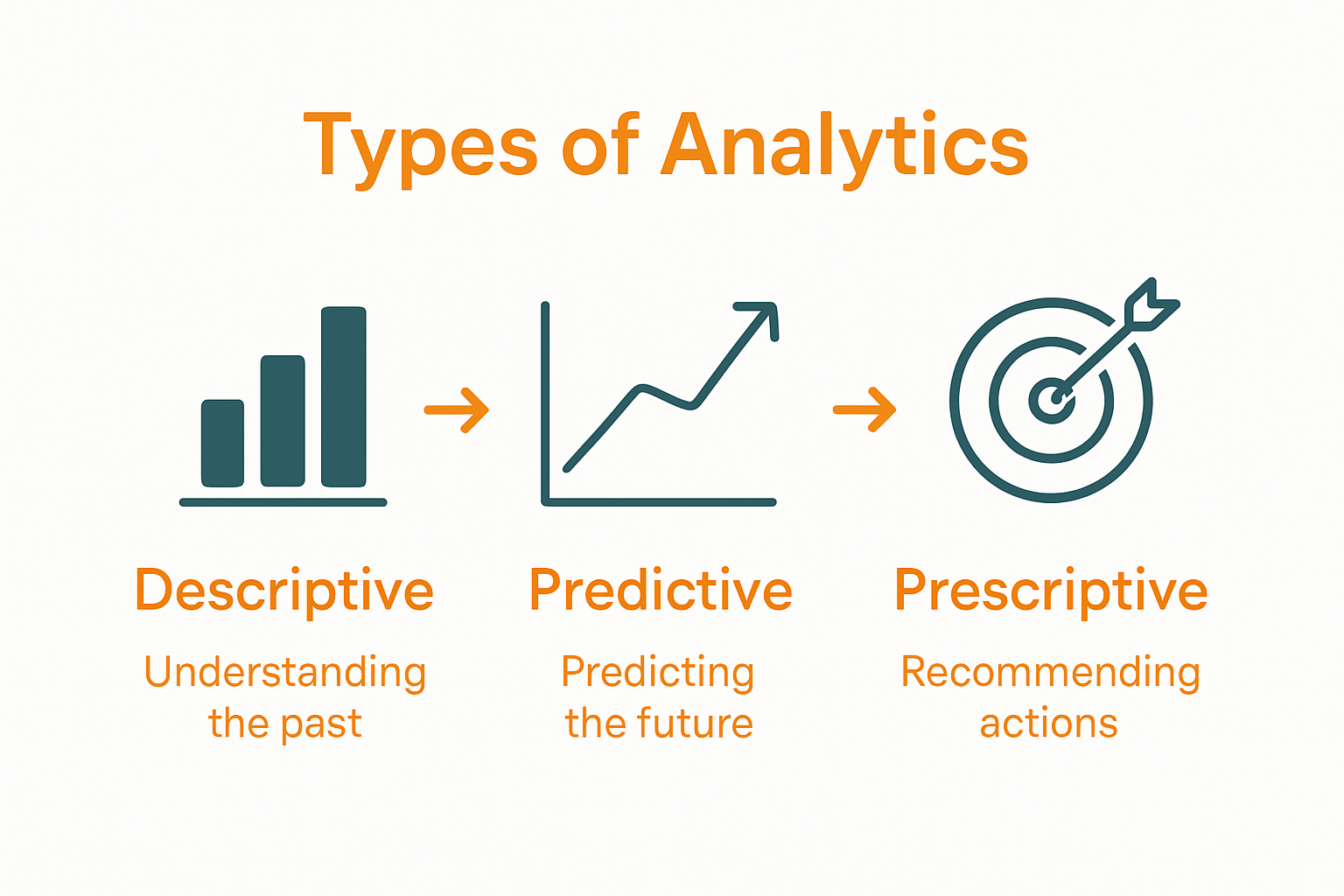
Applied analytics encompasses multiple strategic approaches designed to extract meaningful insights from complex data sets. These models range from understanding historical performance to predicting future scenarios and recommending specific actions for organizational success.
According to Sophia, there are four primary types of analytics that form the foundation of this discipline:
- Descriptive Analytics: Summarizes historical data to understand past performance
- Diagnostic Analytics: Explores underlying causes of previous outcomes
- Predictive Analytics: Uses statistical models to forecast potential future events
- Prescriptive Analytics: Recommends specific actions to achieve desired outcomes
Predictive analytics involves developing sophisticated statistical models that analyze current and historical data patterns to generate future projections. These models help organizations anticipate potential risks, market trends, and performance indicators across various sectors.
Semo highlights that prescriptive analytics represents an advanced approach integrating predictive insights with optimization techniques. By leveraging AI, machine learning, and complex business rules, this model answers the critical question: “What should we do?”
Professionals can develop expertise in these analytics models through targeted training, understanding how each approach provides unique strategic value.
For instance, while descriptive analytics offers retrospective understanding, predictive and prescriptive models enable proactive decision-making.
Those interested in expanding their knowledge can explore our Business Analytics Training Guide to gain comprehensive insights into applying these sophisticated analytical approaches across different industry contexts.
Key Tools and Techniques in Applied Analytics
Applied analytics leverages a sophisticated array of computational tools and techniques that transform raw data into strategic business intelligence. These technologies enable professionals to extract meaningful insights, predict complex patterns, and drive data-driven decision-making across diverse organizational contexts.
Key analytical tools include:
- Statistical programming languages like R and Python
- Machine learning frameworks such as TensorFlow and scikit-learn
- Advanced visualization platforms like Tableau and Power BI
- Big data processing systems including Apache Spark and Hadoop
Wikipedia highlights that IT operations analytics represents a critical technique involving sophisticated data retrieval, analysis, and reporting. This approach applies big data analytics to large datasets, helping organizations discover complex patterns within high-volume IT system data to improve operational efficiency and strategic decision-making.
Modern applied analytics techniques emphasize advanced computational methodologies:
- Predictive modeling using regression and classification algorithms
- Natural language processing for unstructured data analysis
- Deep learning neural network architectures
- Simulation and optimization techniques
Professionals must develop proficiency in selecting and applying appropriate analytical tools based on specific business challenges. This requires understanding each tool’s strengths, limitations, and potential applications across different industry scenarios.
Those looking to expand their technical expertise can explore our Data Analytics Guide to gain comprehensive insights into selecting and implementing cutting-edge analytical technologies.
Business Applications and Real-World Use Cases
Applied analytics has transformed decision-making across multiple industries by providing data-driven insights that enable organizations to optimize operations, predict trends, and develop strategic initiatives. From healthcare to marketing, these advanced analytical approaches offer unprecedented opportunities for understanding complex business challenges.
PMC highlights the critical role of analytics in healthcare, where descriptive and predictive techniques support crucial decision-making processes. In clinical settings, these approaches help:
- Forecast patient admission rates
- Predict potential disease outbreaks
- Optimize resource allocation
- Enhance clinical decision support systems
- Improve pharmacovigilance monitoring
Marketing analytics represents another powerful application of these techniques. Wikipedia explains that marketing mix modeling enables businesses to quantify the impact of marketing activities on sales by establishing complex relationships between marketing elements through sophisticated regression analysis.
Other significant business application domains include:
- Financial risk management
- Supply chain optimization
- Customer behavior prediction
- Operational efficiency enhancement
- Fraud detection and prevention
These analytical approaches allow organizations to transform raw data into actionable strategic insights, moving beyond traditional intuition-based decision-making. By leveraging advanced statistical models and machine learning algorithms, businesses can anticipate market shifts, understand customer preferences, and develop proactive strategies.
Professionals seeking to understand how data science drives business innovation can explore our comprehensive guide on business data science to gain deeper insights into practical applications across industries.
Skills Needed and Common Pitfalls to Avoid
Mastering applied analytics requires a sophisticated blend of technical expertise, analytical thinking, and strategic understanding. Professionals must develop a comprehensive skill set that bridges computational techniques, statistical reasoning, and business intelligence.
Essential skills for success include:
- Advanced statistical programming
- Machine learning algorithm development
- Data visualization techniques
- Critical problem-solving abilities
- Strong mathematical foundation
- Business domain knowledge
ArXiv emphasizes the complexity of high-dimensional statistical inference in data analytics, highlighting the critical need for professionals to develop advanced skills in developing robust statistical models. This involves managing complex data structures, ensuring model accuracy, and effectively translating theoretical concepts into practical analytical solutions.
Common pitfalls to avoid in applied analytics:
- Overlooking data quality and preprocessing
- Misinterpreting statistical significance
- Confirmation bias in model development
- Neglecting domain-specific context
- Over-relying on single analytical approaches
ArXiv notes that utility-oriented pattern mining requires nuanced understanding of various parameters like weight, price, and profit. Professionals must develop skills to comprehensively analyze data beyond surface-level interpretations.
Successful analytics professionals continuously learn, adapt, and refine their approaches. This involves staying current with emerging technologies, understanding statistical methodologies, and maintaining a critical perspective on data interpretation.
Professionals seeking to develop comprehensive analytical skills can explore our Business Analytics Training Guide to gain structured insights into advanced analytical techniques and career development strategies.
Unlock the Power of Applied Analytics to Advance Your Career
Applied analytics combines complex data techniques like predictive modeling and machine learning to turn raw data into clear, actionable insights. Professionals often struggle with mastering these advanced tools and applying them effectively to real-world business challenges. Whether it is managing data quality, avoiding common pitfalls, or integrating multiple analytics approaches, understanding applied analytics concepts is critical for driving impactful decisions.
Take control of your future by gaining practical, industry-relevant knowledge through hands-on training. Explore our Uncategorized Archives – Ambeone to discover learning pathways that strengthen your skills in statistics, AI, and business applications of analytics.
Start your journey today at Ambeone and join instructor-led workshops designed specifically for professionals in Dubai and the UAE who want to excel in applied analytics. Don’t wait to gain the expertise that sets you apart in a competitive market. Visit our site now to find out how you can enhance your career with certification and practical training tailored to your goals.
Frequently Asked Questions
What is applied analytics?
Applied analytics is a strategic approach to transforming raw data into actionable business insights using statistical analysis, machine learning algorithms, and predictive modeling.
What are the main types of applied analytics?
The main types of applied analytics include descriptive analytics, diagnostic analytics, predictive analytics, and prescriptive analytics, each serving a unique purpose in analyzing data.
What key tools are used in applied analytics?
Key tools include statistical programming languages like R and Python, machine learning frameworks such as TensorFlow and scikit-learn, and visualization platforms like Tableau and Power BI.
What skills are essential for professionals working in applied analytics?
Essential skills include advanced statistical programming, machine learning development, data visualization techniques, analytical problem-solving, and strong knowledge of business domains.