
Machine Learning Course Dubai: Why Your Training Should Be In-Person (Just Like Your Future Job)
Let's talk about that folder.
You know the one. "Courses_To_Finish" sitting on your desktop. It's got at least three half-watched Udemy courses on machine learning, a Coursera certificate you paid for but never completed, and maybe a YouTube playlist titled "Learn ML in 30 Days!" that you haven't touched since day 4.
You're not alone. And honestly? It's not entirely your fault.
Machine learning isn't like learning to use Canva or mastering Excel formulas. You can't just watch a 10-minute video, follow along, and call yourself proficient. ML is a different beast entirely, and trying to tame it through a screen while sitting in your pajamas is like trying to learn surgery from TikTok.
Why Machine Learning Breaks the Online Learning Model
Here's the thing about online courses: they're brilliant for certain skills.
Want to learn the basics of Python syntax? Sure, watch a video.
Need to understand what an algorithm is conceptually? YouTube's got your back.
But machine learning? That's where the wheels fall off.
Machine learning is inherently complex. You're not just learning a programming language. You're learning:
- Statistics and probability theory
- Linear algebra and calculus
- Data preprocessing and feature engineering
- Model selection and hyperparameter tuning
- Evaluation metrics and interpretation
- Deployment considerations
And here's the kicker: all of these concepts interact with each other. Understanding one without the others is like knowing how to hold a steering wheel but not what the pedals do.
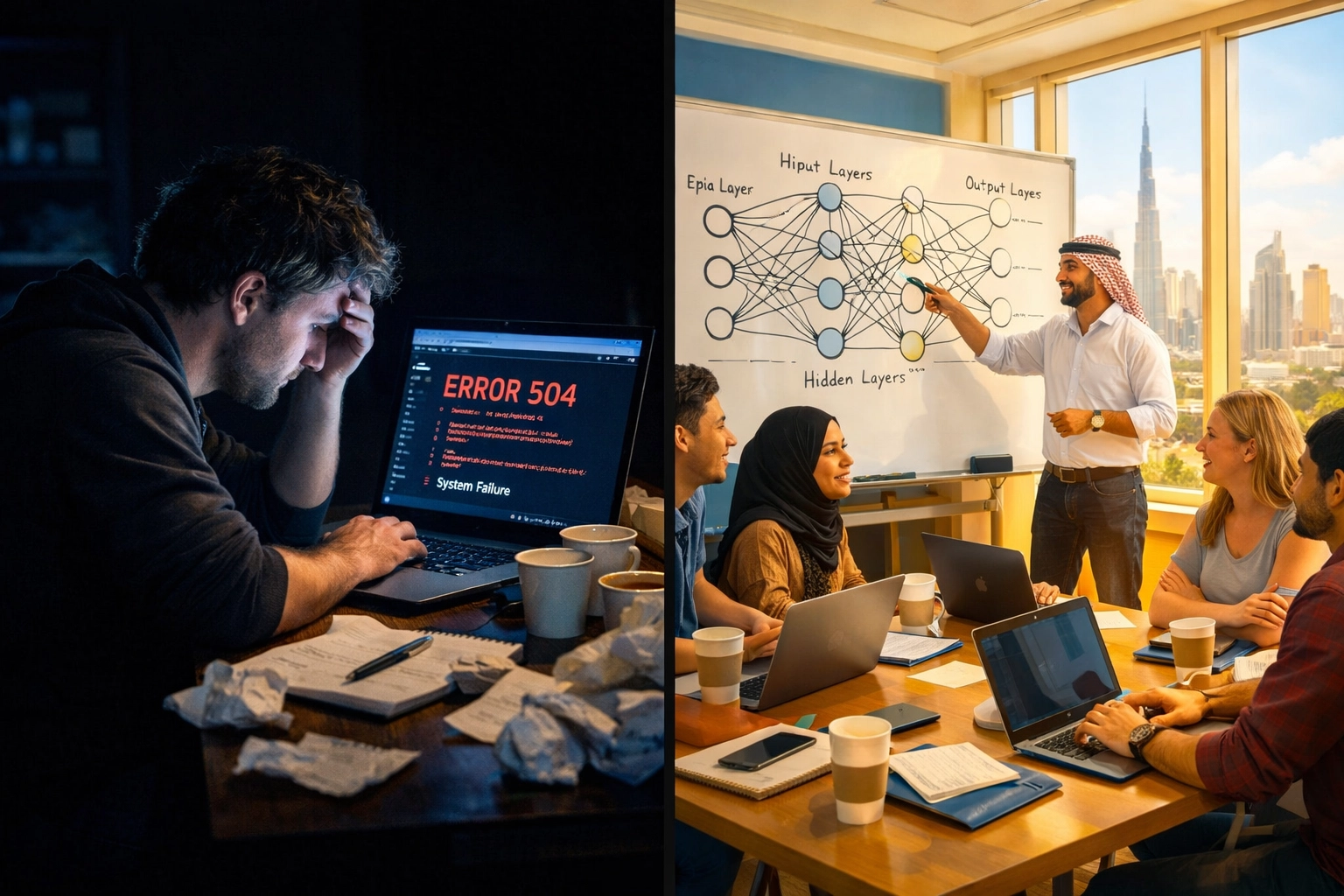
When you're stuck trying to debug why your model is overfitting at 2 AM with no one to ask? That's when the online course dream dies.
The Great Online Learning Trap
Let me paint you a picture.
You sign up for a machine learning course Dubai residents are raving about online. It's got 4.7 stars. The instructor seems friendly. The syllabus looks comprehensive.
Week 1: You're motivated. Taking notes. Feeling smart.
Week 2: The neural networks section starts. You rewind the video 6 times. Still confused.
Week 3: Your code doesn't work. The error message makes no sense. You Google it. Find a StackOverflow thread from 2019. The solution doesn't apply to your version of TensorFlow.
Week 4: You've fallen behind. The community forum is dead. You tell yourself you'll catch up this weekend.
Week 8: The course is now in that folder.
Sound familiar?
The problem isn't you. The problem is that machine learning requires immediate feedback loops. When you're learning complex concepts, you need someone to catch your misconceptions before they become bad habits. You need to see how experienced practitioners actually think through problems, not just how they present polished solutions.
Why Your ML Training Should Be In-Person (Like Your Future Job)
Think about every job posting you've seen for AI course Dubai graduates.
How many say "remote-first, never come to office"? Maybe a few.
How many require collaboration with cross-functional teams, stakeholder presentations, and working alongside engineers? Most of them.

Here's what no one tells you: The technical skills are only half the equation.
Machine learning in the real world means:
- Explaining your model choices to non-technical stakeholders
- Collaborating with data engineers on pipeline issues
- Whiteboarding solutions with your team
- Getting real-time feedback on your approach
- Building relationships with mentors who've been there
None of that happens through a comments section.
The AMBÉONE Difference: Learning from People Who've Actually Done This
When we say our instructors have 30+ years of experience, we're not talking about people who learned to code last year and started teaching.
We're talking about industry veterans who've built machine learning systems for actual businesses. Who've debugged production models at 3 AM. Who know the difference between what works in tutorials and what works in reality.
In our physical classroom in Dubai, here's what actually happens:
You ask a question about gradient descent. Instead of waiting 48 hours for a forum response, you get an answer now, with a whiteboard diagram, real-world context, and three different ways to think about it.
Your code breaks during a lab session. Your instructor doesn't just give you the answer. They walk you through the debugging process, showing you how to think like a machine learning engineer.
You're working on a classification problem and can't decide between Random Forest and XGBoost. You turn to the person next to you, someone from a different industry with a different perspective, and suddenly you're learning from peer experience, not just instruction.
Real Projects, Real Portfolio, Real Career
Let's be honest about another online course failure point: those "capstone projects."
You know the ones. Predict house prices using the Boston Housing dataset. Classify iris flowers. Build a sentiment analyzer on movie reviews.
Cool. And completely useless for your portfolio.

At AMBÉONE, your hands-on projects are designed to be portfolio-worthy from day one. We're talking about:
- Real business problems from actual industries
- Datasets that are messy and incomplete (like the real world)
- Projects that require you to make strategic decisions, not just follow instructions
- Work you can confidently discuss in interviews
And because you're doing this in a collaborative environment, you're also learning:
- How to present technical findings to a group
- How to give and receive code reviews
- How to work with version control in a team setting
- How to articulate your decision-making process
Try getting that from a pre-recorded video.
The 6-Month Career-Ready Pathway (Actually Career-Ready)
Here's where we get specific about our data science course Dubai approach.
Six months. That's our timeline to take you from curious beginner to job-ready professional.
Not six months of watching videos at 1.5x speed. Six months of:
- Structured, progressive learning with clear milestones
- Immediate feedback on every assignment
- Industry-relevant projects that build on each other
- Career preparation including interview skills and portfolio development
- KHDA-approved certification that actually means something to employers
The difference? At the end of six months, you're not adding another certificate to LinkedIn and hoping for the best. You're walking into interviews with confidence, a solid portfolio, and the ability to actually do the job.
But Isn't In-Person More Expensive?
Look, we could lie and say price doesn't matter. But let's be real.
Yes, in-person training costs more than a $12.99 Udemy course.
But let's do some math:
- $13 course you never finish = $13 and 0 career progress
- $500 in online courses you partially complete over 2 years = $500 and maybe some surface knowledge
- In-person training you actually complete with career support = actual ROI
The question isn't "what's cheapest?" The question is "what actually works?"
If you're serious about transitioning into machine learning, data science, or AI: not just dabbling, but actually making it your career: then investing in proper training is the only move that makes sense.
Your Future Workplace Won't Be Virtual Forever
Even companies that went "fully remote" during 2020 are reconsidering. Why? Because complex work requires real collaboration.
And machine learning is complex work.

You'll need to:
- Brainstorm solutions with your team
- Present findings to stakeholders face-to-face
- Debug problems collaboratively
- Build relationships with senior engineers who can mentor you
Start practicing that now. In a real classroom. With real people. Building real skills.
Ready to Actually Learn Machine Learning?
If you're tired of adding courses to that folder and ready to actually master machine learning, it's time to try a different approach.
AMBÉONE's physical classroom in Dubai isn't about recreating the online experience with desks. It's about providing what online learning can't: immediate feedback, industry expertise, peer collaboration, and hands-on experience that actually prepares you for the job market.
Our machine learning programs are designed for working professionals who are serious about career transition: not hobbyists collecting certificates.
6 months. Industry veterans. Real projects. KHDA-approved. Career-ready.
That's not a promise. That's the program.
Explore our courses and see what in-person training can actually do for your career. Or keep collecting those certificates. Your call.
But we both know which folder they'll end up in. 😉