AI Certification Explained: Key Types, Value, and Impact
More than 60 percent of American employers now view technology credentials as critical for hiring in artificial intelligence roles. As the demand for AI expertise grows, understanding which certifications truly matter can make a real difference in your career path. Whether you are new to the world of AI or aiming to enhance your existing skills, learning how AI certifications work and what they offer helps you make smarter, more informed decisions in a rapidly changing job market.
Table of Contents
- Defining AI Certification and Its Purpose
- Major Types of AI Certifications Available
- Key Requirements and Eligibility Criteria
- Industry Recognition and Real-World Applications
- Risks, Costs, and Common Pitfalls
Key Takeaways
| Point | Details |
|---|---|
| AI Certifications Enhance Career Prospects | Obtaining recognized AI certifications can significantly improve career opportunities in a technology-driven job market. |
| Diverse Certification Types Address Different Needs | Various AI certifications cater to different professional goals, from vendor-specific to academic and specialized credentials. |
| Continuous Learning is Essential | Pursuing AI certification should be seen as part of ongoing education; staying updated is crucial for relevance in a fast-evolving field. |
| Evaluate Risks and Costs Before Commitment | Professionals should critically assess the costs and potential industry recognition of certifications to ensure a worthwhile investment. |
Defining AI Certification and Its Purpose
Artificial Intelligence (AI) certification represents a structured credentialing process designed to validate an individual’s knowledge, skills, and expertise in emerging artificial intelligence technologies. These professional credentials serve as critical benchmarks for assessing an individual’s technical proficiency and understanding of complex AI principles, methodologies, and practical applications.
At its core, AI certification aims to standardize professional competencies across rapidly evolving technological domains. By establishing rigorous assessment criteria, these certifications help organizations identify talent with demonstrated capabilities in developing, implementing, and managing AI solutions. The certification process typically involves comprehensive examinations that test theoretical understanding and practical skills in areas such as machine learning, neural networks, data analysis, and ethical AI development.
The purpose of AI certification extends beyond individual skill validation. These credentials play a strategic role in driving industry standards, promoting responsible AI innovation, and creating a common language for technological competence. For professionals, obtaining a recognized AI certification can significantly enhance career prospects, providing a competitive edge in a job market increasingly driven by artificial intelligence and data-driven technologies.
Pro Tip – Certification Strategy: Research multiple AI certification programs, compare their curriculum and industry recognition, and select credentials aligned with your specific career goals and technological specialization.
Pro Tip – Continuous Learning: View AI certification not as an endpoint, but as a milestone in ongoing technological education, staying updated with the latest advancements and emerging AI paradigms.
Major Types of AI Certifications Available
The world of AI certification encompasses diverse credential types designed to validate specialized skills across multiple technological domains. Professional AI certifications range from vendor-specific technical credentials to comprehensive academic and industry-recognized programs, each targeting different professional needs and technological expertise levels.
Key categories of AI certifications include:
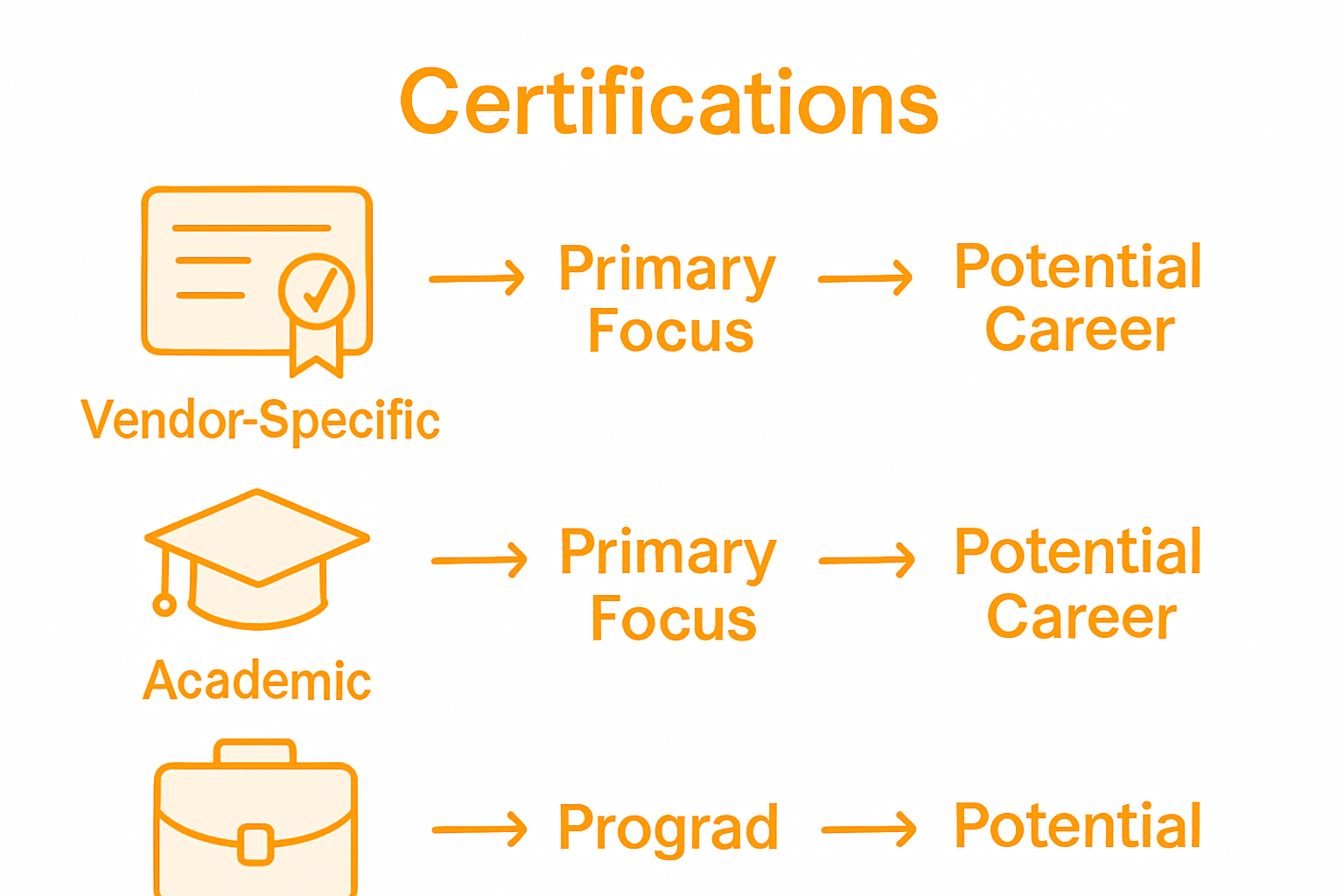
- Vendor-Specific Certifications: Programs offered by major technology companies like Google, Microsoft, and Amazon, focusing on their specific AI platforms and cloud-based machine learning tools
- Academic Certifications: Advanced credentials from universities and research institutions that provide deep theoretical and practical understanding of artificial intelligence principles
- Professional Skills Certifications: Industry-recognized credentials demonstrating practical competence in AI implementation, data analysis, and machine learning applications
- Specialized Technical Certifications: Focused credentials in specific AI subfields such as natural language processing, computer vision, robotics, and neural network design
These certification categories address different career stages and professional requirements, enabling technology professionals to validate their expertise and demonstrate commitment to continuous learning in the rapidly evolving AI landscape. Each certification type offers unique benefits, from platform-specific technical skills to broader theoretical knowledge and practical implementation strategies.
Here’s a quick comparison of major AI certification types and their strategic value:
| Certification Type | Best For | Typical Focus | Example Impact |
|---|---|---|---|
| Vendor-Specific | Tech professionals using platforms | Platform tools and deployment | Faster onboarding |
| Academic | Researchers and theorists | Deep theoretical knowledge | Research credibility |
| Professional Skills | Applied practitioners | Practical, cross-platform skills | Smoother job transitions |
| Specialized Technical | Niche AI experts | Focused technical subdomains | Thought leadership roles |
Pro Tip – Certification Selection: Carefully evaluate your career goals, current skill level, and target industry when selecting an AI certification, prioritizing credentials that align with your specific professional trajectory.
Pro Tip – Strategic Credentialing: Combine multiple certification types to create a comprehensive professional profile that showcases both broad understanding and specialized expertise in artificial intelligence technologies.
Key Requirements and Eligibility Criteria
AI certification programs have diverse eligibility criteria designed to ensure candidates possess the foundational knowledge and technical skills necessary for advanced technological learning. Tech certification prerequisites typically vary based on the specific program’s complexity, specialization, and target professional audience.
General eligibility requirements for AI certifications often include:
Educational Background: – Bachelor’s degree in Computer Science, Mathematics, Engineering, or related technical fields – Some advanced certifications may require graduate-level education
Technical Prerequisites:
- Fundamental programming skills (Python, R, Java)
- Basic understanding of statistical analysis
- Working knowledge of machine learning concepts
- Familiarity with data structures and algorithms
Professional Experience:
- Entry-level programs: No prior experience required
- Intermediate certifications: 1-2 years of relevant professional experience
- Advanced credentials: Minimum 3-5 years of specialized AI or data science work
Most certification programs also require candidates to demonstrate proficiency through comprehensive examinations, practical assessments, and project submissions. These evaluations measure not just theoretical knowledge but also practical application of artificial intelligence principles across real-world scenarios.

Pro Tip – Preparation Strategy: Review the specific prerequisites for your target certification carefully, and systematically address any skill gaps through online courses, tutorials, and practical coding practice before applying.
Pro Tip – Skill Mapping: Create a detailed skills inventory comparing your current capabilities with certification requirements, identifying precise areas for targeted professional development.
Industry Recognition and Real-World Applications
AI certification industry perspectives reveal a complex landscape where professional credentials are increasingly critical for demonstrating practical technological competence. While recognition varies across different sectors, these certifications have become essential markers of technical proficiency in an increasingly competitive job market.
Real-world applications of AI certifications span multiple critical industry domains:
Technology Sector:
- Software development and engineering roles
- Cloud computing infrastructure management
- Machine learning algorithm design
- Advanced data analytics positions
Healthcare Applications:
- Medical imaging analysis
- Predictive diagnostic systems
- Patient treatment optimization
- Research and pharmaceutical development
Financial Services:
- Algorithmic trading systems
- Fraud detection mechanisms
- Risk assessment modeling
- Automated customer service platforms
Industry leaders increasingly view AI certifications as concrete evidence of an individual’s ability to translate theoretical knowledge into practical technological solutions. These credentials demonstrate not just technical skills but also a professional’s commitment to understanding emerging technological paradigms and their potential transformative impacts across various organizational contexts.
Pro Tip – Professional Networking: Leverage your AI certification as a conversation starter and professional differentiator, actively connecting with industry experts who recognize and value specialized technological credentials.
Pro Tip – Continuous Validation: Treat your certification as a baseline, continuously updating your skills through practical projects, conference participation, and ongoing technological research.
Risks, Costs, and Common Pitfalls
AI certification challenges represent a complex landscape of potential investments and professional development strategies that require careful navigation. Professionals must critically evaluate the potential risks, financial implications, and potential limitations associated with pursuing technological credentials in the rapidly evolving artificial intelligence domain.
Key risks and potential pitfalls include:
Financial Considerations:
- Certification program costs ranging from $300 to $3,000
- Additional expenses for study materials and examination fees
- Potential opportunity costs of time investment
- Limited return on investment for outdated or narrow-scope certifications
Knowledge Limitations:
- Rapid technological obsolescence
- Incomplete practical skill translation
- Potential gaps between theoretical knowledge and real-world application
- Over-reliance on standardized curriculum
Career Impact Risks:
- Inconsistent industry recognition
- Potential employer skepticism about certification value
- Limited differentiation in competitive job markets
- Risk of credential becoming quickly outdated
Successful professionals approach AI certification as a strategic investment, understanding that credentials alone cannot substitute for practical experience, continuous learning, and demonstrable technological capabilities. The most effective approach involves combining certification with hands-on projects, ongoing skill development, and active professional networking.
This summary outlines main risks of AI certification and ways to mitigate them:
| Main Risk | Potential Impact | Mitigation Strategy |
|---|---|---|
| High cost | Burden on personal finances | Choose programs with best ROI |
| Outdated knowledge | Skills lose relevance | Regularly update and recertify |
| Incomplete skills | Gaps in real-world ability | Pair with hands-on experience |
| Weak industry value | Limited career benefit | Research employer recognition |
Pro Tip – Strategic Validation: Before investing in any AI certification, thoroughly research its current market relevance, speak with professionals who have completed the program, and assess its alignment with your specific career objectives.
Pro Tip – Cost-Benefit Analysis: Calculate the potential return on investment by comparing certification costs against projected salary increases, job opportunities, and skill enhancement potential.
Elevate Your AI Career with Expert-Led Training and Certification
Facing the challenge of navigating diverse AI certification types and ensuring your skills align with industry demands can feel overwhelming. This article highlights key concerns like matching your educational background and experience to the right credential, avoiding costly certifications with limited value, and continuously updating your expertise in a fast-changing field. If you are determined to stand out as a confident AI professional, practical knowledge combined with recognized certification is essential.
At Ambeone, we specialize in empowering professionals in Dubai and the UAE to overcome these hurdles through in-person instructor-led training, comprehensive workshops, and career-focused certification pathways in Artificial Intelligence, Data Science, and Applied Analytics. Our KHDA-approved programs emphasize real-world business applications, making sure you not only gain certification but also the hands-on skills employers demand.
Take control of your AI journey today by exploring our tailored courses and discovering the ideal learning path that aligns with your career goals. Visit our main website to start your transformation and unlock exclusive opportunities designed for driven professionals like you. Don’t wait to future-proof your career with practical expertise and industry-recognized credentials at Ambeone.
Frequently Asked Questions
What is AI certification?
AI certification is a structured credentialing process designed to validate an individual’s knowledge, skills, and expertise in artificial intelligence technologies, helping to standardize professional competencies across the industry.
What are the major types of AI certifications available?
The major types of AI certifications include vendor-specific certifications, academic certifications, professional skills certifications, and specialized technical certifications, each targeting different professional needs and expertise levels.
What are the eligibility criteria for AI certification programs?
Eligibility criteria typically include an educational background in technical fields, basic programming skills, an understanding of statistical analysis, and professional experience that varies depending on the certification level.
How can AI certification impact my career?
AI certification can significantly enhance career prospects by validating technical skills, promoting responsible AI practices, and increasing competitiveness in a job market increasingly driven by artificial intelligence technologies.