AI Learning Pathways: Roadmap for Career Growth
More than 60 percent of American professionals report uncertainty about the most effective way to advance their artificial intelligence skills. As rapid technological change shapes every corner of the modern workforce, finding reliable strategies for AI learning has never been more urgent. This guide unpacks how carefully defined AI learning pathways empower American professionals to build in-demand expertise, adapt to shifting industry needs, and stay ahead in a fiercely competitive career landscape.
Table of Contents
- Defining AI Learning Pathways For Professionals
- Core Stages And Categories Of AI Training
- Essential Skills And Prerequisites For Advancement
- Real-World Applications In Business And Industry
- Certification, Costs, And Common Pitfalls
Key Takeaways
| Point | Details |
|---|---|
| AI Learning Pathways | Professionals should pursue dynamic AI learning frameworks that align with individual career goals and industry trends. |
| Core AI Competencies | Essential skills include both technical knowledge and ethical reasoning, with an emphasis on interdisciplinary collaboration. |
| Practical Applications | AI technologies are transforming industries by optimizing processes and enhancing decision-making capabilities. |
| Certification Considerations | Evaluate the costs and potential pitfalls of AI certifications, ensuring the alignment of skills with market demands. |
Defining AI Learning Pathways for Professionals
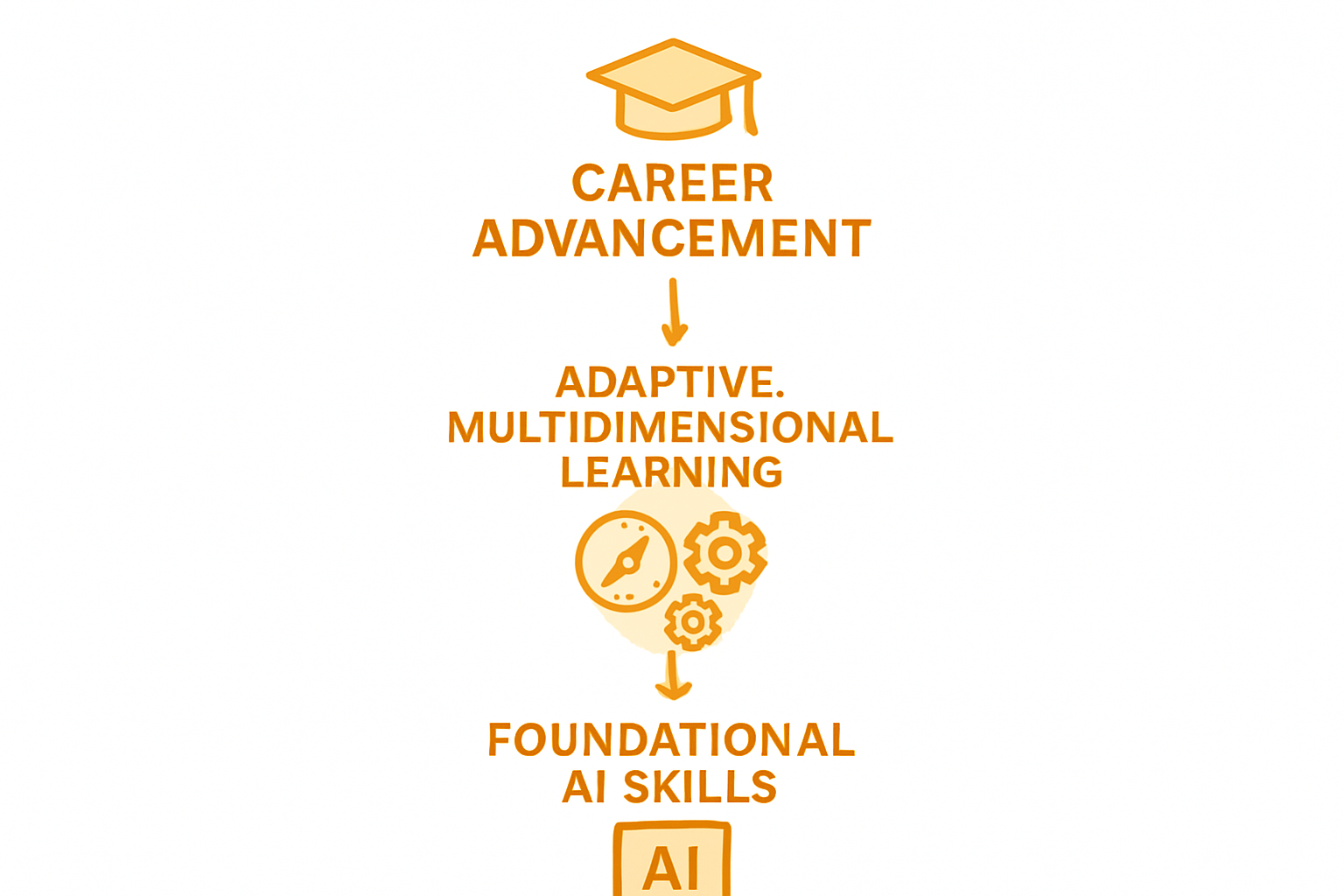
AI learning pathways represent strategic roadmaps that help professionals systematically develop advanced technical skills and cognitive competencies required in rapidly evolving artificial intelligence domains. These structured frameworks are not simply linear training programs but dynamic blueprints that adapt to individual career objectives, technological shifts, and emerging industry requirements.
Professionals exploring AI learning pathways must understand the comprehensive landscape of skill development. The AI & Data Acumen Learning Outcomes Framework offers a sophisticated approach to integrating AI literacy across multiple proficiency levels. This framework identifies critical competencies professionals need, ranging from foundational understanding to advanced technical implementation. Key dimensions include technical knowledge, ethical reasoning, practical application skills, and the ability to navigate complex technological ecosystems.
Successful AI learning pathways incorporate multidimensional skill development strategies. The AI Thinking framework highlights essential decision-making capabilities critical for professionals, including:
- Motivating AI Use: Understanding strategic value and potential transformative impact
- Formulating Methods: Developing systematic approaches to AI problem solving
- Assessing Tools: Critically evaluating technological solutions and their limitations
- Selecting Data: Identifying appropriate data sources and understanding data quality requirements
- Situating AI: Comprehending broader sociotechnical contexts and ethical implications
Modern AI learning pathways are not about mastering a fixed set of technical skills but cultivating adaptive learning capabilities. Professionals must develop a growth mindset that embraces continuous learning, interdisciplinary thinking, and the flexibility to integrate emerging technologies into their existing expertise. By approaching AI skill development as an ongoing journey of intellectual exploration and strategic capability building, individuals can position themselves at the forefront of technological innovation and career advancement.
Core Stages and Categories of AI Training
AI training encompasses a sophisticated ecosystem of learning approaches designed to equip professionals with comprehensive technological competencies. The progression from novice to expert involves strategic skill development across multiple interconnected domains, requiring a nuanced understanding of technical, analytical, and strategic dimensions.

The CDAC AI Life Cycle provides a comprehensive framework that outlines three critical phases of AI system development: Design, Develop, and Deploy. This methodology identifies 17 distinct stages that guide professionals through the intricate process of transforming conceptual ideas into functional AI solutions. Each stage represents a crucial milestone in creating intelligent systems that can solve complex real-world challenges.
Professionals pursuing AI training can understand their development trajectory through the Three Levels of AI Development framework, which categorizes skill progression across multiple professional roles:
- AI Designer: Focuses on conceptual design, problem framing, and strategic vision
- AI Engineer: Develops practical implementation strategies, model architecture, and technical infrastructure
- AI Researcher: Explores cutting-edge algorithmic innovations, theoretical frameworks, and advanced computational methodologies
Successful AI training requires a holistic approach that integrates theoretical knowledge, practical application, and continuous learning. Professionals must develop adaptable skill sets that transcend traditional technical boundaries, emphasizing critical thinking, interdisciplinary collaboration, and the ability to navigate complex technological ecosystems. By understanding these core stages and categories, individuals can strategically map their learning journey, ensuring they remain competitive and innovative in the rapidly evolving field of artificial intelligence.
Essential Skills and Prerequisites for Advancement
Navigating the complex landscape of artificial intelligence requires professionals to develop a robust and multifaceted skill set that extends far beyond traditional technical competencies. Success in AI demands a strategic approach to skill acquisition that integrates technical prowess, analytical thinking, and adaptive learning capabilities.
The field of AI engineering encompasses a comprehensive range of technical domains, including data engineering, model development, and critical ethical considerations. Professionals must master intricate skills such as data collection, sophisticated preprocessing techniques, advanced model training methodologies, rigorous evaluation processes, and seamless deployment strategies. These technical foundations form the bedrock of effective AI solution development.
Understanding skill progression through Bloom’s taxonomy provides a structured framework for professional development across multiple cognitive domains:
- Foundational Knowledge: Comprehending fundamental AI concepts and theoretical principles
- Comprehension: Interpreting and explaining complex AI algorithms and methodologies
- Application: Implementing AI solutions in practical, real-world scenarios
- Analysis: Critically evaluating AI model performance and identifying improvement strategies
- Synthesis: Integrating interdisciplinary knowledge to create innovative AI approaches
- Evaluation: Making sophisticated judgments about AI system effectiveness and ethical implications
Advancement in AI requires a holistic approach that balances technical skills with broader intellectual capabilities. Professionals must cultivate adaptability, continuous learning mindsets, and the ability to navigate rapidly evolving technological landscapes. By developing a comprehensive skill set that combines technical expertise, critical thinking, and ethical reasoning, individuals can position themselves at the forefront of AI innovation and drive meaningful technological transformation.
Real-World Applications in Business and Industry
Artificial intelligence has transformed business operations across multiple industries, creating unprecedented opportunities for innovation, efficiency, and strategic decision-making. Organizations are increasingly leveraging AI technologies to solve complex challenges, optimize processes, and gain competitive advantages in rapidly evolving markets.
The Outline of Artificial Intelligence reveals comprehensive applications of AI in business domains, including automated reasoning, sophisticated knowledge representation, strategic planning, and advanced machine learning techniques. These technologies enable organizations to develop powerful decision support systems that can analyze massive datasets, predict market trends, and generate actionable insights with remarkable precision and speed.
AI applications span diverse industry sectors, demonstrating transformative potential:
- Manufacturing: Predictive maintenance, quality control, supply chain optimization
- Finance: Fraud detection, algorithmic trading, risk assessment
- Healthcare: Diagnostic imaging, personalized treatment planning, patient risk prediction
- Retail: Customer behavior analysis, inventory management, personalized recommendations
- Transportation: Autonomous vehicle development, route optimization, predictive maintenance
Beyond technical implementation, adaptive learning systems showcase AI’s capacity to customize experiences across industries. By dynamically adjusting processes based on real-time data and individual performance metrics, these intelligent systems enable organizations to create more responsive, efficient, and personalized operational strategies that continuously evolve with changing business environments.
Certification, Costs, and Common Pitfalls
Navigating the complex landscape of AI professional development requires a strategic approach to understanding certification requirements, managing financial investments, and avoiding potential career obstacles. Professionals must carefully evaluate the return on investment, credential value, and potential challenges associated with advanced AI training programs.
The AI-powered personalized learning pathways research reveals significant improvements in knowledge acquisition, highlighting the importance of selecting targeted, efficient educational approaches. Cost considerations extend beyond tuition, encompassing time investment, opportunity costs, and potential technological resources required for comprehensive AI skill development.
Key financial and professional considerations for AI certification include:
- Direct Costs:
- Professional certification program fees
- Required software and hardware investments
- Supplementary learning materials
- Indirect Costs:
- Time spent in training
- Potential reduction in work hours
- Technology upgrade expenses
The learning pathway concept emphasizes structured educational progression, revealing common pitfalls professionals must anticipate. Potential challenges include technological obsolescence, skill misalignment with market demands, and the rapid evolution of AI technologies. Successful professionals develop adaptive learning strategies, maintain continuous skill updates, and remain flexible in their educational and career approaches. By understanding these dynamics, individuals can make informed decisions that maximize their professional development investments and minimize potential career risks.
Accelerate Your AI Career with Expert-Guided Learning Pathways
Navigating the complexities of AI skill development requires more than just understanding theory. If you seek a clear roadmap tailored to your professional growth and want to master essential competencies such as AI system design, ethical reasoning, and practical deployment strategies, you are not alone. Many professionals face challenges like skill misalignment and rapid technology changes. At Ambeone, we specialize in helping individuals overcome these hurdles through in-person instructor-led training and certification programs focused on real-world AI and Data Science applications.
Take control of your career trajectory today by engaging with thoughtfully structured courses that mirror the AI learning pathways described in your industry’s leading frameworks. Explore our comprehensive offerings at Ambeone where you will find detailed course structures, faculty credentials, and success stories to inspire your journey. Visit Ambeone now and start transforming your potential into recognized expertise with practical, industry-relevant knowledge that positions you at the forefront of AI innovation.
Frequently Asked Questions
What are AI learning pathways?
AI learning pathways are strategic roadmaps that help professionals systematically develop the technical skills and cognitive competencies required in the evolving domains of artificial intelligence. They are adaptive frameworks tailored to individual career objectives and industry requirements.
What skills are essential for advancing in AI?
Essential skills for advancing in AI include foundational knowledge of AI concepts, practical application of AI solutions, analytical thinking for evaluating model performance, and ethical reasoning to understand the implications of AI technologies.
How do AI learning pathways incorporate multidimensional skill development?
AI learning pathways incorporate multidimensional skill development by emphasizing essential decision-making capabilities, such as motivating AI use, formulating methods for problem-solving, critically assessing tools, selecting appropriate data, and situating AI within broader sociotechnical contexts.
What are the core stages of AI training?
The core stages of AI training include the Design, Develop, and Deploy phases, which encompass 17 distinct stages outlined in the AI Life Cycle framework, guiding professionals from conceptual ideas to functional AI solutions.
Recommended
- How to Choose AI Courses for Career Growth and Success – Ambeone
- Beginner AI Courses in Dubai | Learn AI with Ambeone
- Why Choose AI as a Career: Complete Guide – Ambeone
- Deep Learning vs Machine Learning
- Artificial intelligence: Teaching English online in the age of AI – EBC Trinity CertTESOL and TEFL courses
- HR-аналитика и Python