Master the AI Project Management Process for Business Success
Over 85 percent of American organizations face challenges aligning artificial intelligence projects with clear objectives and the right stakeholders. This gap often leads to wasted resources and missed business opportunities. By understanding the fundamentals of project planning, from defining goals to verifying results, you can streamline your American AI initiatives and achieve solutions that actually deliver measurable value.
Table of Contents
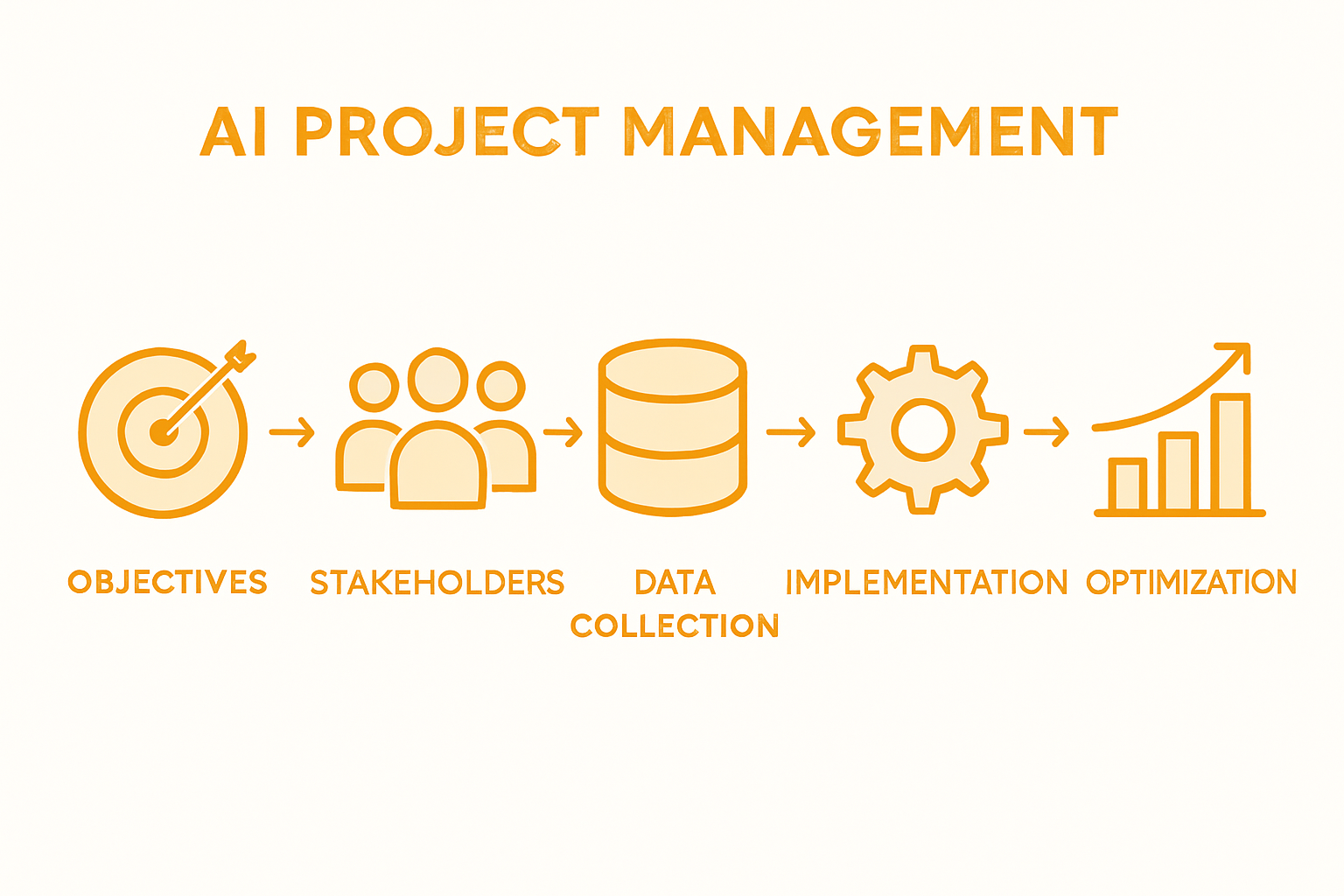
- Step 1: Define Project Objectives And Stakeholders
- Step 2: Establish Data Collection And Preparation Plan
- Step 3: Select Appropriate AI Solutions And Tools
- Step 4: Implement And Monitor AI Project Workflow
- Step 5: Verify Outcomes And Optimize For Performance
Quick Summary
| Key Point | Explanation |
|---|---|
| 1. Define Clear Project Objectives | Establish specific metrics and targets to ensure the AI solution effectively addresses the intended business problem. |
| 2. Identify and Engage Stakeholders | Create a comprehensive list of all affected parties to prioritize communication and address unique risks associated with the AI project. |
| 3. Plan for Data Collection and Preparation | Design a workflow for data sourcing, cleaning, and preprocessing to enhance accuracy and reliability in AI model development. |
| 4. Select Appropriate AI Tools and Solutions | Use an evaluation matrix to score tools against project criteria, ensuring alignment with business objectives and technical needs. |
| 5. Implement and Monitor Progress | Establish a structured deployment timeline with milestones and real-time tracking to quickly identify and address any project bottlenecks. |
Step 1: Define Project Objectives and Stakeholders
Successfully launching an AI project requires crystal clear objectives and a comprehensive understanding of all stakeholders involved. In this crucial first step, you will map out the foundational blueprint that guides your entire project trajectory.
Begin by conducting an in-depth analysis of the specific business problem you aim to solve. Research emphasizes the critical importance of specifying precise prediction targets and units of analysis to ensure project success. Ask yourself key questions: What specific challenge will this AI solution address? What measurable outcomes are you seeking? Who will benefit most from this implementation?
Identifying stakeholders is equally important. AI projects carry unique risks regarding potential harms or damages to individuals and society, so mapping out all potential impacted parties is crucial. Your stakeholder list should include not just internal team members but also potential end users, decision makers, technical experts, and any groups who might be affected by the project’s outcomes.
Pro Tip: Create a stakeholder impact matrix that rates each group’s potential influence and interest in the project. This helps prioritize communication and engagement strategies.
By meticulously defining objectives and stakeholders upfront, you set a solid foundation for navigating the complex landscape of AI project management. Your next step will involve translating these objectives into a detailed project roadmap.
Step 2: Establish Data Collection and Preparation Plan
Data is the lifeblood of any successful AI project, making your data collection and preparation strategy absolutely critical. In this step, you will design a robust framework for gathering, organizing, and preprocessing the information that will power your AI solution.

The CDAC AI Life Cycle emphasizes data acquisition and preparation as fundamental design phase components that can make or break your project. Start by identifying all potential data sources relevant to your project objectives. These might include internal databases, external repositories, survey results, sensor data, or real world transaction logs. Assess the quality, relevance, and accessibility of each potential data stream.
Next, develop a comprehensive data preparation workflow. This involves cleaning raw data, handling missing values, removing duplicates, and standardizing formats. AI technologies can significantly enhance cognitive load management during complex project data processes, so consider leveraging automated data preprocessing tools that can streamline these tasks.
Pro Tip: Create a detailed data inventory that tracks the origin, quality, and transformation steps for each dataset. This ensures transparency and reproducibility in your AI project.
By meticulously planning your data collection and preparation strategy, you build a solid foundation for accurate and reliable AI model development. Your next step will involve selecting appropriate machine learning algorithms and techniques to transform this prepared data into actionable insights.
Step 3: Select Appropriate AI Solutions and Tools
Choosing the right AI solutions and tools is a critical decision that can make or break your project’s success. In this step, you will navigate the complex landscape of AI technologies to find the most suitable solutions for your specific business objectives.
The aiSTROM framework provides strategic guidance for managers developing AI strategies, emphasizing the importance of carefully analyzing your organizational needs before selecting tools. Begin by conducting a comprehensive assessment of your project requirements. Consider factors such as data complexity, computational resources, scalability, integration capabilities, and the specific machine learning techniques most appropriate for your use case.
The CDAC AI Life Cycle recommends a structured approach to selecting AI models and tools during the development phase to ensure effective deployment. Evaluate potential solutions across multiple dimensions including performance metrics, ease of implementation, cost effectiveness, and long term adaptability. Look beyond surface level features and consider how each tool aligns with your broader organizational goals and technical infrastructure.
Pro Tip: Create a comprehensive evaluation matrix that scores potential AI solutions against key criteria. Include weightings for each factor to help make an objective decision.
By methodically selecting the most appropriate AI solutions and tools, you set the stage for a successful implementation. Your next step will involve designing the technical architecture and planning the detailed implementation strategy.
Step 4: Implement and Monitor AI Project Workflow
Successfully implementing your AI project requires a strategic and systematic approach to workflow management. In this critical phase, you will transform your carefully planned strategy into actionable steps while establishing robust monitoring mechanisms to track progress and performance.
The CDAC AI Life Cycle provides a comprehensive framework for implementing and monitoring AI project workflows, emphasizing the importance of creating a structured deployment strategy. Begin by breaking down your implementation into clear, manageable milestones. Develop a detailed project timeline that includes specific tasks, assigned responsibilities, resource allocations, and expected deliverables for each stage of the AI solution development.
Research on AI project adaptation highlights the significance of monitoring cognitive load and workflow dynamics to ensure optimal performance. Implement real time tracking mechanisms that allow you to assess project progress, identify potential bottlenecks, and make data driven adjustments quickly. This might involve setting up dashboards, establishing key performance indicators, and creating regular checkpoints to evaluate the AI solution against your original objectives.
Pro Tip: Use agile methodology principles to create flexible implementation workflows that can adapt to emerging challenges and technological shifts.
By carefully implementing and continuously monitoring your AI project workflow, you create a responsive and resilient approach to achieving your strategic objectives. Your next step will involve assessing project outcomes and preparing for potential iterations or scaling.
Step 5: Verify Outcomes and Optimize for Performance
The final stage of your AI project requires a meticulous approach to evaluating results and fine tuning performance. In this critical phase, you will systematically assess the effectiveness of your AI solution and identify opportunities for continuous improvement.
The CDAC AI Life Cycle emphasizes comprehensive computational performance evaluation, guiding you to develop a robust verification strategy. Begin by establishing clear performance benchmarks that align with your original project objectives. Conduct rigorous testing across multiple scenarios, comparing actual outcomes against predefined success metrics. This involves analyzing key performance indicators, assessing predictive accuracy, measuring computational efficiency, and evaluating the solution’s real world applicability.
Research on AI project adaptation underscores the importance of sustainable data processes and cognitive load management during performance optimization. Implement a systematic approach to identifying performance bottlenecks by collecting comprehensive performance data, running diagnostic tests, and creating iterative improvement cycles. Pay close attention to model accuracy, processing speed, resource utilization, and scalability potential.
Pro Tip: Develop a continuous improvement framework that allows for regular performance reviews and incremental enhancements.
By thoroughly verifying outcomes and strategically optimizing your AI solution, you transform your initial implementation into a high performing, adaptive system that delivers measurable business value. Your journey continues with ongoing monitoring, learning, and refinement to ensure sustained success.
Unlock Your Potential to Master AI Project Management for Real Business Impact
Navigating the complexities of AI project management requires more than just theoretical knowledge. From defining clear objectives and identifying critical stakeholders to choosing the right AI tools and optimizing outcomes, every step demands practical expertise and strategic insight. If you want to overcome these challenges and deliver measurable business value through AI initiatives, gaining hands-on experience is essential.
Take control of your AI career growth by enrolling in professional training programs offered at Ambeone. Our instructor-led courses in Artificial Intelligence and Data Science are designed to equip you with industry-relevant skills such as business-focused machine learning, data preparation strategies, and project implementation workflows. Learn directly from expert faculty in Dubai and the UAE, and gain the confidence to lead AI projects that align with organizational goals. Do not wait to elevate your proficiency in mastering the AI project management process. Visit Ambeone now to explore detailed course options, success stories, and certification paths that will fast-track your journey to expert AI practitioner.
Frequently Asked Questions
What are the essential steps to manage an AI project successfully?
To manage an AI project successfully, start by defining clear objectives and mapping out all stakeholders involved. Follow a structured process that includes collecting and preparing data, selecting appropriate AI solutions, implementing the project, and verifying outcomes to optimize performance.
How can I define clear objectives for my AI project?
Define clear objectives by analyzing the specific business problem you want to solve. Ask questions regarding the challenge and measurable outcomes, and incorporate a stakeholder impact matrix to assess who will be affected and benefit from the AI solution.
What should I include in my data collection and preparation plan?
Your data collection and preparation plan should identify relevant data sources and develop a robust workflow for cleaning and organizing the data. Ensure comprehensive documentation by creating a data inventory that tracks origin, quality, and transformation steps for transparency.
How do I select the right AI tools for my project?
Select the right AI tools by conducting a comprehensive assessment of your project requirements, including data complexity and integration capabilities. Create an evaluation matrix to score potential solutions against key criteria to facilitate an objective decision.
What monitoring strategies should I implement during the AI project workflow?
Implement monitoring strategies such as real-time tracking mechanisms and regular checkpoints to assess progress and identify bottlenecks. Set measurable key performance indicators to keep the project aligned with your objectives and make data-driven adjustments as necessary.
What steps can I take to optimize the performance of my AI solution?
To optimize performance, establish clear benchmarks based on your project’s original objectives and conduct rigorous testing against these metrics. Create iterative cycles for continuous improvement by collecting performance data and identifying bottlenecks to enhance model accuracy and resource utilization.