Here's the short answer: Yes, but only if you pick the right format.
2026 data tells a clear story. Online AI courses have a completion rate hovering around 7%. In-person programs? Over 85%.
That gap isn't a coincidence.
Let's break down what actually matters when you're investing AED 4,000–20,000 in an AI course in Dubai: and why physical classroom training still dominates in real-world outcomes.
The "Completion Gap" No One Talks About
MOOCs look perfect on paper. Self-paced. Affordable. Big-name universities.
Then reality hits.
You're on Lesson 4 of a 12-week course. Work gets busy. Your laptop stays closed for three days. Then a week. Then you forget your login password.
This is the completion gap.
Here's what 2026 data from Dubai-based learners shows:
- Online-only programs: 93% drop out before finishing
- Hybrid programs: 60% drop out
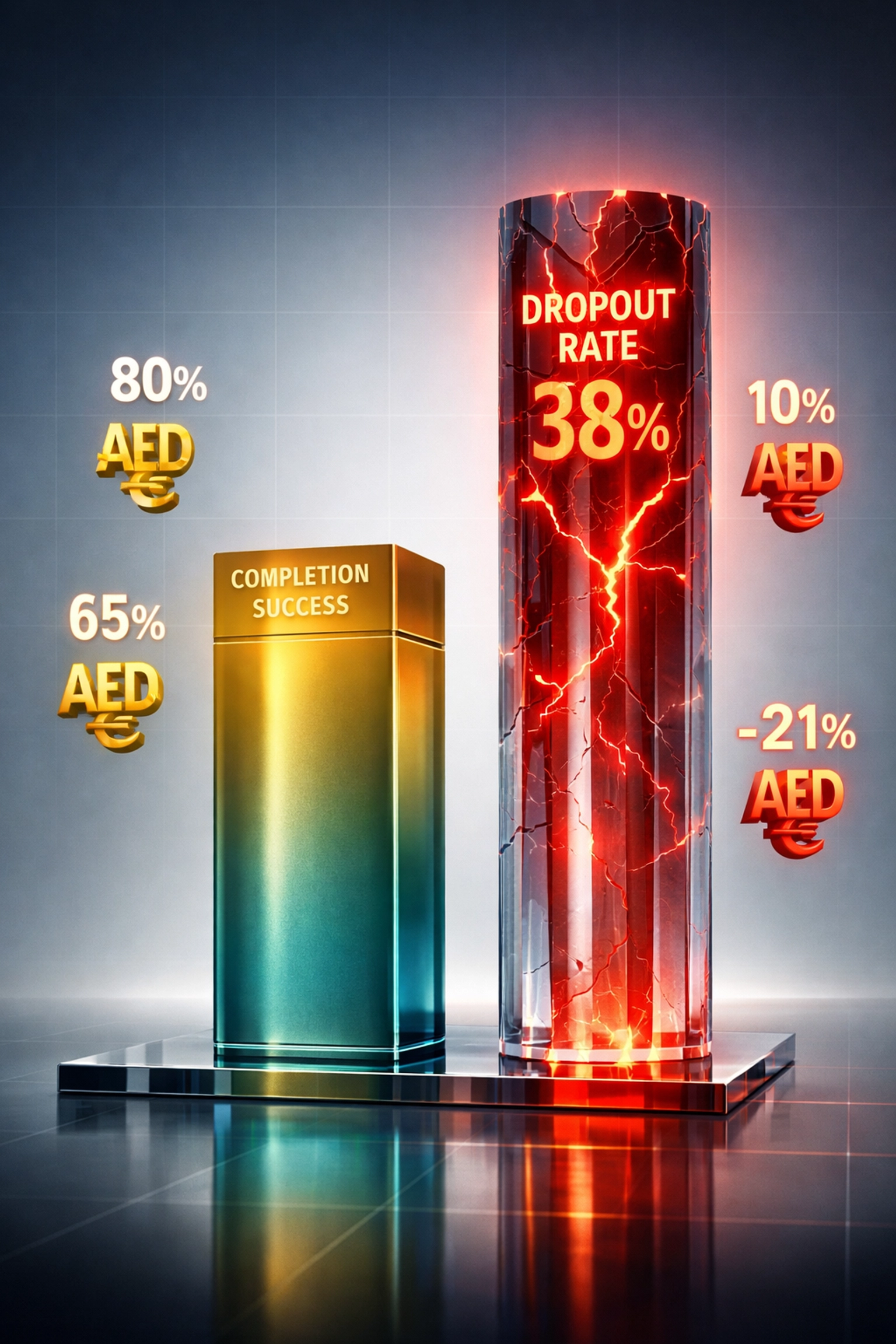
- In-person structured pathways: 15% drop out

Why does AMBÉONE's 10-level system work? Because you can't ghost a classroom.
Each level builds on the last. You show up. Your cohort shows up. The faculty tracks your progress: not through automated emails, but actual conversations during breaks.
No one's letting you vanish into the digital void after Week 2.
When you're physically present, accountability isn't optional. It's baked into the structure.
Networking That Actually Leads Somewhere
Let's be honest. Online course "discussion forums" are graveyards.
Someone asks a question on Day 3. The instructor responds on Day 9. By then, you've already Googled the answer or given up.
In-person learning in Dubai changes that equation completely.
You're sitting next to someone who works at Emirates NBD. Behind you, a healthcare analyst from Cleveland Clinic. To your left, a government sector project manager building smart city solutions.
These aren't LinkedIn connections. These are actual humans you'll grab coffee with after class.
AMBÉONE's faculty includes IIM graduates and PhDs with 30+ years in AI and data science. That's not marketing fluff. That's someone who can tell you exactly which machine learning model Dubai's real estate sector prefers: and why.
When you're stuck on a project at 8 PM, you text your classmate. Not some chatbot. Not a forum moderator in another timezone.
This is how job referrals happen. This is how consulting gigs get passed around. This is how you actually break into Dubai's AI ecosystem: not by collecting digital badges, but by showing up.

Local Credibility > Global Brand Name
Global platforms love to flex university partnerships.
Here's what they won't tell you: Dubai employers care more about KHDA registration than a Coursera certificate from Stanford.
Why? Because KHDA registration means the curriculum was vetted for relevance to UAE industries. It means the training provider has physical infrastructure. It means they're not vanishing overnight.
AMBÉONE is KHDA-registered. That's not a bureaucratic checkbox. That's proof that what we teach aligns with Dubai's National AI Strategy 2031.
Our projects aren't hypothetical datasets from Silicon Valley. They're based on:
- Fraud detection models for UAE banks
- Predictive analytics for Dubai's logistics sector
- Energy consumption forecasting for DEWA-style utilities
When you walk into a job interview with a portfolio full of Dubai-specific case studies, you're not explaining what AI could do. You're showing what it already does here.

The Real Cost Breakdown (2026 Edition)
Let's talk money.
Average AI course cost in Dubai: AED 4,000–20,000
AMBÉONE's structured pathway: Competitive, with flexible payment options
But here's the hidden cost no one mentions: Your time.
If you drop out of a AED 2,000 online course after three weeks, you didn't save money. You wasted it.
If you finish AMBÉONE's data science certification and land a role paying AED 15,000/month, that's a 3-month ROI.
The math is simple:
- Online course completion: 7% × AED 2,000 = AED 28,571 per successful graduate (if you factor in drop-outs)
- In-person completion: 85% × AED 10,000 = AED 11,765 per successful graduate
In-person training is cheaper when you actually finish.
Why In-Person Learning Dominates in 2026
Technology improved. Zoom got better. AI tutors became smarter.
But human brains didn't change.
We still learn best through:
- Immediate feedback (not asynchronous forum replies)
- Peer pressure (showing up because others are counting on you)
- Physical routine (your brain associates "classroom" with "focus time")
- Real-time problem-solving (debugging code together, not alone at midnight)
Dubai's 2026 job market reinforces this. Employers hiring for AI roles now ask:
- "Can you explain your model to non-technical stakeholders?" (Requires presentation practice, not just Jupyter notebooks)
- "Have you worked on collaborative projects?" (Group work beats solo problem sets)
- "Do you understand regional compliance requirements?" (GDPR doesn't apply here; UAE PDPL does)
AMBÉONE's machine learning course and deep learning program train you for those exact scenarios. Not through theory. Through live case discussions with faculty who've built AI systems for Dubai-based enterprises.
The "Campus Tour" Test
Here's a filter that works every time:
If a training provider won't show you their physical space, don't pay them.
AMBÉONE's campus in Dubai isn't a coworking space rental. It's a dedicated training facility with:
- Labs equipped for hands-on Python, R, and TensorFlow work
- Whiteboards where faculty diagram neural networks in real-time
- Study areas where your cohort preps for capstone projects
When you visit, you'll see current students working through predictive modeling exercises. You'll meet instructors. You'll ask uncomfortable questions like "What's your job placement rate?" and get straight answers.
Online platforms can't offer that. They can offer slick websites and celebrity instructor videos. But they can't show you where the learning actually happens.
What You Should Do Next
If you're serious about breaking into AI in Dubai, stop collecting free trial accounts.
Come see the space.
Book a campus tour at AMBÉONE. Talk to faculty. Sit in on a session if timing works. Ask current students whether the 10-level pathway actually delivers.
We don't do online learning. We don't do "self-paced flexible options." We do structured, in-person training that gets you from Excel analyst to AI-capable professional in a timeline that actually works.
The 2026 data is clear: completion rates, job outcomes, and ROI all favor physical classroom training.
The question isn't whether AI courses in Dubai are worth it.
The question is whether you're willing to show up.