Master the Data Science Learning Workflow for Career Growth
Every American aiming to break into data science faces a big hurdle right at the starting line. Studies show that less than 25 percent of aspiring data scientists accurately assess their own skills before beginning a learning path. Knowing exactly where you stand matters because it shapes how quickly and confidently you advance toward real job opportunities. This guide walks you through practical, research-backed steps for mastering every phase of your data science journey from self assessment to recognized certification.
Table of Contents
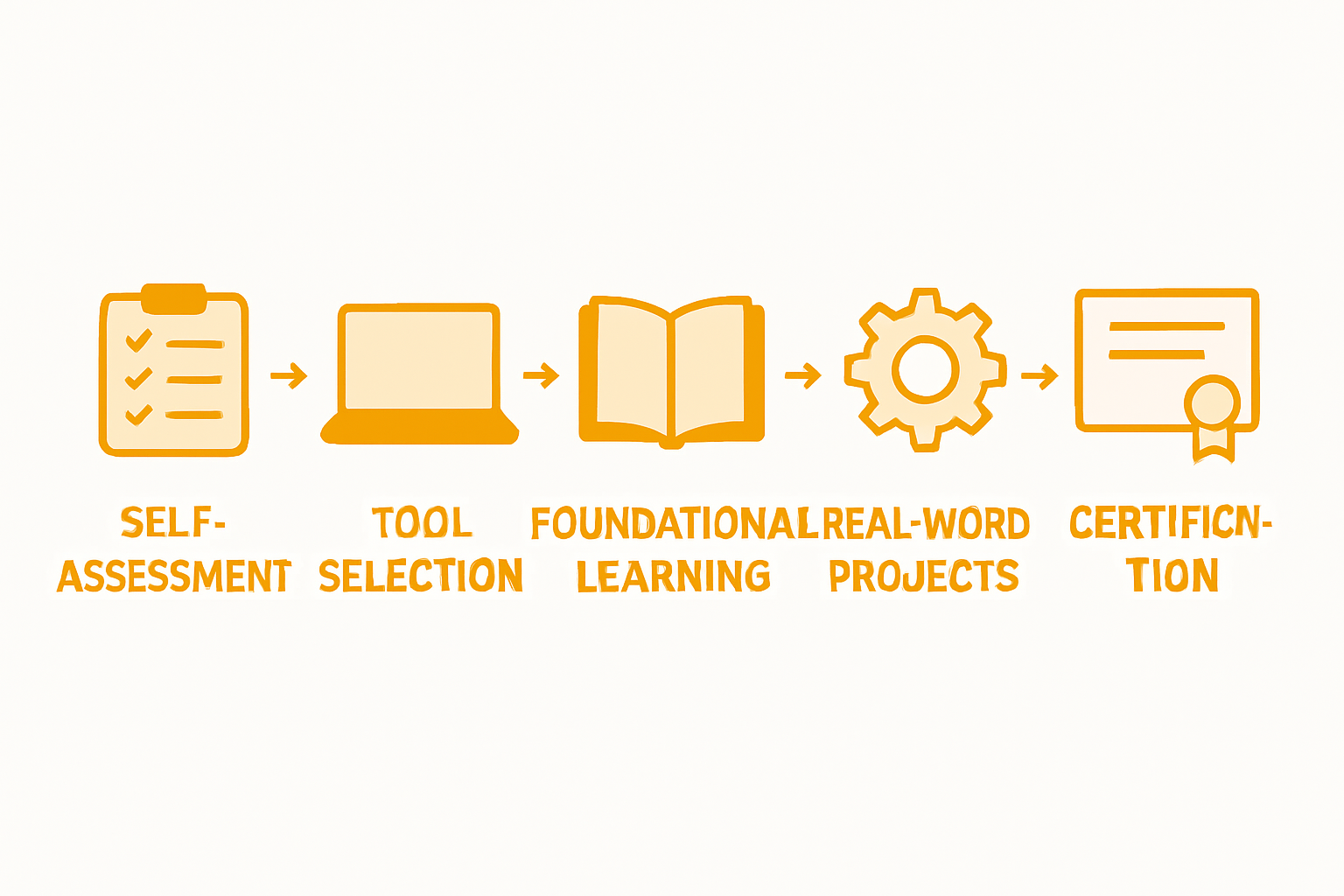
- Step 1: Assess Your Current Skills And Set Clear Objectives
- Step 2: Select Relevant Tools And Learning Resources
- Step 3: Build Foundational Data Science Knowledge
- Step 4: Apply Techniques With Real-World Projects
- Step 5: Verify Competency And Pursue Certification
Quick Summary
| Key Insight | Explanation |
|---|---|
| 1. Assess your skills honestly | Create a skills inventory to understand your strengths and gaps in data science domains like programming and statistical analysis. |
| 2. Choose relevant tools strategically | Select programming languages and resources, such as Python or R, that align with your specific learning objectives and career goals. |
| 3. Build a strong foundational knowledge | Focus on mathematical disciplines and core competencies through structured study and practical projects to deepen understanding. |
| 4. Apply knowledge through real projects | Engage in hands-on projects using real-world datasets to apply multiple techniques and enhance problem-solving abilities. |
| 5. Verify skills with certification | Pursue industry-recognized certifications and develop a strategic study plan to validate your expertise and boost professional recognition. |
Step 1: Assess Your Current Skills and Set Clear Objectives
Successfully navigating the data science learning workflow starts with understanding exactly where you stand right now. Your goal in this critical first step is performing an honest, comprehensive self assessment of your current technical capabilities.
Begin by creating a detailed skills inventory that maps your existing knowledge across key data science domains. Research from academic frameworks suggests tracking proficiencies in programming languages like Python and R, statistical analysis techniques, machine learning algorithms, data visualization skills, and database management. Rate yourself honestly on each skill using a simple scale: beginner, intermediate, or advanced. Pro tip: screenshot your skills matrix or create a spreadsheet for future tracking.
Next, compare your current skill profile against industry standards outlined by university research on data science competencies. Look for specific gaps between your abilities and job market requirements. Are you strong in programming but weak in statistical modeling? Do you understand machine learning theory but lack practical implementation experience? Identifying these precise skill gaps helps you design targeted learning objectives.
Remember that self assessment is not about criticism but strategic growth. Your skill inventory becomes a personalized roadmap for professional development. By understanding exactly where you are now, you can chart a clear path toward becoming the data scientist you want to become.
Step 2: Select Relevant Tools and Learning Resources
Now that you have assessed your current skills, its time to strategically choose the right tools and resources to power your data science learning journey. Think of this step as curating your personal learning toolkit that will transform theoretical knowledge into practical expertise.
Comprehensive research on data science learning platforms suggests focusing on versatile programming languages and specialized tools that align with your specific learning objectives. Start by selecting core programming languages like Python and R, which remain industry standards for data manipulation and analysis. Complement these with powerful libraries such as Pandas for data manipulation and machine learning frameworks like Scikit-learn that provide robust functionality for complex analytical tasks.
When selecting learning resources, prioritize platforms that match your current skill level and career aspirations. Industry insights recommend exploring tools like Apache Spark for big data processing and Tableau for advanced data visualization. Pro tip: Look for resources that offer hands-on projects and real world application scenarios. Interactive coding platforms, video tutorials, and specialized online courses can help bridge the gap between theoretical understanding and practical implementation.
Remember that tool selection is not about collecting the most resources but strategically choosing those that provide the most relevant learning experience for your specific data science goals. Your toolkit should evolve as your skills grow and industry technologies advance.
Step 3: Build Foundational Data Science Knowledge
Building a rock-solid foundation in data science requires a strategic approach to learning that goes beyond surface level understanding. Your mission in this critical phase is to systematically develop core competencies that will serve as the backbone of your professional expertise.
Interactive computational resources provide excellent platforms for developing fundamental statistical and probabilistic skills. Start by diving deep into core mathematical disciplines like linear algebra, calculus, and probability theory. These disciplines form the mathematical infrastructure that powers advanced data science techniques. Focus on understanding core concepts like regression analysis, hypothesis testing, and statistical distributions rather than memorizing formulas. Supplement your theoretical learning with comprehensive academic lecture series that offer in depth explanations of complex data science principles.

To accelerate your learning, create a structured study plan that balances theoretical knowledge with practical application. Develop skills in key foundational areas such as statistical programming, data manipulation, and basic machine learning algorithms. Practice consistently by working on small projects that reinforce your learning. Remember that foundational knowledge is not about collecting information but developing a robust conceptual framework that allows you to solve real world problems creatively and efficiently.
Step 4: Apply Techniques with Real-World Projects
Transforming theoretical knowledge into practical skills requires immersive project experiences that challenge your understanding and push your technical boundaries. This critical phase is where you will convert academic learning into tangible professional capabilities.
Research on collaborative learning environments highlights the importance of hands-on project work in developing authentic data science skills. Start by identifying real world datasets and problem domains that align with your learning objectives. Choose projects that require you to apply multiple techniques simultaneously, such as data cleaning, exploratory analysis, predictive modeling, and visualization. Master interview-ready project techniques by selecting challenges that demonstrate your ability to solve complex analytical problems.
Develop a systematic approach to project execution. Begin with clear problem definition, followed by comprehensive data exploration, feature engineering, model selection, and rigorous evaluation. Document your entire workflow meticulously, capturing not just the code but your decision making process. This documentation serves two critical purposes creating a portfolio of work and reinforcing your learning by forcing you to articulate your technical reasoning. Remember that exceptional data science projects are not about perfect execution but about demonstrating creative problem solving and continuous learning.
Step 5: Verify Competency and Pursue Certification
Transitioning from learning to professional recognition requires strategic validation of your data science skills through rigorous certification processes. This critical phase transforms your knowledge into officially acknowledged expertise that employers and industry professionals respect.
Open source resources and simulated exams provide excellent platforms for assessing and validating your technical capabilities. Begin by identifying industry recognized certifications that align with your career goals such as those from Google, Microsoft, IBM, or specialized data science organizations. Explore standardized assessment frameworks that offer structured learning pathways and comprehensive evaluation mechanisms. These frameworks not only test your current skills but also highlight potential areas for future improvement.
Prepare systematically for certification by developing a focused study plan that combines theoretical review, practical problem solving, and mock exam practice. Create a tracking system to monitor your progress across different skill domains. Treat certification as more than just a credential its a comprehensive validation of your professional capabilities. Your goal is not just passing an exam but demonstrating a holistic understanding of data science principles and their real world applications. Remember that true mastery is proven through consistent performance and continuous learning.
Elevate Your Data Science Journey with Expert-Led Training
Mastering the data science learning workflow requires not only clear objectives and foundational knowledge but also access to guidance and real-world practice tailored for career success. If you are ready to overcome skill gaps, apply advanced techniques, and achieve recognized certification, expert support can make all the difference. At Ambeone, we specialize in empowering professionals in Dubai and the UAE through hands-on instructor-led courses, workshops, and certification programs designed to build your confidence and practical expertise.
Take the next step now by exploring our carefully crafted programs that align with industry standards and focus on applied learning and career growth. Discover how you can transform your ambitions into tangible skills on our Uncategorized Archives – Ambeone page and learn more about our comprehensive offerings directly at Ambeone. Start your transformational data science journey today and position yourself as a leader in the competitive AI and data science fields.
Frequently Asked Questions
How do I assess my current skills in data science?
Begin by creating a comprehensive skills inventory that outlines your proficiency in key areas such as programming languages, statistical analysis techniques, and data visualization skills. Rate yourself as beginner, intermediate, or advanced in each category to identify gaps that need addressing.
What should I include in my data science learning toolkit?
Focus on core programming languages like Python and R, and select specialized tools that align with your learning objectives. Prioritize resources that allow for hands-on practice and real-world application to enhance your understanding.
How can I build foundational knowledge in data science effectively?
Adopt a structured study plan that balances theoretical learning with practical projects. Concentrate on core mathematical concepts like probability and statistics, and reinforce your knowledge through consistent practice and application of these concepts in real-world scenarios.
What types of projects should I pursue to apply data science techniques?
Choose real-world datasets that challenge you to use multiple techniques, such as data cleaning and predictive modeling. Document your workflow and decision-making process to create a portfolio that showcases your ability to solve complex analytical problems.
How can I prepare for data science certification?
Systematically develop a study plan that incorporates theoretical reviews, practical exercises, and mock exams. Track your progress across different skill domains to ensure you are ready to validate your competencies through certification.
Why is self-assessment important in the data science learning workflow?
Self-assessment helps you understand your current capabilities and identify specific skill gaps that need to be filled. By evaluating your skills honestly, you can set clear, targeted objectives for your learning journey.
Recommended
- How to become a Data Scientist – Ambeone
- Data Scientist Explained: Roles, Skills, and Careers
- Data Science Explained: Career Impact and Uses – Ambeone
- How to Build Data Science Skills for Career Growth – Ambeone
- Understanding the Importance of Continuous Learning – My WordPress
- Cos’è un percorso formativo online – Opportunità e tutele – Recupero Anni Scolastici e Diploma Online