What Is Machine Learning and Why It Matters
Most American companies now rely on machine learning for at least one business task, yet confusion still surrounds what this technology actually does. Machine learning is often misunderstood, with some believing it will instantly solve all problems or is synonymous with artificial intelligence. This introduction clears up the biggest myths and gives a clear starting point to understand how machine learning really works, what it requires, and why it matters for decision making in an American context.
Table of Contents
- Machine Learning Defined and Common Misconceptions
- Types of Machine Learning Approaches Explained
- How Machine Learning Works in Practice
- Business Applications Across Industries
- Challenges, Limitations, and Risks to Know
Key Takeaways
| Point | Details |
|---|---|
| Machine Learning is Not Monolithic | It consists of various approaches, each with unique methodologies for problem-solving and requires human expertise for effective implementation. |
| Data Quality is Critical | The success of machine learning relies heavily on the quality of training data, making data validation and bias auditing essential. |
| Machine Learning in Business | Industries such as finance and healthcare leverage machine learning for predictive analytics, leading to improved decision-making and operational efficiency. |
| Ethical Considerations Are Essential | Organizations must account for potential biases in algorithms and maintain transparency to avoid discriminatory outcomes. |
Machine Learning Defined and Common Misconceptions
Machine Learning represents an innovative approach to computational problem solving where computer systems can learn and improve from experience without explicit programming. Unlike traditional software that follows rigid instructions, machine learning algorithms dynamically adapt and refine their performance based on incoming data.
Contrary to popular belief, machine learning is not a monolithic technology but a nuanced field with multiple approaches. Prevalent misconceptions about artificial intelligence and machine learning often stem from oversimplified narratives that treat these technologies as magical solutions. In reality, machine learning requires sophisticated statistical techniques, carefully curated datasets, and specialized expertise to develop effective models.
Some key misconceptions include the assumption that machine learning and artificial intelligence are interchangeable terms. While related, they represent distinct domains. Machine learning is a subset of artificial intelligence focused on statistical pattern recognition and predictive modeling. Another common myth is that machine learning algorithms can automatically solve any problem with minimal human intervention. Successful implementations demand significant human expertise in data preparation, algorithm selection, and continuous model refinement.
Pro Tip for Tech Professionals: Develop a systematic approach to machine learning by continuously updating your skills, understanding the mathematical foundations, and practicing with real-world datasets to distinguish between theoretical knowledge and practical implementation.
Types of Machine Learning Approaches Explained
Machine Learning encompasses several fundamental approaches that enable computational systems to learn and adapt from data. Diverse machine learning types offer unique methodologies for solving complex problems, each with specialized techniques for extracting insights and making predictions.
The primary machine learning approaches include Supervised Learning, where algorithms train on labeled datasets with known outcomes, Unsupervised Learning, which identifies patterns in unlabeled data without predefined categories, and Reinforcement Learning, where systems learn through trial and error interactions with an environment. Supervised learning is particularly effective in scenarios like image recognition and spam detection, while unsupervised learning excels at clustering and anomaly detection.

Each machine learning approach has distinct characteristics and application domains. Machine learning techniques vary in their complexity and problem-solving capabilities, ranging from simple linear regression models to advanced neural networks. Supervised learning requires extensive labeled training data, unsupervised learning discovers hidden structures independently, and reinforcement learning mimics adaptive learning through reward-based feedback mechanisms.
Pro Tip for Data Scientists: Develop a versatile skill set by practicing multiple machine learning approaches and understanding their strengths, limitations, and appropriate use cases across different computational challenges.
Here is a comparison of the main machine learning approaches and their typical applications:
| Approach | Learning Style | Common Use Cases | Data Requirement |
|---|---|---|---|
| Supervised Learning | Labeled Training | Credit scoring, image recognition | Extensive labeled data |
| Unsupervised Learning | Pattern Discovery | Customer segmentation, clustering | Unlabeled data |
| Reinforcement Learning | Trial and Error | Robotics, game playing | Environment interactions |
How Machine Learning Works in Practice
Machine Learning transforms raw data into intelligent predictions through a systematic process of data collection, preparation, model training, and continuous refinement. Optimization techniques drive practical machine learning implementations, enabling complex computational systems to extract meaningful insights from diverse datasets.
The practical workflow of machine learning typically involves several critical stages. First, data scientists collect and preprocess relevant data, cleaning and transforming it into a format suitable for algorithmic analysis. Practical machine learning methods like nearest neighbor approaches demonstrate how raw information can be transformed into predictive models. During the training phase, algorithms learn patterns by adjusting internal parameters, comparing predictions against actual outcomes and incrementally improving their accuracy.
In real-world scenarios, machine learning models tackle complex challenges across industries. For instance, financial institutions use predictive models to detect fraudulent transactions, healthcare systems leverage algorithms for disease diagnosis, and manufacturing plants employ machine learning to optimize production processes. These practical applications require sophisticated techniques that can handle nuanced, multidimensional datasets while maintaining high reliability and adaptability.
Pro Tip for Aspiring Data Scientists: Build practical machine learning skills by working on diverse, real-world projects that expose you to different data types, preprocessing challenges, and model optimization techniques across multiple domains.
Business Applications Across Industries
Machine Learning has revolutionized business operations across multiple industries, providing unprecedented capabilities for data-driven decision making. Machine learning applications span diverse sectors, transforming traditional business models through intelligent, adaptive computational strategies that optimize performance and unlock new competitive advantages.
In financial services, machine learning enables sophisticated fraud detection systems, predictive credit scoring, and algorithmic trading platforms that analyze market trends with remarkable precision. Healthcare industries leverage these technologies for diagnostic imaging, personalized treatment recommendations, and predictive patient care modeling. Real-world machine learning implementations demonstrate transformative potential across e-commerce, healthcare, and financial domains, helping organizations make more accurate, timely decisions.
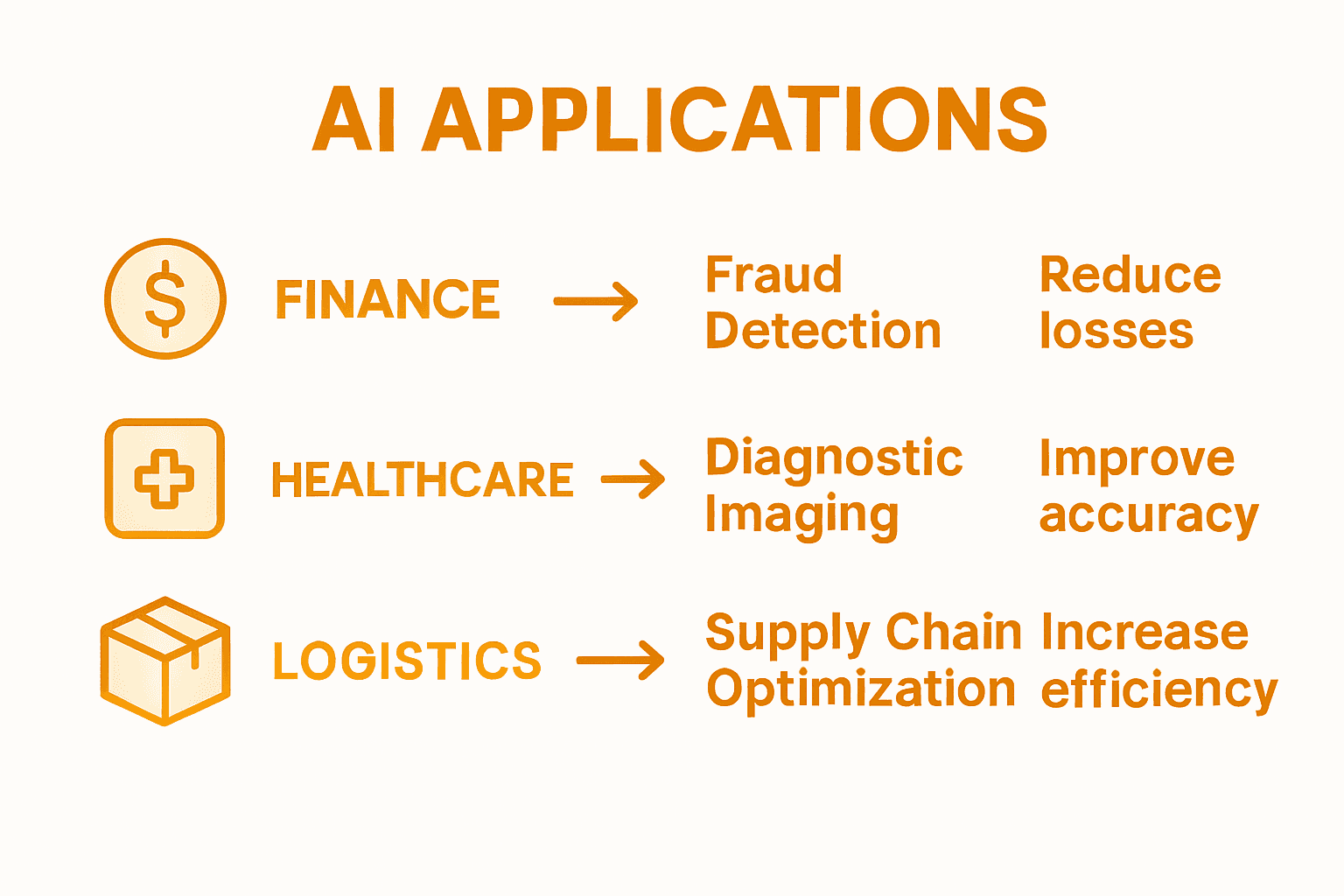
Manufacturing and logistics sectors utilize machine learning for predictive maintenance, supply chain optimization, and demand forecasting. Retail businesses apply advanced algorithms to personalize customer experiences, optimize pricing strategies, and manage inventory with unprecedented efficiency. These applications represent more than technological upgrades — they fundamentally reshape how organizations understand and respond to complex operational challenges, translating massive datasets into actionable strategic insights.
Pro Tip for Business Leaders: Prioritize developing a data-driven organizational culture that views machine learning not just as a technological tool, but as a strategic framework for continuous innovation and competitive differentiation.
The table below summarizes leading business sectors using machine learning and their business benefits:
| Industry | Machine Learning Role | Business Benefit |
|---|---|---|
| Finance | Fraud detection, risk modeling | Reduce losses, informed lending |
| Healthcare | Diagnostics, patient care | Faster, more accurate decisions |
| Manufacturing | Process optimization | Lower costs, fewer breakdowns |
| Retail | Personalization, pricing | Higher sales, better targeting |
Challenges, Limitations, and Risks to Know
Machine Learning is not a universal solution, and understanding its inherent limitations is crucial for responsible implementation. Machine learning technologies face significant challenges related to data dependency, interpretability, and ethical considerations, which can dramatically impact their effectiveness and reliability.
One primary challenge is the data quality problem. Machine learning algorithms are fundamentally dependent on the data they are trained on, which means biased, incomplete, or unrepresentative datasets can produce skewed or inaccurate results. Critical risks in machine learning include overfitting, data reliability issues, and potential ethical complications, particularly in sensitive domains like finance, healthcare, and legal decision making. Overfitting occurs when an algorithm learns the training data too precisely, losing its ability to generalize to new, unseen scenarios.
Ethical concerns represent another significant challenge in machine learning deployment. Algorithms can inadvertently perpetuate existing societal biases present in training data, leading to discriminatory outcomes in areas such as hiring processes, loan approvals, and criminal justice predictions. Transparency and interpretability remain ongoing challenges, as many advanced machine learning models operate as complex “black boxes” where decision-making processes are not easily understood or explained by human experts.
Pro Tip for Responsible Implementation: Develop rigorous data validation processes, continuously audit your machine learning models for potential biases, and maintain human oversight to ensure ethical and accurate computational decision making.
Unlock the Power of Machine Learning with Expert-Led Training
Understanding machine learning and its real-world applications can be challenging without the right guidance. This article highlights critical pain points like mastering supervised and unsupervised learning, avoiding common misconceptions, and tackling challenges such as data quality issues and model interpretability. If you want to move beyond theory and build practical skills that empower you to create impactful AI solutions, guided instruction is essential.
Take control of your AI career journey today by enrolling in comprehensive, in-person courses designed specifically for professionals in Dubai and the UAE. At Ambeone, you will gain hands-on experience with machine learning techniques, dive deep into data preparation, and learn how to apply these skills in business contexts like finance, healthcare, and retail. Visit Ambeone now to explore course offerings, certifications, and career development pathways that help you transform from a learner into an industry-ready expert.
Frequently Asked Questions
What is machine learning?
Machine learning is a field of computer science that enables systems to learn from data and improve their performance over time without being explicitly programmed. It focuses on using algorithms to recognize patterns and make predictions based on data.
What are the main types of machine learning approaches?
The primary types of machine learning include supervised learning, unsupervised learning, and reinforcement learning. Supervised learning works with labeled data, unsupervised learning identifies patterns in unlabeled data, and reinforcement learning involves systems learning through interactions with an environment.
How is machine learning applied in business?
Machine learning is applied across various industries for purposes such as fraud detection in finance, diagnostic imaging in healthcare, and personalization in retail. These applications help organizations make data-driven decisions and optimize operations.
What are some challenges associated with machine learning?
Challenges in machine learning include data quality issues, the risk of overfitting, and ethical concerns regarding bias in algorithms. Ensuring high-quality data, resolving interpretability challenges, and maintaining human oversight are essential for responsible implementation.