AI vs Machine Learning: What Every Analyst Needs to Know
Most tech companies now rely heavily on both Artificial Intelligence and Machine Learning, yet the terms are often misunderstood—even among experienced professionals in Dubai. For those planning a career transition, distinguishing between these powerful approaches is a practical necessity. This guide highlights how over 60 percent of data analysts feel unprepared for AI-driven roles without a clear grasp of these differences, making clarity your edge in a competitive market.
Table of Contents
- Defining AI And Machine Learning Clearly
- Types And Key Characteristics Compared
- How AI And Machine Learning Really Work
- Practical Business Applications In Analytics
- Career Skills And Training Requirements
- Common Pitfalls And How To Avoid Them
Key Takeaways
| Point | Details |
|---|---|
| Distinction Between AI and ML | Artificial Intelligence is the broader category focused on simulating human cognition, while Machine Learning is a subset enabling systems to learn from data. |
| Types of Learning Paradigms | Machine Learning includes supervised, unsupervised, and reinforcement learning, each with distinct methods for training algorithms. |
| Applications Across Industries | AI and Machine Learning are transforming sectors like healthcare, finance, and manufacturing, offering predictive analytics and operational efficiencies. |
| Importance of Data Quality | Successful machine learning relies on rigorous data preparation and validation to ensure that models operate effectively and ethically. |
Defining AI and Machine Learning Clearly
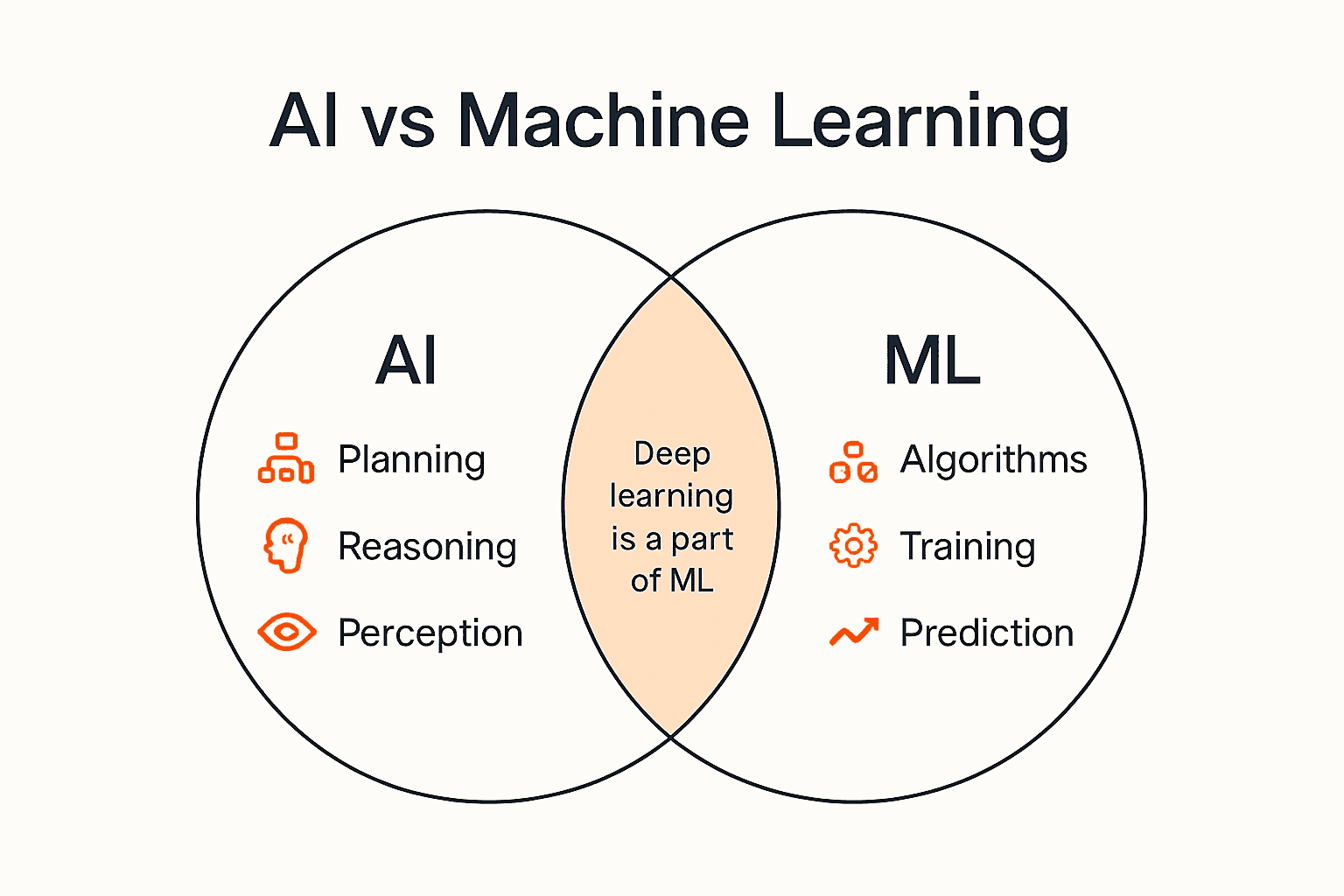
Artificial Intelligence (AI) and Machine Learning (ML) represent transformative technologies that are reshaping how we analyze data and solve complex problems. While often used interchangeably, these terms describe distinct technological approaches with unique characteristics. AI is a broader field focused on creating intelligent systems that can simulate human cognitive functions, whereas machine learning represents a specific subset of AI dedicated to enabling computers to learn and improve from experience without explicit programming.
At its core, machine learning involves developing algorithms that can automatically learn patterns and make predictions by processing large amounts of data. These algorithms fall into three primary categories: supervised learning, unsupervised learning, and reinforcement learning. Supervised learning involves training models using labeled datasets, unsupervised learning identifies hidden patterns in unlabeled data, and reinforcement learning enables systems to learn through trial and error interactions with an environment. The evolution of machine learning from rule-based systems to complex neural networks demonstrates the field’s remarkable progression.
The relationship between AI and machine learning can be understood through an analogy of a toolkit. AI represents the entire toolbox containing various problem-solving approaches, while machine learning is a specific, powerful tool within that box. Modern AI systems increasingly rely on machine learning techniques to achieve sophisticated outcomes across industries like healthcare, finance, transportation, and technology. This integration allows for more adaptive, intelligent systems capable of handling complex, dynamic challenges that traditional rule-based programming cannot easily address.
Pro Tip: When exploring AI and machine learning, focus on understanding the practical applications rather than getting lost in technical jargon, as real-world problem-solving is where these technologies truly shine.
Types and Key Characteristics Compared
Artificial Intelligence encompasses multiple complex approaches, with distinct types ranging from narrow AI to potentially superintelligent systems. These categories represent progressively advanced levels of technological capability. Narrow AI focuses on performing specific tasks within a limited domain, such as image recognition or language translation. General AI represents a more sophisticated approach aimed at creating systems capable of understanding, learning, and applying intelligence across multiple contexts, similar to human cognitive flexibility.

Machine Learning itself contains three primary algorithmic paradigms that enable different learning strategies. Supervised learning involves training models using labeled datasets where the desired output is known, allowing the system to learn predictive patterns. Unsupervised learning explores unlabeled data to discover inherent structures and relationships without predefined outcomes. Reinforcement learning represents a dynamic approach where algorithms learn through interaction, receiving rewards or penalties based on their actions, much like training an intelligent agent to navigate complex environments.
The hierarchical relationship between these technologies reveals a nuanced landscape of intelligent systems. Deep learning, a sophisticated subset of machine learning, utilizes neural networks with multiple layers to process complex, unstructured data. These networks can automatically extract intricate features and representations, making them particularly powerful for tasks involving image recognition, natural language processing, and predictive analytics. By mimicking the interconnected structure of human neural networks, deep learning algorithms can achieve remarkable levels of pattern recognition and decision-making capabilities.
Pro Tip: When exploring AI technologies, focus on understanding the specific problem you want to solve and then match the appropriate AI or machine learning approach, rather than getting caught up in technological complexity.
Here’s a side-by-side summary of key differences between Artificial Intelligence, Machine Learning, and Deep Learning:
| Aspect | Artificial Intelligence | Machine Learning | Deep Learning |
|---|---|---|---|
| Main Focus | Simulate human cognition | Learn from data patterns | Multilayer data feature extraction |
| Example Applications | Language translation, games | Fraud detection, recommendation | Image recognition, speech processing |
| Human Intervention | Varies by system | Required for feature selection | Minimal due to automatic learning |
| Data Requirement | Moderate to high | High for accuracy | Very high for robust performance |
How AI and Machine Learning Really Work
Artificial Intelligence and Machine Learning operate through a complex series of computational processes that transform raw data into intelligent decision-making systems. The fundamental workflow of machine learning begins with comprehensive data collection and preprocessing, where raw information is cleaned, normalized, and prepared for algorithmic analysis. During this critical initial stage, data scientists carefully select and transform datasets, removing inconsistencies, handling missing values, and ensuring the input represents a representative sample that can generate meaningful insights.
The core mechanism of machine learning involves training algorithms through different learning paradigms. Supervised learning algorithms learn by examining labeled datasets, where each data point has a known outcome, allowing the system to develop predictive models. Unsupervised learning approaches explore unlabeled data to discover hidden patterns and relationships, while reinforcement learning enables systems to learn through iterative interactions, receiving feedback and adjusting behaviors based on success or failure. These learning strategies enable machines to recognize complex patterns, make predictions, and continuously improve their performance without explicit human programming.
Neural networks represent a sophisticated approach within machine learning, mimicking the interconnected structure of biological brain systems. These complex algorithms use layered computational nodes that process and transmit information, allowing deep learning models to handle intricate, unstructured data like images, speech, and text. By progressively extracting and refining features through multiple computational layers, neural networks can achieve remarkable levels of pattern recognition, enabling advanced applications in computer vision, natural language processing, and predictive analytics. The ability to automatically learn and adapt makes these systems increasingly powerful across various domains, from medical diagnostics to autonomous vehicle navigation.
Pro Tip: Focus on understanding the specific problem you want to solve before selecting a machine learning approach, as matching the right technique to your unique challenge is more important than chasing the most complex algorithm.
Practical Business Applications in Analytics
Business analytics has undergone a transformative revolution with the integration of artificial intelligence and machine learning technologies. Automated machine learning (AutoML) is dramatically reshaping organizational decision-making processes across multiple industries, enabling companies to extract deeper insights and make more precise predictions from complex datasets. This technological shift allows businesses to move beyond traditional descriptive analytics toward more sophisticated predictive and prescriptive analytical models that can anticipate market trends, optimize operational efficiency, and drive strategic planning.
In practical applications, machine learning algorithms are solving complex business challenges across diverse sectors. Financial institutions use predictive models to assess credit risk and detect fraudulent transactions, while healthcare organizations leverage AI to predict patient outcomes and personalize treatment plans. Manufacturing companies employ machine learning for predictive maintenance, identifying potential equipment failures before they occur, and retail businesses use advanced analytics to optimize inventory management and personalize customer experiences. These applications demonstrate how data science and machine learning techniques are transforming business intelligence across global industries, creating new opportunities for innovation and competitive advantage.
The implementation of AI-driven analytics requires a strategic approach that goes beyond simply adopting new technologies. Successful organizations develop comprehensive data strategies that integrate machine learning capabilities with existing business processes, ensuring that technological investments translate into tangible performance improvements. This involves creating cross-functional teams that combine technical expertise with domain-specific knowledge, investing in robust data infrastructure, and developing a culture of continuous learning and experimentation. By treating machine learning as a strategic capability rather than just a technological tool, businesses can unlock unprecedented levels of operational efficiency and strategic insight.
Pro Tip: Start small with machine learning implementations by identifying specific, measurable business problems where data-driven insights can provide immediate value, rather than attempting complex, organization-wide transformations.
Career Skills and Training Requirements
Artificial Intelligence and Machine Learning career paths demand a sophisticated blend of technical skills, strategic thinking, and ethical understanding. The ARISA AI Skills Needs Analysis reveals a comprehensive landscape of competencies required for modern AI practitioners, highlighting the complexity of professional development in this rapidly evolving field. Successful candidates must develop a multidimensional skill set that goes beyond traditional programming, encompassing data science, algorithmic design, statistical analysis, and critical problem-solving capabilities.
The technical foundation for AI and machine learning careers requires proficiency in several key programming languages and tools. Python remains the primary language for most machine learning applications, with strong capabilities in libraries like TensorFlow, PyTorch, and scikit-learn. Professionals also need robust statistical knowledge, understanding of linear algebra and calculus, and the ability to design and implement complex machine learning models. Advanced skills in data preprocessing, feature engineering, model validation, and performance optimization are increasingly becoming standard expectations in the job market, differentiating top-tier candidates from average practitioners.
Beyond technical prowess, successful AI professionals must develop critical soft skills and strategic perspectives. This includes understanding the ethical implications of AI technologies, developing robust communication skills to translate complex technical concepts for non-technical stakeholders, and cultivating a holistic view of how machine learning can drive business innovation. Organizations are increasingly seeking professionals who can bridge the gap between technical implementation and strategic vision, capable of designing AI solutions that align with broader organizational goals and societal considerations. Continuous learning, adaptability, and a growth mindset are essential, as the AI landscape evolves at an unprecedented pace.
Pro Tip: Build a diverse portfolio of practical projects that demonstrate your ability to solve real-world problems, showcasing not just technical skills but also creative problem-solving and strategic thinking.
Below is a summary of essential skills needed for advancing in AI and Machine Learning careers:
| Skill Area | Example Tools or Knowledge | Purpose in Career Development |
|---|---|---|
| Programming | Python, R, Java | Implement models and solutions |
| Math & Statistics | Linear algebra, calculus | Analyze data, optimize algorithms |
| Data Handling | pandas, SQL, preprocessing | Clean, manage and prepare datasets |
| Communication | Visualization, reporting | Explain results to stakeholders |
Common Pitfalls and How to Avoid Them
Machine learning implementations are fraught with potential challenges that can undermine project success. Comprehensive research has identified systematic pitfalls throughout the machine learning lifecycle that analysts must proactively address, ranging from data preparation to model evaluation and deployment. The most critical errors often emerge not from complex algorithmic issues, but from fundamental oversights in data handling, model selection, and interpretation.
Data quality represents the most significant potential failure point in machine learning projects. Common mistakes include insufficient data cleaning, inappropriate feature selection, sampling bias, and inadequate representation of real-world complexity. Analysts must develop rigorous preprocessing techniques that systematically identify and mitigate data anomalies, ensuring training datasets genuinely reflect the problem space. Researchers consistently highlight the importance of comprehensive validation strategies that go beyond simple accuracy metrics, emphasizing the need for robust cross-validation, careful performance assessment, and transparent reporting of model limitations.
Ethical considerations and technical transparency are increasingly critical dimensions of avoiding machine learning pitfalls. Organizations must implement governance frameworks that assess potential algorithmic biases, understand model interpretability, and establish clear protocols for monitoring model performance over time. This involves creating multidisciplinary teams that can critically evaluate machine learning systems from technical, business, and societal perspectives, ensuring that AI solutions remain accountable, fair, and aligned with broader organizational objectives. Successful practitioners recognize that avoiding pitfalls requires continuous learning, systematic documentation, and a commitment to responsible innovation.
Pro Tip: Always maintain a skeptical mindset and treat your machine learning model as a hypothesis to be continuously tested and refined, not an infallible solution.
Master AI and Machine Learning with Expert-Led Training
Understanding the differences and practical applications of Artificial Intelligence and Machine Learning is crucial for analysts facing the challenge of navigating complex technologies and business demands. This article highlights key pain points such as the need to select the right learning approach and avoid common pitfalls by applying data-driven insights effectively. If you want to bridge the gap between theory and real-world impact through industry-relevant skills in AI, data science, and applied analytics, Ambeone offers comprehensive solutions.
Explore hands-on, instructor-led courses designed to equip you with practical knowledge in machine learning algorithms, data preprocessing, and AI strategies tailored for business success. Whether you are looking for a career upgrade or aiming to implement AI-powered analytics in your organization, start your journey today at Ambeone. Learn more about our offerings and discover how our programs can help you overcome AI challenges by visiting our Uncategorized Archives – Ambeone and dive deep into focused professional training that transforms potential into performance.
Frequently Asked Questions
What is the difference between AI and Machine Learning?
AI is a broader field that focuses on creating intelligent systems capable of simulating human cognitive functions, while Machine Learning is a specific subset of AI that allows computers to learn from data and improve over time without explicit programming.
What are the main types of Machine Learning?
The three primary types of Machine Learning are supervised learning, which uses labeled datasets; unsupervised learning, which identifies hidden patterns in unlabeled data; and reinforcement learning, which learns through trial and error based on feedback from interactions with an environment.
How do AI and Machine Learning work in practice?
AI and Machine Learning work through a series of computational processes that transform raw data into intelligent decision-making systems. This includes data collection, preprocessing, and training algorithms using different learning paradigms to recognize patterns and make predictions.
What skills are essential for a career in AI and Machine Learning?
Essential skills for a career in AI and Machine Learning include programming (especially in Python), proficiency in data handling and statistical analysis, understanding of machine learning algorithms, and strong communication skills to convey complex concepts to non-technical stakeholders.