Applied Analytics Step by Step for Business Success
Over 80 percent of American companies say their analytics projects fail to deliver real business impact. Without clear goals, even the best data efforts risk missing the mark, wasting precious resources and time. Defining business objectives forms the backbone of every successful analytics journey, guiding your team from raw numbers to results that matter. Learn the critical first steps that elevate analytics from guesswork to genuine organizational change.
Table of Contents
- Step 1: Define Business Goals And Analytics Objectives
- Step 2: Collect And Prepare Relevant Data Sets
- Step 3: Build And Apply Analytical Models
- Step 4: Interpret Results And Generate Insights
- Step 5: Implement Actions And Measure Impact
Quick Summary
| Key Point | Explanation |
|---|---|
| 1. Define Clear Business Goals | Establish specific, measurable objectives to guide analytics efforts, linking them with strategic business priorities. |
| 2. Ensure Data Quality and Relevance | Gather high-quality data from various sources, focusing on accuracy and compatibility with business objectives. |
| 3. Apply Robust Analytical Models | Choose and refine analytical techniques tailored to your goals, ensuring interpretations lead to actionable insights. |
| 4. Communicate Insights Effectively | Translate complex analytical results into clear narratives and visuals for non-technical stakeholders. |
| 5. Monitor Implementation Progress | Develop a structured plan for applying insights, regularly reviewing outcomes to adapt strategies as needed. |
Step 1: Define Business Goals and Analytics Objectives
Successful applied analytics starts with crystal clear business goals. This initial step establishes the strategic framework that transforms raw data into meaningful business intelligence.
Defining your objectives requires a systematic approach grounded in understanding your organization’s core challenges and opportunities. Utilizing structured frameworks like the BADIR methodology can help translate broad business goals into specific, measurable analytics targets. Begin by conducting a comprehensive organizational assessment that identifies key performance indicators (KPIs) directly tied to your strategic priorities.
Start mapping your goals by asking critical questions: What specific business challenges are you trying to solve? What decisions will these analytics inform? Which metrics will demonstrate meaningful impact? Your objectives should be precise and actionable – avoiding vague statements in favor of concrete, quantifiable outcomes. For instance, instead of saying “improve sales performance,” specify “increase quarterly sales revenue by 15% through targeted customer segment analysis.”
Pro Tip: Create a goal alignment matrix that connects each analytics objective directly to a specific business strategy, ensuring every data initiative delivers tangible organizational value.
Step 2: Collect and Prepare Relevant Data Sets
Data collection and preparation represent the foundational phase of any analytics project where raw information transforms into actionable insights. Your goal is to gather comprehensive, high-quality data that directly supports the business objectives you established in the previous step.

Data engineering tasks involve systematic organization and quality assessment that go far beyond simple data gathering. Start by identifying all potential data sources both internal and external to your organization – this might include customer databases, transaction logs, market research reports, third party datasets, and real time information streams. Carefully evaluate each source for relevance, accuracy, and compatibility with your specific analytics goals.
The preparation phase requires meticulous attention to detail. Data scientists often spend significant time resolving data quality challenges, including handling missing values, standardizing formats, removing duplicates, and transforming variables into analysis-ready structures. Implement rigorous validation processes to ensure data integrity – this means checking for anomalies, verifying statistical distributions, and cross referencing information against multiple sources.
Pro Tip: Create a comprehensive data inventory spreadsheet that tracks each dataset’s origin, last update timestamp, quality score, and specific use case to maintain clear data provenance and streamline future analytics efforts.
Step 3: Build and Apply Analytical Models
Building and applying analytical models represents the critical transformation stage where your carefully prepared data becomes actionable business intelligence. This step bridges the gap between raw information and strategic decision making.
Analytical engineering for big data requires a systematic approach to acquiring and processing information that goes beyond simple number crunching. Begin by selecting appropriate modeling techniques that align with your specific business objectives – this might include regression analysis, machine learning algorithms, predictive modeling, or statistical inference techniques. Consider the complexity of your data, the specific questions you want to answer, and the computational resources available.
Exploratory Data Analysis provides a crucial foundation for understanding underlying data patterns before building complex models. Visualize your data using scatter plots, histograms, and correlation matrices to uncover hidden relationships and potential insights. Test multiple model iterations, comparing their performance using metrics like accuracy, precision, recall, and predictive power. Remember that model building is an iterative process – be prepared to refine and adjust your approach based on initial results.
Pro Tip: Develop a model validation protocol that includes cross validation techniques and maintains a separate test dataset to ensure your analytical models remain robust and generalized across different scenarios.
Step 4: Interpret Results and Generate Insights
Interpreting analytical results transforms complex data into strategic business intelligence. This critical stage bridges mathematical models and actionable organizational knowledge.
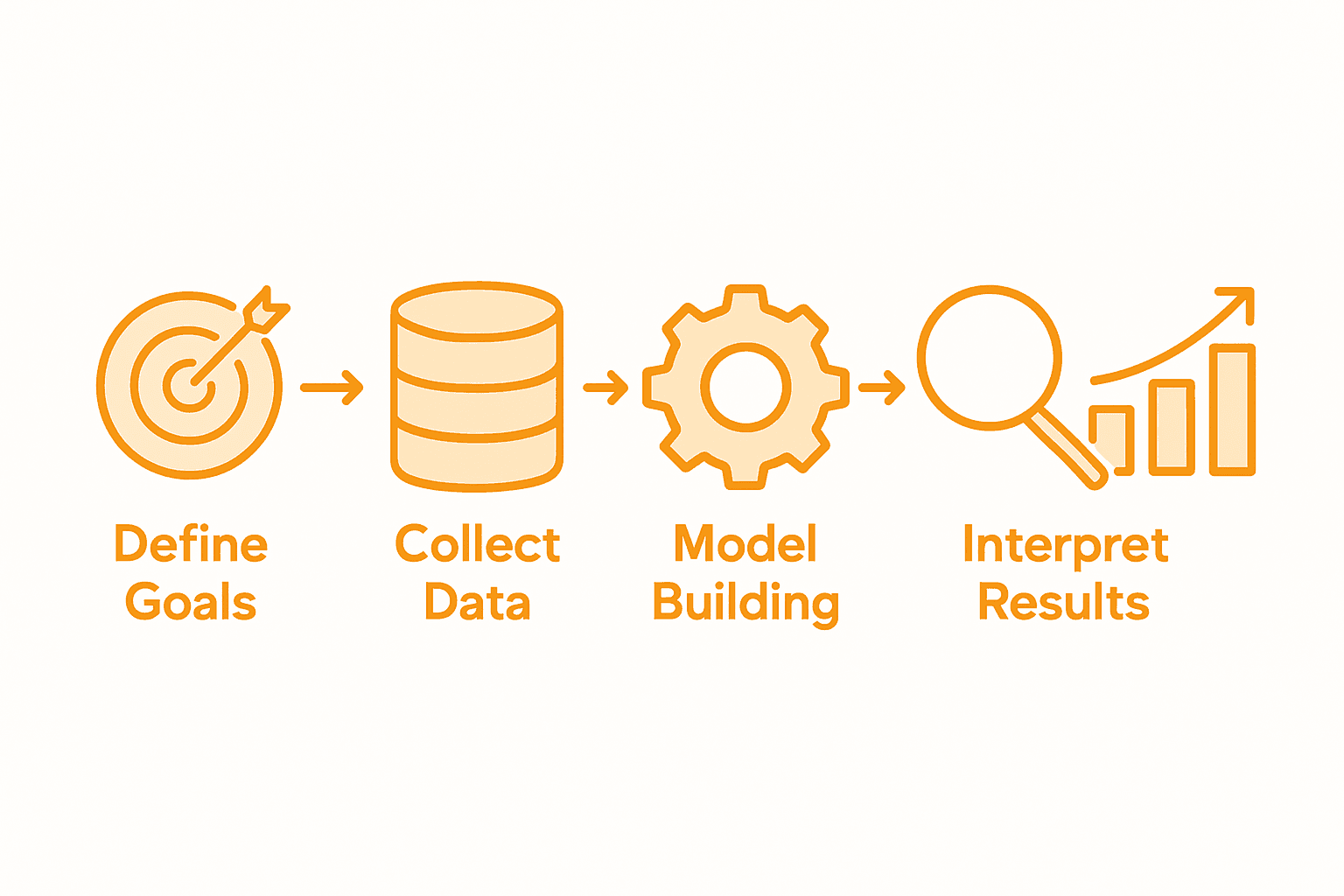
Understanding data requires a comprehensive framework that explores multiple dimensions of insight generation, moving beyond simple numerical analysis. Start by critically examining your analytical models results through multiple lenses – statistical significance, practical relevance, and potential business impact. Look for patterns that reveal unexpected connections, challenge existing assumptions, or highlight potential opportunities for strategic intervention.
Effective interpretation demands both analytical rigor and creative thinking. Translate statistical findings into clear narrative explanations that non technical stakeholders can understand. Develop visual representations like charts, graphs, and dashboards that communicate complex insights quickly and effectively. Consider the broader context of your findings – how do these results connect to your original business objectives? What strategic actions can be recommended based on the discovered insights?
Pro Tip: Always maintain a skeptical perspective and cross validate your interpretations by reviewing results from multiple analytical perspectives, ensuring your insights are robust and not based on potential data artifacts or statistical anomalies.
Step 5: Implement Actions and Measure Impact
Implementing analytics insights transforms theoretical understanding into tangible business transformation. This crucial stage bridges strategic recommendations with practical organizational change.
The OGSM framework provides a structured approach to goal setting and action planning that ensures systematic execution of your analytical insights. Develop a comprehensive implementation strategy that breaks down complex recommendations into specific actionable steps. Assign clear responsibilities to team members, establish precise timelines, and create mechanisms for tracking progress. Anticipate potential obstacles and design contingency plans that allow for adaptive implementation.
The following table compares two popular execution frameworks:
| Framework | Main Purpose | Unique Strength |
|---|---|---|
| BADIR | Guides analytics from business goals to results | Emphasizes traceability from metrics to goals |
| OGSM | Drives structured goal-setting and implementation | Integrates objectives with action and measurement |
Utilizing a balanced scorecard approach enables comprehensive impact measurement across multiple organizational dimensions. Create a robust monitoring system that tracks both quantitative performance metrics and qualitative strategic outcomes. Regularly review implementation progress, comparing actual results against initial projections. Be prepared to make real time adjustments based on emerging data and unexpected organizational dynamics. Recognize that successful implementation is an iterative process requiring continuous learning and strategic refinement.
Pro Tip: Establish a dedicated cross functional implementation team with representatives from different departments to ensure holistic perspective and collaborative execution of your analytical insights.
Here is a summary of analytics project stages and their core focus:
| Stage | Primary Focus | Key Activity |
|---|---|---|
| Define Objectives | Align analytics with business goals | Identify specific goals and KPIs |
| Data Preparation | Gather and clean relevant data | Validate sources and improve quality |
| Model Development | Analyze data for actionable insights | Build and test analytical models |
| Insight Generation | Translate results into business value | Interpret findings and visualize outcomes |
| Implementation | Execute strategies and monitor results | Apply insights and measure impact |
Unlock Business Success with Applied Analytics Training
Struggling to turn complex data into clear, actionable insights? The article outlines crucial steps like defining precise business goals, preparing high-quality data, and building reliable analytical models—challenges many face when trying to leverage data for real impact. If you want to master these concepts and confidently lead data-driven projects, professional training is key. Gain the practical skills needed to handle everything from analytics frameworks like BADIR and OGSM to model validation and implementation strategies.
Take control of your career and business outcomes by enrolling in expert-led courses tailored for professionals serious about data science and applied analytics. Visit Ambeone’s landing page and explore the Uncategorized Archives – Ambeone for insights on courses that will equip you with the tools to solve business challenges using analytics. Act now to transform raw data into measurable success and join a community committed to real-world results.
Frequently Asked Questions
How do I define my business goals for an applied analytics project?
Start by identifying the core challenges and opportunities within your organization. Use frameworks like the BADIR methodology to translate broad business goals into specific, measurable analytics targets, setting clear metrics like increasing quarterly sales revenue by 15%.
What data should I collect for my analytics project?
Gather data from both internal and external sources relevant to your business objectives. Focus on collecting high-quality information that includes customer databases and transaction logs, while ensuring data accuracy and compatibility.
How do I build effective analytical models using my data?
Select modeling techniques that directly align with your business objectives, such as regression analysis or machine learning. Begin with exploratory data analysis to visualize patterns, then test multiple model iterations to find the most effective approach, aiming for optimal accuracy and precision.
How can I interpret the results from my analytics models?
Examine your analytical results through different dimensions, including statistical significance and business impact. Use visual representation tools like charts and graphs to communicate insights clearly, connecting findings back to your original business goals.
What steps should I follow to implement analytics insights within my organization?
Develop a comprehensive implementation strategy that breaks down recommendations into actionable steps. Assign clear responsibilities within your team and establish timelines, while continuously monitoring progress against your set metrics to ensure successful execution.
How do I measure the impact of my analytics implementation?
Create a robust monitoring system to track both quantitative and qualitative outcomes. Regularly compare the actual results with initial projections, making adjustments as needed to enhance your business strategies and ensure ongoing success.
Recommended
- Business Analytics Definition: Complete Guide and Examples
- The Essential Guide to the Role of Applied Analytics
- The Essential Guide to Applications of Applied Analytics – Ambeone
- What Is Data Analytics? Complete Guide Explained – Ambeone
- Improving Diagnostic Accuracy for Diesel Injection Specialists – My WordPress
- Master Step by Step Video Analysis for Impactful Insights
- Video Summaries for Market Analysis Explained: Complete Guide