Artificial Intelligence Explained: Practical Applications Guide
More than 35 percent of american businesses already use artificial intelligence to improve operations and decision making. This new technology touches daily life in ways that were science fiction just a decade ago. With rapid advances and new uses emerging every year, understanding AI’s true nature and capabilities helps everyone, from students to professionals, make sense of its growing impact.
Table of Contents
- Defining Artificial Intelligence: Core Concepts
- AI Types: Narrow Vs. General Systems
- How Artificial Intelligence Works Today
- Business Applications And Career Opportunities
- Challenges, Risks, And Ethical Considerations
Key Takeaways
| Point | Details |
|---|---|
| Understanding AI | AI simulates human cognitive processes and decision-making, extending beyond mere computation to include human purpose and adaptability. |
| Narrow vs. General AI | Narrow AI performs specific tasks effectively, while General AI aims for broader, human-like intelligence that remains largely theoretical. |
| Operational Mechanisms | Modern AI systems utilize machine learning, neural networks, and deep learning to analyze data and generate insights autonomously. |
| Ethical Considerations | The evolution of AI raises critical issues such as bias, privacy, and accountability, necessitating responsible governance and ethical practices in the field. |
Defining Artificial Intelligence: Core Concepts
Artificial Intelligence (AI) represents a groundbreaking technological paradigm where machines simulate human-like cognitive processes and decision making capabilities. According to research from arxiv, AI can be conceptualized through two primary philosophical approaches: a rationalistic framework focusing on systems that think and act logically, and a humanistic perspective emphasizing the emulation of human intelligence.
At its core, artificial intelligence encompasses computer systems designed to perform tasks that traditionally require human intelligence. These tasks include learning, reasoning, problem solving, perception, and language understanding. The sociotechnical definition proposed by arxiv expands beyond technical functions to include human purpose and dynamic technological expectations, recognizing AI as more than just a computational tool.
Key characteristics that distinguish artificial intelligence include:
- Adaptive Learning: AI systems can improve performance through experience
- Pattern Recognition: Ability to identify complex patterns in large datasets
- Autonomous Decision Making: Making intelligent choices with minimal human intervention
- Predictive Analytics: Forecasting outcomes based on historical data
To truly understand AI, we must recognize it as a complex, evolving field that bridges computer science, cognitive psychology, and advanced mathematics. While current AI technologies represent remarkable achievements, they are still fundamentally tools designed to augment and enhance human capabilities rather than replace human intelligence entirely.
AI Types: Narrow vs. General Systems
Artificial Intelligence is categorized into two primary systems: Narrow AI and General AI, each representing distinct technological capabilities and potential. According to GeeksforGeeks, these systems differ fundamentally in their scope, complexity, and functional range.
Narrow AI, also known as Weak AI, is designed to perform specific tasks with high precision and efficiency. These systems excel in specialized domains like image recognition, language translation, or playing chess. Unlike human intelligence, Narrow AI cannot generalize learning or transfer skills between different contexts. Corporate Finance Institute highlights that Narrow AI currently dominates practical applications across industries, powering everything from smartphone assistants to complex financial algorithms.
Key distinctions between Narrow and General AI include:
- Scope of Intelligence: Narrow AI is task-specific; General AI aims for human-like adaptability
- Learning Capability: Narrow AI learns within predefined parameters; General AI could potentially learn across domains
- Current Technological State: Narrow AI is fully realized; General AI remains theoretical
- Complexity: Narrow AI solves targeted problems; General AI would mimic comprehensive human reasoning
While General AI represents the holy grail of artificial intelligence research, current technologies remain firmly in the Narrow AI domain. Researchers continue pushing boundaries, developing increasingly sophisticated systems that inch closer to more generalized intelligent behavior.
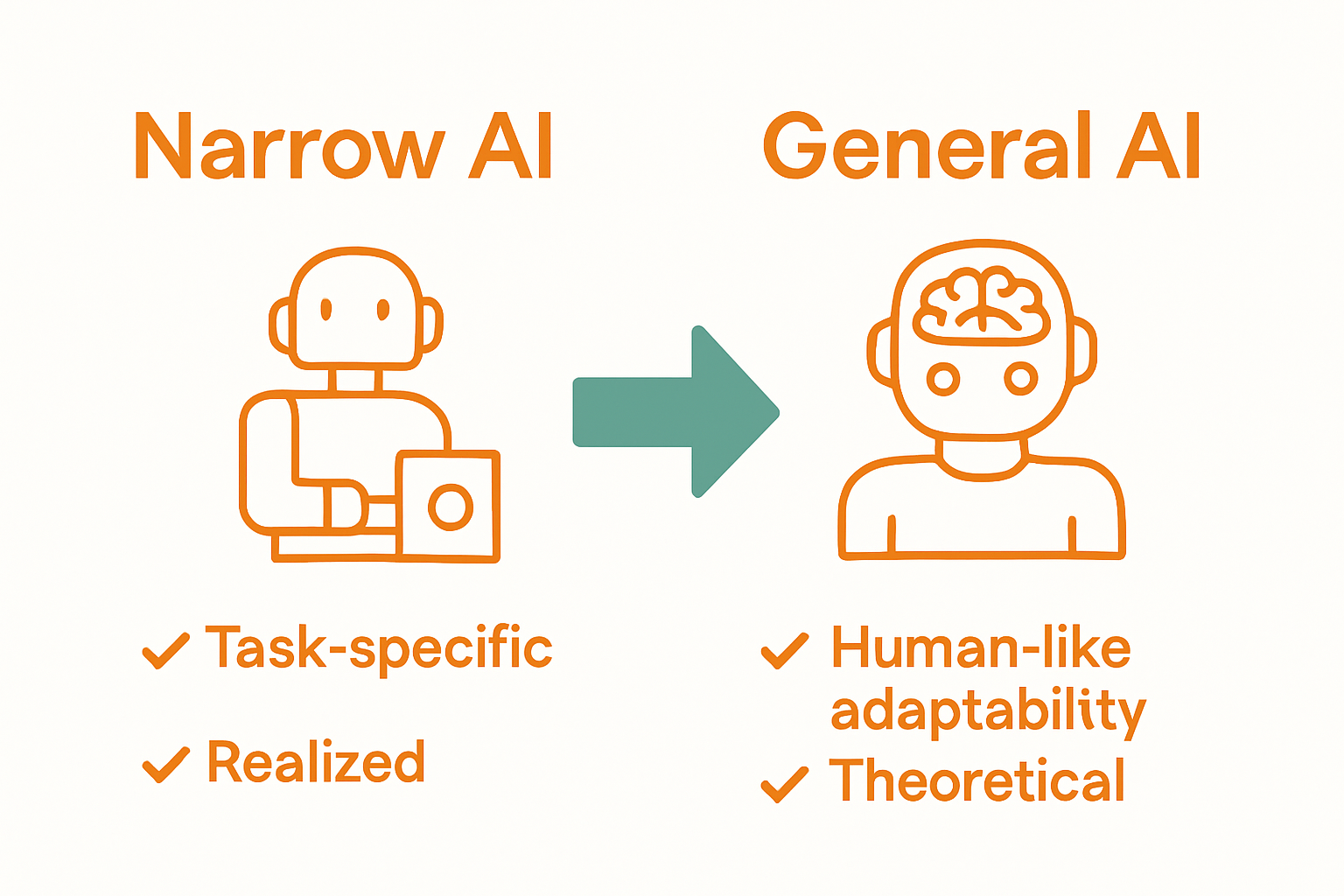 The journey from task-specific algorithms to truly adaptive, human-like artificial intelligence remains an exciting frontier of technological innovation.

How Artificial Intelligence Works Today
Artificial Intelligence operates through complex computational systems that simulate human-like cognitive processes and decision-making capabilities. Wikipedia explains that at its core, AI functions through sophisticated expert systems that emulate human expert reasoning, primarily using advanced if-then rule-based logic to solve intricate problems.
Modern AI systems leverage multiple interconnected technologies to process and analyze data. These include machine learning algorithms, neural networks, and deep learning models that enable computers to learn from massive datasets, recognize patterns, and make intelligent predictions. Some advanced AI systems, as described by Wikipedia, even function as discovery systems capable of autonomously analyzing scientific data and generating novel insights.
Key operational mechanisms of contemporary AI include:
- Data Processing: Consuming and analyzing massive datasets
- Pattern Recognition: Identifying complex correlations and trends
- Predictive Modeling: Generating probabilistic forecasts
- Adaptive Learning: Continuously improving performance through experience
To fully understand AI’s functionality, we must recognize it as a dynamic technological ecosystem. While current systems excel at specific tasks, they fundamentally work by transforming raw data into actionable intelligence through sophisticated computational techniques. The Why Use Artificial Intelligence: Complete Guide offers deeper insights into how businesses and industries are leveraging these powerful technological capabilities to drive innovation and efficiency.
Business Applications and Career Opportunities
Artificial Intelligence has transformed business landscapes across multiple industries, delivering unprecedented operational capabilities. Corporate Finance Institute highlights how Narrow AI specifically drives critical business functions like financial data analysis, fraud detection, market predictions, and sophisticated risk assessment strategies.
Businesses are leveraging AI technologies to enhance performance, efficiency, and strategic decision making. Parangat emphasizes that domain-specific AI solutions provide more reliable and efficient outcomes across sectors including finance, healthcare, manufacturing, and customer service. The ability to process complex datasets and generate actionable insights has become a game-changing competitive advantage for forward-thinking organizations.
Key business and career opportunities in AI include:
- Data Science Roles: Machine learning engineers, AI researchers, data analysts
- Industry-Specific Positions: Healthcare AI specialists, financial algorithm designers
- Strategic Consulting: AI implementation and transformation experts
- Research and Development: Cutting-edge AI technology innovators
For professionals seeking to transition into AI-driven careers, understanding the evolving technological landscape is crucial. The Why should you choose Artificial Intelligence as Career? guide offers comprehensive insights into navigating this dynamic and rapidly expanding professional domain. As businesses continue integrating AI technologies, the demand for skilled professionals who can bridge technological capabilities with strategic business objectives will only continue to grow.
Challenges, Risks, and Ethical Considerations
Artificial Intelligence presents a complex landscape of transformative potential and significant ethical challenges. arXiv research emphasizes the critical need for responsible governance of General Purpose Artificial Intelligence Systems (GPAIS), highlighting the potential societal risks that emerge as AI technologies become increasingly sophisticated and autonomous.
The ethical considerations surrounding AI extend beyond technical capabilities into profound philosophical and social domains. Wikipedia explores singularity studies, an interdisciplinary field examining the hypothetical point where AI might potentially surpass human intelligence, raising critical questions about technological autonomy, decision-making accountability, and long-term human-machine interactions.
Key challenges and ethical considerations include:
- Bias and Fairness: Preventing algorithmic discrimination
- Privacy Protection: Safeguarding individual data rights
- Job Displacement: Managing workforce transitions
- Accountability: Establishing clear responsibility frameworks
- Transparency: Ensuring explainable AI decision processes
Navigating these challenges requires collaborative approaches involving technologists, ethicists, policymakers, and industry leaders. Professionals entering AI fields must not only understand technological capabilities but also critically analyze potential societal implications. The Why should you choose Artificial Intelligence as Career? guide provides deeper insights into developing responsible and ethical AI practices that balance innovation with human-centric considerations.
Unlock Your Future with Expert AI Training Today
The article highlights key challenges facing those eager to harness Artificial Intelligence technology such as mastering Narrow AI applications, understanding ethical considerations, and bridging the gap from theoretical knowledge to practical business impact. If you are looking to develop skills in adaptive learning, predictive analytics, or ethical AI implementation this is the perfect moment to take action. Building confidence in AI through structured, instructor-led training can turn complexity into opportunity while preparing you for rewarding careers in this rapidly evolving field.
Begin your journey by exploring our comprehensive professional courses designed specifically for aspiring AI professionals and business innovators. At AmbeOne, discover detailed course structures, learn from experienced faculty, and gain practical expertise recognized across Dubai and the UAE. Don’t wait to transform your career and become a part of the future shaping AI landscape. Visit AmbeOne’s main site now and step into a world of real-world AI competence and certification that puts you ahead.
Frequently Asked Questions
What is Artificial Intelligence?
Artificial Intelligence (AI) refers to computer systems designed to simulate human-like cognitive processes, including learning, reasoning, and decision-making.
What are the main types of AI?
The main types of AI are Narrow AI, which is specialized for specific tasks, and General AI, which aims to emulate human-like adaptability but is still theoretical.
How does AI work today?
AI operates through complex systems that use machine learning algorithms, neural networks, and deep learning models to analyze data, recognize patterns, and make predictions.
What are the key applications of AI in business?
AI is used in various business applications, including financial data analysis, fraud detection, market predictions, and enhancing customer service efficiency.