Deep Learning Explained: Transforming Business Careers
Deep learning drives much of the recent progress in Artificial Intelligence, yet even seasoned american researchers admit its basics are often misunderstood. For mid-career professionals in Dubai and the UAE looking to join the world of AI and Data Science, understanding these fundamentals is crucial for career growth. You will learn why deep learning is more than just a trend, what common pitfalls trip up learners, and how clear knowledge shapes real business impact.
Table of Contents
- Deep Learning Fundamentals And Misconceptions
- Types Of Neural Networks And Architectures
- How Deep Learning Models Work
- Industry Applications In Business And Ai
- Essential Skills And Learning Requirements
- Risks, Limitations, And Best Practices
Key Takeaways
| Point | Details |
|---|---|
| Deep Learning Complexity | Deep learning is a sophisticated area of machine learning, utilizing multilayered neural networks to recognize patterns but requires significant computational resources. |
| Neural Network Architectures | Different architectures like CNNs and RNNs have unique strengths for specific tasks, such as image and sequential data processing, respectively. |
| Industry Versatility | Deep learning is transforming various industries, enhancing capabilities in areas like predictive maintenance, fraud detection, and customer engagement. |
| Skill Development | A strong foundation in mathematics, programming, and data handling is essential for success in deep learning, along with continuous learning and practical experience. |
Deep learning fundamentals and misconceptions
Deep learning represents a sophisticated subset of machine learning that mimics human neural network processing through advanced computational models. At its core, deep learning uses multilayered artificial neural networks capable of learning complex patterns and representations from raw data, enabling unprecedented performance in tasks ranging from image recognition to natural language processing.
Contrary to popular misconceptions, deep learning is not a magical solution but a nuanced computational approach with specific strengths and limitations. Foundational research on deep learning theories reveals critical insights about model generalizability and over-parameterization. These models excel at pattern recognition but can struggle with interpretability, often functioning like complex “black boxes” where the decision-making process remains opaque.
Key characteristics of deep learning include its ability to automatically extract features from raw data, reducing the need for manual feature engineering. Neural networks with multiple hidden layers can progressively learn increasingly abstract representations, enabling sophisticated understanding across domains like computer vision, speech recognition, and predictive analytics. However, these models require substantial computational resources and large training datasets to achieve optimal performance.
Pro Tip: When exploring deep learning, start with smaller, well-defined projects that allow you to understand model behavior and gradually increase complexity as your expertise grows.
Types of neural networks and architectures
Neural networks are sophisticated computational models designed to simulate human brain processing, with each architecture offering unique capabilities for solving complex computational challenges. Comprehensive research on neural network architectures reveals multiple specialized structures tailored to specific computational tasks and problem domains.
The primary neural network architectures include feedforward networks, which represent the most basic structure where information flows unidirectionally from input to output layers. Convolutional neural networks (CNNs) excel in image and spatial data processing, utilizing specialized layers that detect spatial hierarchies and patterns. Recurrent neural networks (RNNs) are uniquely designed to handle sequential data, maintaining internal memory that allows them to process time-series information like language or financial trends.
Each architecture presents distinct strengths and limitations. Feedforward networks work best for straightforward classification tasks, CNNs dominate image recognition and computer vision applications, while RNNs are optimal for natural language processing and time-dependent predictions. Advanced variants like Long Short-Term Memory (LSTM) networks and Transformer architectures have further expanded the capabilities of traditional neural network designs, enabling more complex and nuanced computational modeling.
Here’s a comparative overview of major neural network architectures and their optimal business uses:
| Architecture Type | Data Best Suited For | Example Use Case | Main Limitation |
|---|---|---|---|
| Feedforward | Tabular, simple input | Basic fraud detection | Limited by lack of memory |
| CNN | Images, spatial data | Product defect identification | Requires large datasets |
| RNN | Sequential, time-series | Market trend analysis | Prone to vanishing gradients |
| Transformer | Text, complex sequences | Customer sentiment analysis | Computationally intensive |
Pro Tip: Select your neural network architecture based on your specific problem domain, understanding that no single design works universally across all computational challenges.
How deep learning models work
Deep learning models operate through complex, multilayered neural network architectures that process information in remarkably sophisticated ways. Comprehensive research on deep learning operational mechanics reveals how these models transform raw input data through intricate computational processes, mimicking biological neural networks by progressively extracting and abstracting increasingly complex features.
The fundamental mechanism involves multiple interconnected layers where each neuron processes and transmits information through weighted connections. During training, models utilize backpropagation, an advanced algorithmic technique that allows the network to adjust internal weights and minimize prediction errors. Different learning paradigms emerge across various model types, including supervised learning (where models learn from labeled data), unsupervised learning (identifying patterns in unlabeled datasets), and reinforcement learning (improving performance through reward-based feedback mechanisms).

Understanding model functionality requires recognizing how neural networks adapt and generalize. Systematic approaches to deep learning model classifications demonstrate that models can transfer knowledge between related tasks, optimize parameters dynamically, and develop increasingly nuanced representations of complex data structures. This adaptability enables deep learning models to excel in domains ranging from image recognition and natural language processing to predictive analytics and autonomous decision-making systems.
Pro Tip: Develop a practice of experimenting with different model architectures and hyperparameters to understand how subtle changes can dramatically impact computational performance and predictive accuracy.
Industry applications in business and AI
Artificial Intelligence and deep learning have revolutionized business operations across multiple industries, creating unprecedented opportunities for innovation and efficiency. Comprehensive global research on AI’s transformative impact reveals how advanced technologies are reshaping critical business functions from marketing and finance to customer service and operations.
In specific industry contexts, deep learning demonstrates remarkable versatility. Manufacturing sectors leverage AI for predictive maintenance, identifying potential equipment failures before they occur. Financial institutions use advanced algorithms for fraud detection and risk assessment, while healthcare organizations apply machine learning to diagnostic imaging and personalized treatment planning. Systematic analysis of AI implementation strategies highlights how these technologies optimize supply chain management, enhance customer engagement, and drive data-driven decision-making across diverse business environments.
The most successful organizations are those that strategically integrate AI technologies, recognizing them not as replacement technologies but as powerful augmentation tools. This approach involves developing robust data infrastructure, investing in employee training, and creating adaptive organizational cultures that can rapidly incorporate technological innovations. Emerging trends indicate increasing integration of AI across sectors like retail, agriculture, and service industries, with particularly significant advances in predictive analytics, autonomous systems, and intelligent process automation.
Pro Tip: Develop a continuous learning mindset by regularly exploring AI applications in your specific industry, understanding that technological adaptation is an ongoing journey of incremental improvements and strategic experimentation.
Essential skills and learning requirements
Deep learning demands a multifaceted skill set that combines technical expertise, analytical thinking, and continuous learning capabilities. Professionals aspiring to excel in this field must develop a robust foundation across several critical domains, including mathematical understanding, programming proficiency, and domain-specific knowledge.
The core technical skills required encompass advanced mathematical disciplines such as linear algebra, calculus, and probability theory. Programming competency is equally crucial, with Python emerging as the primary language for deep learning implementations. Professionals should aim to master key libraries and frameworks like TensorFlow, PyTorch, and Keras. Examples of Artificial Intelligence for Professionals demonstrate the practical applications that underscore the importance of developing comprehensive technical capabilities.
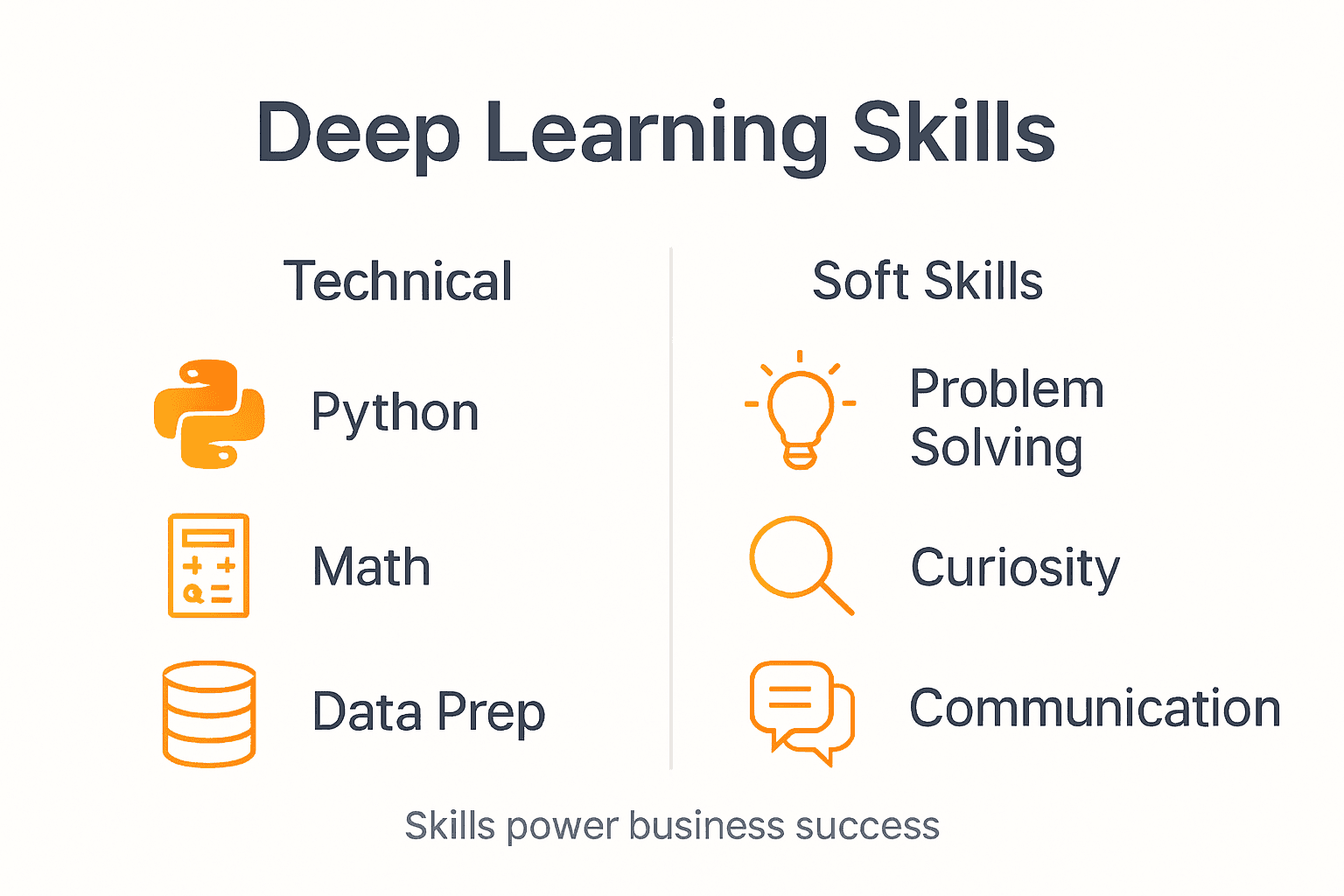
Beyond technical skills, successful deep learning practitioners must cultivate strong problem-solving abilities, intellectual curiosity, and adaptability. This involves developing skills in data preprocessing, model evaluation, and understanding complex algorithmic approaches. Professionals should focus on building a holistic understanding that bridges theoretical knowledge with practical implementation, emphasizing hands-on project experience, continuous learning through online courses, workshops, and active participation in machine learning communities.
Below is a summary of foundational deep learning skills and the practical benefits for career development:
| Skill Area | Why It’s Needed | Business Impact |
|---|---|---|
| Linear Algebra | Model structure & operations | Efficient architecture design |
| Python Programming | Algorithm implementation | Fast prototyping & deployment |
| Data Preprocessing | Data quality assurance | Improved prediction accuracy |
| Model Evaluation | Validate performance | Better decision reliability |
Pro Tip: Create a personal learning roadmap that combines structured online courses, practical project development, and consistent engagement with current research and industry trends in artificial intelligence and deep learning.
Risks, limitations, and best practices
Deep learning technologies, while powerful, come with significant risks and challenges that professionals must carefully navigate. Systematic review of deep learning limitations reveals critical vulnerabilities that can undermine model performance and reliability, including data quality issues, computational constraints, and potential algorithmic biases.
Key risks in deep learning implementation include overfitting, where models perform exceptionally well on training data but fail to generalize to new scenarios. Computational demands present another substantial challenge, requiring significant hardware resources and energy consumption. Model interpretability remains a persistent issue, with complex neural networks often functioning as “black boxes” that make decisions without transparent reasoning. Comprehensive analysis of deep learning challenges highlights the importance of developing robust strategies to mitigate these inherent technological limitations.
Best practices for responsible deep learning deployment involve implementing comprehensive risk management approaches. This includes developing rigorous data preprocessing techniques, utilizing regularization methods to prevent overfitting, maintaining diverse and representative training datasets, and establishing ethical frameworks that prioritize transparency and accountability. Professionals should focus on continuous model evaluation, implementing techniques like cross-validation, developing interpretable machine learning approaches, and staying updated on emerging methodological improvements.
Pro Tip: Develop a systematic approach to model development that prioritizes transparency, regularly audits for potential biases, and maintains a critical perspective on algorithmic decision-making processes.
Empower Your Career with Expert Deep Learning Training
Understanding deep learning concepts such as neural network architectures, model interpretability, and industry applications is crucial for anyone looking to build a thriving AI or Data Science career. If you feel overwhelmed by the technical challenges like handling overfitting, choosing the right architecture, or applying deep learning in business contexts, you are not alone. Many professionals struggle to bridge theory with practical skills that produce real results.
Unlock your potential by gaining hands-on experience and comprehensive knowledge through Ambeone’s instructor-led AI and Data Science courses. Our programs focus on practical, industry-relevant skills covering essential areas like Python programming, model evaluation, and advanced deep learning techniques. With expert faculty and KHDA-approved certifications in Dubai, you will develop the confidence and expertise to excel in complex fields such as predictive analytics and autonomous decision-making.
Take control of your professional future now by exploring how our certification and training offerings can help you master critical AI concepts with personalized guidance. Visit Ambeone’s platform today to start your transformation from learning deep learning fundamentals to applying them successfully in your career.
Frequently Asked Questions
What is deep learning and how does it differ from traditional machine learning?
Deep learning is a subset of machine learning that uses multilayered artificial neural networks to analyze and learn from raw data. Unlike traditional machine learning, which often requires manual feature extraction, deep learning automatically extracts features, allowing for complex pattern recognition in data.
What are the different types of neural networks and their applications?
There are several types of neural networks, including feedforward networks, convolutional neural networks (CNNs), recurrent neural networks (RNNs), and Transformers. Each type has its strengths: feedforward networks are ideal for basic classification, CNNs excel in image analysis, RNNs are suited for sequential data like text, and Transformers are utilized for complex sequences and language processing.
What skills are essential for a career in deep learning?
Key skills for a career in deep learning include proficiency in programming (especially Python), a strong mathematical foundation in linear algebra and probability, and experience with deep learning frameworks like TensorFlow and PyTorch. Practical project experience and a continuous learning mindset are also crucial for success in this fast-evolving field.
What are the risks and limitations of using deep learning in business?
Deep learning comes with risks such as overfitting, where models may perform well on training data but fail to generalize effectively. Other limitations include high computational demands, the potential for algorithmic biases, and challenges with model interpretability, where decision-making processes can remain opaque. Best practices involve rigorous data handling and transparency in model development.