7 Real-Life Examples of AI in UAE for Professionals
Most American professionals are surprised to learn that Dubai’s government services now set the pace for smart city innovations worldwide. By harnessing artificial intelligence, Dubai transforms urban management into a proactive, predictive force. This remarkable shift impacts everything from public safety to citizen experience, offering bold ideas and data driven strategies any American city can study. Discover how technology and vision are reshaping city life and redefining what modern government can achieve.
Table of Contents
- AI-Powered Smart Government Services in Dubai
- AI in Healthcare: Diagnosis and Patient Care
- Retail Innovation With AI-Driven Analytics
- AI Applications in UAE Financial Services
- Smart Transportation and Autonomous Vehicles
- AI for Energy Management and Sustainability
- AI-Enhanced Education and Training Programs
Quick Summary
| Takeaway | Explanation |
|---|---|
| 1. Dubai leads in AI-powered government services | Dubai’s AI systems enhance urban management through proactive solutions and efficiency in public services. |
| 2. AI improves healthcare diagnosis | Machine learning in healthcare enables faster and more accurate diagnosis, improving patient outcomes and personalizing treatment plans. |
| 3. Retail analytics maximize customer engagement | AI-driven insights allow retailers to create personalized shopping experiences and optimize inventory management through predictive analytics. |
| 4. Financial institutions enhance risk management with AI | Advanced AI tools in finance streamline fraud detection and provide data-driven lending and investment strategies for better decision making. |
| 5. AI transforms education and training | AI adapts educational content to individual needs, enhancing learning outcomes and aligning programs with industry requirements. |
1. AI-Powered Smart Government Services in Dubai
Dubai is transforming urban management through cutting-edge artificial intelligence technologies that reimagine how government services operate. Digital Dubai’s innovative AI systems are setting new global standards for smart city infrastructure by leveraging advanced computational capabilities.
The Dubai Municipality has pioneered remarkable AI applications that demonstrate practical and proactive urban management strategies. One standout example is the Smart Municipality Eye, an AI-powered aerial monitoring system using drone technology to revolutionize city maintenance and planning. These autonomous drones can systematically survey green spaces, assess plant health with incredible precision, and predict maintenance requirements before traditional inspection methods would detect potential issues.
Professionals across sectors can learn from Dubai’s approach to integrating AI into government services. The technology goes beyond simple automation, creating predictive and autonomous systems that can independently plan and execute complex tasks. This means government agencies can respond faster, allocate resources more efficiently, and provide more personalized services to citizens.
For instance, the AI systems can analyze urban data in real time, identifying infrastructure needs, optimizing public transportation routes, and even predicting potential maintenance challenges before they become critical problems. This proactive approach saves significant time and financial resources while improving overall urban quality of life.
Pro tip: When exploring AI implementations in professional settings, focus on solutions that demonstrate measurable efficiency gains and can autonomously handle complex decision making processes.
2. AI in Healthcare: Diagnosis and Patient Care
Artificial intelligence is rapidly transforming healthcare delivery in the United Arab Emirates, offering groundbreaking solutions that enhance medical diagnosis and patient care. Healthcare research exploring AI applications reveals significant potential for improving medical outcomes and streamlining professional workflows.
In the UAE, physicians are increasingly adopting AI technologies to augment diagnostic capabilities and personalize patient treatments. Machine learning algorithms can analyze complex medical imaging with remarkable precision, detecting potential health issues faster and more accurately than traditional diagnostic methods. These systems process vast amounts of medical data, identifying patterns that might escape human observation.
AI technologies enable healthcare professionals to move beyond reactive treatment approaches toward proactive and predictive medical interventions. Advanced algorithms can analyze patient data, genetic information, and medical histories to predict potential health risks, recommend preventive strategies, and develop personalized treatment plans tailored to individual patient profiles.
For medical professionals, this means more efficient diagnostics, reduced human error, and enhanced decision making. Radiologists, for instance, can use AI systems to quickly screen medical images, flagging potential abnormalities and allowing for faster, more accurate diagnoses. Similarly, AI can help track patient progress, monitor chronic conditions, and suggest optimal treatment protocols based on comprehensive data analysis.
Pro tip: Stay updated on emerging AI healthcare technologies by attending professional conferences and participating in continuous medical education programs focused on technological innovations.
3. Retail Innovation With AI-Driven Analytics
Artificial intelligence is revolutionizing the retail landscape in the United Arab Emirates, enabling businesses to transform traditional shopping experiences through advanced data analytics and predictive technologies. Innovative AI systems are helping businesses make data backed decisions that drive customer engagement and operational efficiency.
Machine learning algorithms are providing retailers with unprecedented insights into consumer behavior, preferences, and purchasing patterns. These sophisticated technologies analyze massive datasets from multiple sources including point of sale systems, online interactions, social media, and customer feedback to generate actionable intelligence that can dramatically improve business strategies.
Retail professionals can leverage AI technologies to create hyper personalized shopping experiences. By utilizing predictive analytics, businesses can develop targeted marketing campaigns, optimize inventory management, and design personalized product recommendations that resonate with individual customer preferences. For example, AI systems can predict future purchasing trends, helping retailers stock the right products at the right time and minimize inventory waste.
Moreover, AI driven analytics enable real time tracking of consumer sentiment and market dynamics. Retailers can quickly adapt their strategies based on emerging trends, competitive intelligence, and customer feedback. This agile approach allows businesses to stay ahead of market shifts and maintain a competitive edge in the rapidly evolving retail ecosystem.
Pro tip: Invest in continuous learning about AI technologies and attend industry conferences to stay updated on the latest analytics tools and strategies that can transform your retail business.
4. AI Applications in UAE Financial Services
The United Arab Emirates is rapidly transforming its financial services landscape through cutting edge artificial intelligence technologies that revolutionize traditional banking and financial operations. Big data analytics in the finance industry are enabling unprecedented levels of efficiency, risk management, and customer experience optimization.
Machine learning algorithms are empowering financial institutions to develop sophisticated fraud detection systems, personalize customer interactions, and make data driven lending decisions. These advanced AI technologies can analyze complex financial patterns, assess credit risks, and predict potential market trends with remarkable accuracy that far surpasses traditional analytical methods.
For financial professionals, AI offers powerful tools to streamline complex processes. Automated trading algorithms can execute transactions at lightning speed, analyzing multiple market indicators simultaneously. Chatbots and virtual assistants provide instant customer support, handling routine inquiries and freeing human professionals to focus on more strategic tasks that require nuanced decision making.
Risk management has been particularly transformed by AI technologies. Predictive models can now assess financial risks with unprecedented precision, analyzing vast datasets to identify potential vulnerabilities in investment portfolios, detect potential fraud signals, and recommend proactive mitigation strategies. This enables financial institutions to make more informed decisions and protect both organizational and customer interests.
Pro tip: Continuously update your technical skills by pursuing specialized training in AI and financial analytics to remain competitive in the rapidly evolving financial technology landscape.
5. Smart Transportation and Autonomous Vehicles
The United Arab Emirates is pioneering groundbreaking artificial intelligence technologies in transportation, transforming urban mobility through advanced autonomous vehicle systems and intelligent transportation networks. Digital Dubai’s innovative AI driven transportation solutions are setting new global benchmarks for smart city transportation infrastructure.
Machine learning algorithms are revolutionizing how vehicles navigate complex urban environments, enabling unprecedented levels of safety, efficiency, and predictive capabilities. These sophisticated AI systems can process real time data from multiple sensors, making split second decisions that optimize route planning, traffic flow, and collision avoidance.
For transportation professionals and urban planners, AI technologies offer powerful tools to reimagine mobility. Autonomous vehicles can continuously learn from their environment, adapting to changing road conditions, traffic patterns, and individual driving behaviors. This adaptive intelligence means vehicles become progressively more sophisticated and safer with each mile traveled, dramatically reducing human error and potential accident risks.
The UAE is creating comprehensive transportation ecosystems where vehicles communicate with infrastructure, other vehicles, and centralized traffic management systems. This interconnected approach allows for dynamic route optimization, predictive maintenance, and intelligent traffic signal management that can significantly reduce congestion and improve overall urban transportation efficiency.
Pro tip: Stay ahead of transportation technology trends by attending international AI and autonomous vehicle conferences, and continuously updating your technical skills in machine learning and transportation analytics.
6. AI for Energy Management and Sustainability
The United Arab Emirates is spearheading innovative artificial intelligence solutions to transform energy management and drive sustainable infrastructure development. Data science techniques are revolutionizing energy efficiency through sophisticated predictive analytics and intelligent resource optimization.
Machine learning algorithms are enabling unprecedented insights into energy consumption patterns, allowing utility providers and industrial organizations to develop more intelligent and responsive energy management strategies. These advanced AI technologies can analyze complex datasets from multiple sources, identifying inefficiencies, predicting maintenance needs, and recommending precise optimization strategies.
For energy professionals, AI offers powerful tools to dramatically reduce waste and improve operational efficiency. Intelligent systems can monitor energy consumption in real time, automatically adjusting power distribution, identifying potential equipment failures before they occur, and creating dynamic energy allocation models that respond instantaneously to changing demand patterns.
The Dubai Electricity and Water Authority exemplifies this approach with innovative AI solutions like the ‘Rammas’ chatbot, which demonstrates how artificial intelligence can enhance customer service while simultaneously improving operational efficiency. These technologies enable more responsive, adaptive energy management systems that can significantly reduce environmental impact and operational costs.
Pro tip: Develop interdisciplinary skills by combining technical knowledge of AI with specialized understanding of energy systems to become a valuable professional in the emerging field of sustainable technology.
7. AI-Enhanced Education and Training Programs
The United Arab Emirates is transforming educational experiences through advanced artificial intelligence technologies that personalize and optimize learning across multiple sectors. AI training offers significant advantages for professional development by creating adaptive, intelligent learning environments.
Machine learning algorithms are revolutionizing educational approaches by developing intelligent systems that can analyze individual student performance, adapt curriculum in real time, and provide personalized learning pathways. These sophisticated AI technologies can identify learning gaps, recommend targeted interventions, and create customized educational experiences that maximize knowledge retention and skill development.
For educators and training professionals, AI offers powerful tools to enhance learning outcomes. Intelligent tutoring systems can provide immediate feedback, track student progress with unprecedented granularity, and develop predictive models that help identify students who might need additional support. This approach transforms traditional educational models from standardized instruction to highly personalized learning experiences.
Digital Dubai’s innovations at GITEX Global demonstrate how AI can create more responsive and efficient educational ecosystems. By integrating advanced computational technologies, educational institutions can develop curriculum that adapts to emerging industry needs, ensuring that training programs remain current and aligned with rapidly evolving professional requirements.
Pro tip: Continuously explore emerging AI educational technologies and develop a growth mindset that embraces technological integration to remain competitive in the rapidly changing professional learning landscape.
Below is a comprehensive table summarizing the applications and benefits of AI technologies across various sectors in the United Arab Emirates, as discussed throughout the article.
| Sector | AI Implementation | Key Benefits |
|---|---|---|
| Government Services | AI-powered systems like Smart Municipality Eye use drones for city maintenance. | Improved urban management and proactive resource allocation. |
| Healthcare | Machine learning algorithms enhance diagnosis and personalize treatments. | Faster, more accurate medical outcomes and efficient workflows. |
| Retail | AI-driven analytics provide insights into consumer behavior. | Personalized shopping experiences and optimized inventory management. |
| Financial Services | Advanced algorithms for fraud detection and customer interaction. | Enhanced efficiency, risk management, and customer service. |
| Transportation | Autonomous vehicles and intelligent networks improve urban mobility. | Increased safety, reduced congestion, and better route optimization. |
| Energy Management | AI technologies for predicting and optimizing energy use. | Reduced waste, improved efficiency, and lower environmental impact. |
| Education | Adaptive AI systems tailor learning experiences. | Personalized education and improved learning outcomes. |
Unlock Your AI Potential with Expert Training in the UAE
The article highlights several challenges professionals face in adopting AI technologies across diverse sectors such as government services, healthcare, finance, and transportation. Common pain points include mastering complex machine learning algorithms, developing practical skills for predictive analytics, and understanding how to implement AI-driven business solutions effectively. If you are eager to transform your career and gain hands-on expertise that directly addresses these challenges, focused professional training is essential.
At AmbeOne, we specialize in delivering comprehensive in-person courses tailored for individuals seeking to harness the power of artificial intelligence and data science in the UAE’s dynamic market. Our instructor-led certification programs emphasize real-world applications including predictive modeling, autonomous systems, and AI-powered analytics — all critical competencies discussed in the article.
Elevate your skills with industry-relevant training that empowers you to make smarter decisions and drive innovation in your field.
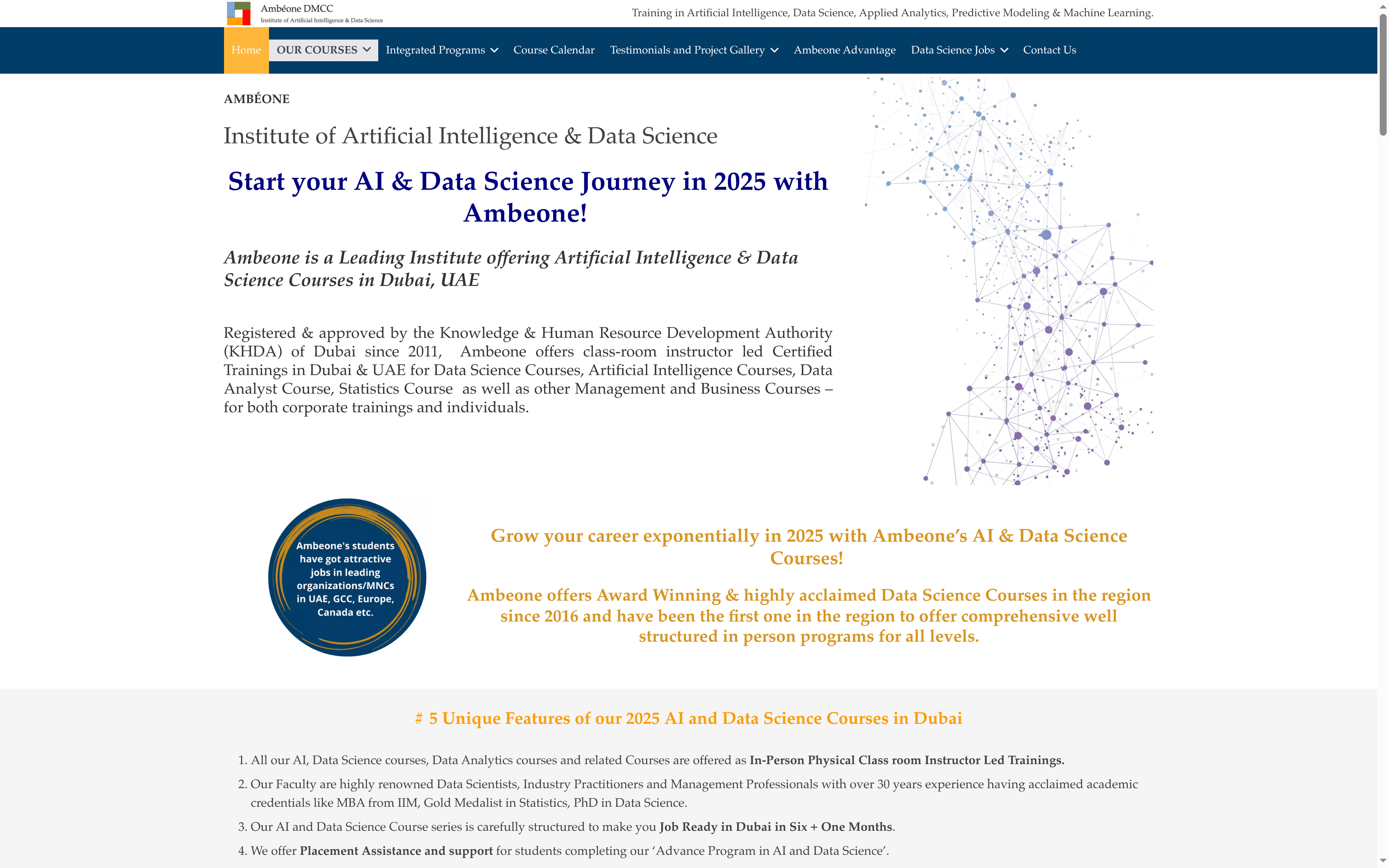
Take the step today to join a community of forward-thinking professionals advancing AI across sectors. Explore our detailed course structures and discover how AmbeOne’s expert faculty and hands-on workshops prepare you for success. Don’t wait for AI to transform industries around you — become the expert driving that change now by visiting AmbeOne and enrolling in your next career-defining course.
Frequently Asked Questions
How is AI used in healthcare in the UAE?
Artificial intelligence is significantly enhancing healthcare by improving medical diagnosis and patient care. To implement AI systems, healthcare professionals can consider adopting machine learning algorithms that analyze complex medical data, detect health issues earlier, and personalize treatment plans tailored to individual patients’ needs.
What role does AI play in urban management in the UAE?
AI technologies are transforming urban management by enabling proactive and efficient city planning and maintenance. Professionals can explore AI systems like aerial monitoring and predictive analytics to streamline operations in areas such as infrastructure development and resource allocation within urban environments.
How can AI facilitate personalized shopping experiences in the UAE retail sector?
AI enables retailers to create personalized shopping experiences by analyzing consumer data and predicting buying behaviors. Retail professionals should implement predictive analytics tools to tailor marketing campaigns and optimize inventory management, potentially increasing sales by meeting customer demand more effectively.
What are the benefits of using AI in financial services in the UAE?
AI enhances financial services by improving fraud detection, personalizing customer interactions, and making data-driven lending decisions. Financial professionals should invest in advanced AI tools to streamline processes and reduce risks, which can lead to improved customer satisfaction and operational efficiency.
How can transportation systems in the UAE benefit from AI technologies?
AI technologies improve transportation efficiency through smart traffic management and autonomous vehicles. Transportation professionals can implement AI systems that analyze real-time traffic data and optimize route planning to reduce congestion and improve overall urban mobility.
How can educators utilize AI to improve learning outcomes?
Educators can harness AI to create personalized learning experiences tailored to individual student needs. By adopting intelligent tutoring systems that provide immediate feedback and track progress, educational professionals can enhance engagement and help students achieve better outcomes.