What Is Big Data Analytics and Why It Matters
Most American businesses are flooded with massive amounts of raw data, yet only a fraction unlock true value from these resources. Over 80 percent of collected data sits unused, highlighting a widespread struggle to separate myths from genuine opportunities in big data analytics. Understanding the real meaning and potential of big data matters more than ever as organizations look to technology for smarter decisions and a competitive edge.
Table of Contents
- Big Data Analytics Defined and Debunked
- Types of Big Data Analytics Explained
- How Big Data Analytics Works in Practice
- Key Applications Across Business Sectors
- Risks, Challenges, and Best Practices
Key Takeaways
| Point | Details |
|---|---|
| Understanding Big Data | Big data analytics requires sophisticated techniques to process large, complex datasets that traditional methods cannot handle. It’s crucial to focus on actionable insights rather than merely collecting data. |
| Types of Analytics | The four primary types of analytics—descriptive, diagnostic, predictive, and prescriptive—serve distinct purposes in transforming raw data into strategic intelligence. Each level increases in complexity and strategic value. |
| Implementation Challenges | Successful big data analytics involves addressing challenges like data quality and ethical considerations, necessitating rigorous validation processes and governance frameworks. Organizations should prioritize responsible data management. |
| Industry Applications | Big data analytics has profound implications across various sectors, including finance and healthcare, enhancing decision-making and operational efficiency by turning complex information into actionable intelligence. |
Big Data Analytics Defined and Debunked
Big data analytics represents a sophisticated approach to examining massive, complex datasets that traditional data processing methods cannot effectively manage. When we talk about big data, we’re referring to information collections so large and intricate that standard computational techniques become inadequate. Understanding this technological paradigm requires unpacking its core characteristics and dispelling prevalent misconceptions.
Research from academic sources reveals significant ambiguity surrounding big data’s definition. A comprehensive survey of academic literature highlights the lack of a unified understanding, which introduces complexity in technological discourse. Big data analytics typically involves processing datasets characterized by three primary dimensions: volume (massive data quantities), velocity (rapid data generation and processing), and variety (diverse data types from multiple sources like text, images, sensor readings).
Contrary to popular belief, big data analytics isn’t just about collecting massive amounts of information. The true value emerges from extracting meaningful insights that drive strategic decision-making. Researchers examining social media data analysis have identified several critical myths surrounding big data, particularly regarding data interpretation and reliability. These myths often lead organizations to overestimate or misunderstand the potential of their data resources.
Key aspects of big data analytics include:
- Advanced computational techniques like machine learning
- Real-time data processing capabilities
- Complex statistical modeling
- Predictive and prescriptive analytical approaches
Professionals working with big data must understand that raw data alone provides little value. The transformative power lies in sophisticated analysis that converts unstructured information into actionable business intelligence. Data analytics techniques play a crucial role in translating complex datasets into strategic insights that can revolutionize organizational decision-making processes.
Types of Big Data Analytics Explained
Big data analytics encompasses a range of sophisticated approaches designed to extract meaningful insights from complex datasets. Comprehensive research from academic sources has identified four primary types of analytics that organizations leverage to transform raw data into strategic intelligence: descriptive, diagnostic, predictive, and prescriptive analytics.
Descriptive Analytics represents the foundational layer of big data analysis. This approach focuses on summarizing historical data to understand past performance and trends. For instance, a retail company might use descriptive analytics to examine sales figures from the previous quarter, providing a clear snapshot of what has already occurred. Business analytics techniques play a crucial role in translating complex data into comprehensible insights.

Diagnostic Analytics goes a step further by exploring why specific events or outcomes happened. This type of analysis involves deeper investigation, using techniques like data discovery, drill-down, and correlations to uncover the root causes behind specific business performances. Organizations can identify underlying factors that contributed to success or challenges, enabling more informed strategic planning.
The more advanced forms of analytics include Predictive and Prescriptive Analytics. Predictive analytics uses statistical models and machine learning techniques to forecast future trends and potential outcomes. Prescriptive analytics takes this a step further by recommending specific actions based on those predictions. Applied analytics approaches enable businesses to not just understand past and potential future scenarios, but to proactively shape their strategic decisions.
Key characteristics of these analytics types include:
- Increasing complexity from descriptive to prescriptive
- Growing strategic value with each analytical level
- Requirement for advanced computational techniques
- Integration of machine learning and statistical modeling
Professionals working with big data must understand that each analytical type serves a unique purpose. The true power of big data lies not in collecting massive amounts of information, but in transforming that data into actionable intelligence that drives meaningful business outcomes.
How Big Data Analytics Works in Practice
Big data analytics transforms raw information into strategic insights through a complex, multistage process that involves sophisticated technological infrastructure and advanced computational techniques. A comprehensive statistical framework provides the foundational principles that guide how organizations systematically extract value from massive datasets.
The practical implementation of big data analytics typically involves several critical stages. First, data collection occurs across multiple sources, including structured databases, unstructured social media content, sensor networks, and transactional records. Big data analytics in finance demonstrates how diverse data streams can be integrated to generate comprehensive insights. Organizations must then clean and preprocess these datasets, removing inconsistencies, handling missing values, and standardizing formats to ensure analytical accuracy.
Privacy and ethical considerations are paramount in big data analytics implementations. Researchers have emphasized the critical importance of integrating privacy safeguards directly into the analytical process, ensuring that data collection and analysis respect individual privacy rights. This approach, known as “privacy by design,” involves implementing robust security protocols, anonymizing sensitive information, and establishing strict access controls.
Key practical components of big data analytics include:
- Advanced machine learning algorithms
- High-performance computing infrastructure
- Real-time data processing capabilities
- Sophisticated statistical modeling techniques
The practical execution of big data analytics requires a combination of technological infrastructure, statistical expertise, and strategic vision. Professionals must understand that successful implementation goes beyond technical capabilities, demanding a holistic approach that balances technological innovation with ethical considerations and business objectives.
Key Applications Across Business Sectors
Big data analytics has revolutionized decision-making processes across multiple industries, transforming how organizations leverage information to drive strategic outcomes. Applications of applied analytics demonstrate the versatility and profound impact of data-driven insights across diverse business environments.
In the financial sector, big data analytics enables unprecedented risk assessment and fraud detection capabilities. Banks and financial institutions utilize advanced algorithms to analyze transaction patterns, identify potential fraudulent activities, and develop more sophisticated credit scoring models. These techniques allow organizations to make more accurate lending decisions, minimize financial risks, and create personalized financial products tailored to individual customer profiles.
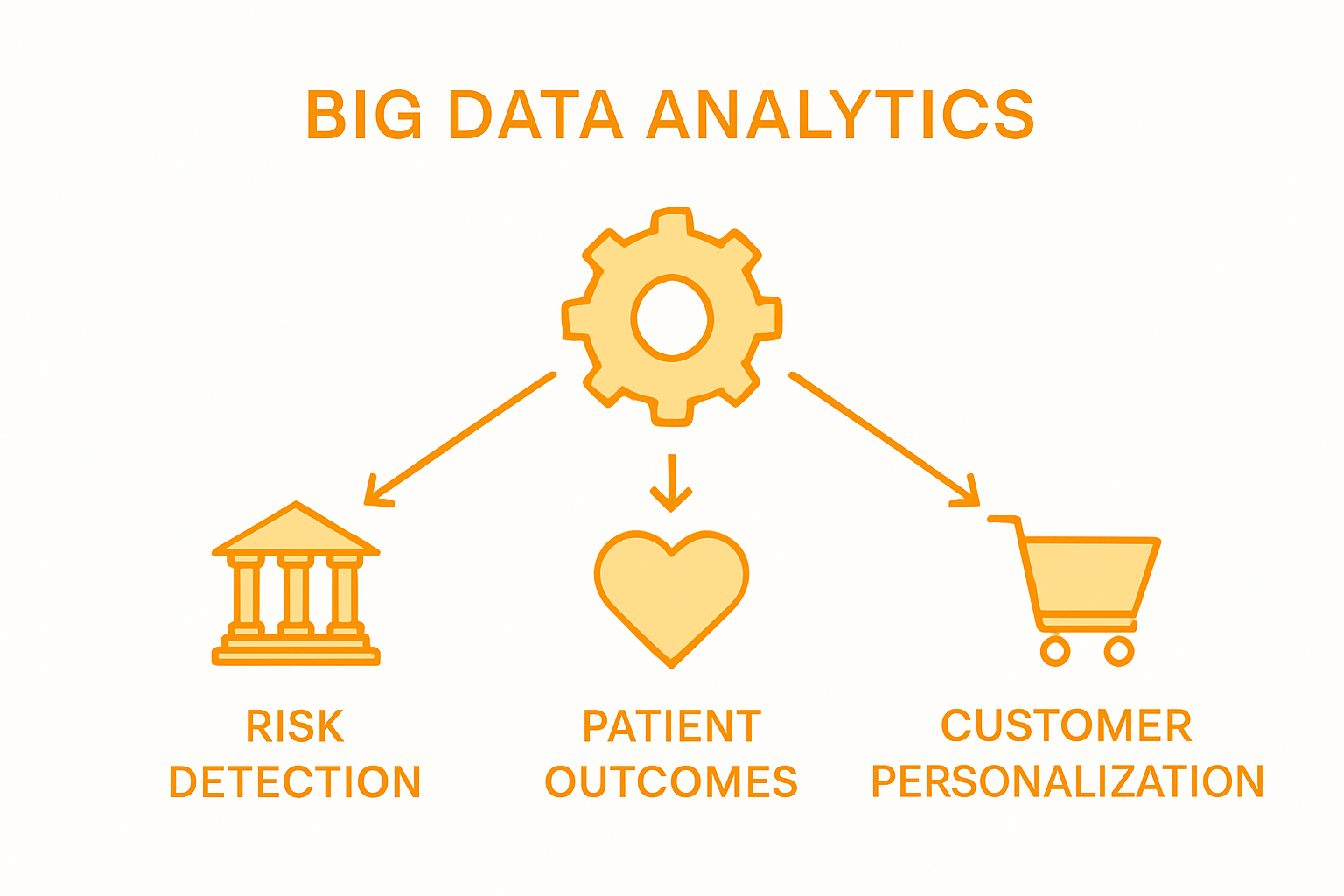
Healthcare represents another critical domain where big data analytics delivers transformative insights. Medical researchers and healthcare providers can now analyze vast patient datasets to identify disease patterns, predict potential health risks, and develop more targeted treatment protocols. Business intelligence techniques help healthcare organizations optimize resource allocation, improve patient outcomes, and streamline operational efficiency.
Key business sectors benefiting from big data analytics include:
- Financial services
- Healthcare and medical research
- Retail and e-commerce
- Manufacturing
- Transportation and logistics
- Marketing and customer experience
The true power of big data analytics lies in its ability to convert complex, seemingly unrelated information into actionable strategic intelligence. Organizations that successfully implement these technologies gain significant competitive advantages, enabling more precise decision-making, enhanced operational efficiency, and innovative approaches to addressing complex business challenges.
Risks, Challenges, and Best Practices
Big data analytics presents a complex landscape of potential risks and ethical challenges that organizations must carefully navigate. Privacy-enhancing technologies have emerged as critical strategies for mitigating the inherent vulnerabilities associated with large-scale data collection and analysis.
One of the most significant challenges in big data analytics involves ensuring data veracity and quality. Research exploring analytical methodologies highlights the potential for misinterpretation when working with massive, complex datasets. Organizations must implement rigorous data validation processes, including comprehensive cleaning protocols, cross-referencing multiple sources, and developing sophisticated error detection mechanisms to maintain analytical integrity.
Ethical considerations represent another crucial dimension of big data analytics. Privacy risks are paramount, with organizations facing increasing scrutiny regarding data collection, storage, and usage practices. Key ethical challenges include protecting individual privacy, preventing unauthorized data access, and ensuring transparent data handling practices. Companies must develop robust governance frameworks that prioritize individual rights while extracting meaningful insights.
Best practices for managing big data analytics risks include:
- Implementing comprehensive data governance policies
- Developing advanced cybersecurity protocols
- Establishing clear ethical guidelines for data usage
- Creating transparent data collection and processing frameworks
- Investing in continuous staff training on data privacy
- Conducting regular privacy impact assessments
Successful big data analytics requires a balanced approach that combines technological innovation with ethical responsibility. Organizations must view data not just as a resource, but as a critical asset that demands careful, responsible management.
Unlock the Power of Big Data Analytics with Expert Training
Big data analytics presents a unique challenge for many professionals and organizations striving to turn massive, complex datasets into actionable, strategic insights. The need to master advanced techniques such as machine learning, predictive modeling, and real-time data processing is more critical than ever. If you are ready to move beyond confusion and myths about big data and want to gain practical skills to drive business success, our training programs can help you achieve those goals.
Explore comprehensive courses designed to build your expertise in artificial intelligence, data science, and applied analytics. Whether you aim to understand descriptive and prescriptive analytics, boost your career, or lead data-driven initiatives, Uncategorized Archives – Ambeone offers detailed insights and resources to guide you. Take the first step toward transforming your potential into real-world impact by visiting Ambeone’s main site today. Your journey to mastering big data analytics starts now with hands-on, instructor-led training tailored for professionals in Dubai and the UAE.
Frequently Asked Questions
What is big data analytics?
Big data analytics refers to the sophisticated techniques used to process and analyze large and complex datasets that traditional methods cannot effectively handle. It aims to extract meaningful insights that drive strategic decision-making.
What are the main types of big data analytics?
The four primary types of big data analytics are descriptive, diagnostic, predictive, and prescriptive analytics. Each type serves a unique purpose in transforming raw data into actionable intelligence for organizations.
How does big data analytics work in practice?
Big data analytics involves a multi-stage process that includes data collection from various sources, data cleaning and preprocessing, application of advanced computational techniques, and the use of machine learning for analysis, all while ensuring privacy and ethical considerations are met.
Why is big data analytics important for businesses?
Big data analytics is crucial for businesses as it allows them to make data-driven decisions, identify trends, enhance operational efficiency, and gain competitive advantages by converting complex data into actionable strategies.
Recommended
- What Is Data Analytics? Complete Guide Explained – Ambeone
- Why Data Science Course and Certifications are important?
- Big Data Analytics in Finance Industry- Here to stay! | Ambeone
- Find out if Data Scientist is the Sexiest Job of 21st Century?
- AI Business Analytics: Complete Guide for 2024 – BizDev Strategy
- Big Data im Marketing: Alles, was du wissen musst – Onlinemarketing360