
Business analytics career explained—key roles, skills, real-world uses, and growth prospects. Learn paths, qualifications, and Dubai’s industry demand.
Business Analytics Career: Shaping Strategic Decisions
Business Analytics Career: Shaping Strategic Decisions
More than 60 percent of leading companies, including many American firms, are now prioritizing business analytics to stay ahead in a data-driven world. For professionals in Dubai and the United Arab Emirates with a few years of analytical experience, the shift toward strategic decision making has never been more urgent. By understanding how modern business analytics redefines problem solving and adds value across industries, you can position yourself among the most sought-after talent in today’s global market.
Table of Contents
- Defining Business Analytics Careers Today
- Key Roles And Career Paths In Analytics
- Core Skills And Industry Applications
- Education, Certification, And Regional Trends
- Common Challenges And Career Pitfalls
Key Takeaways
| Point | Details |
|---|---|
| Emerging Career Path | Business analytics professionals bridge data science and strategic decision-making, requiring a blend of technical and strategic skills. |
| Diverse Roles | Key positions like Data Scientist and Business Intelligence Analyst offer different strategies for transforming data into actionable insights. |
| Critical Skills | A comprehensive skill set, including technical expertise and communication abilities, is essential to navigate the complexities of this field. |
| Challenges | Professionals must continually update their skills to keep pace with technological changes and maintain ethical standards in data interpretation. |
Defining Business Analytics Careers Today
Business analytics has emerged as a transformative career path that bridges data science and strategic decision making. At its core, business analytics represents a sophisticated approach to interpreting complex organizational data and generating actionable insights. Professionals in this field leverage statistical analysis, predictive modeling, and advanced computational techniques to help businesses make informed strategic choices.
The landscape of business analytics careers continues to evolve rapidly, driven by technological advancements and increasing data complexity. Contemporary business analytics research indicates that professionals must develop a robust skill set encompassing technical proficiency, business understanding, and strategic thinking. Modern business analytics practitioners are no longer just data interpreters but strategic partners who translate numerical patterns into meaningful organizational recommendations.
Key responsibilities in business analytics careers typically include data mining, statistical analysis, predictive modeling, and developing comprehensive business intelligence reports. Professionals work across diverse industries such as finance, healthcare, technology, and manufacturing, applying analytical techniques to solve complex business challenges. The most successful business analytics experts combine technical skills like programming and statistical analysis with strong communication abilities that allow them to explain complex insights to non technical stakeholders.
Pro Tip – Career Advancement: Build a diverse portfolio of projects demonstrating your ability to transform raw data into strategic recommendations, showcasing not just technical skills but your capacity to drive business value through analytical insights.
Additionally, business analytics definitions and functionality underscore the field’s critical role in organizational decision making. Professionals who can effectively blend technical expertise with strategic thinking will find themselves in high demand across global markets.
Key Roles And Career Paths In Analytics
Business analytics offers diverse and dynamic career paths across multiple industries, enabling professionals to leverage data-driven insights for strategic decision making. Contemporary career opportunities for business analytics graduates reveal several promising professional trajectories that extend far beyond traditional data analysis roles.
Key career paths in business analytics include data scientist, business intelligence analyst, operations research analyst, and predictive analytics specialist. These roles require a sophisticated blend of technical skills, statistical knowledge, and strategic thinking. Advanced analytics research in smart manufacturing highlights how these professionals transform complex data into actionable business strategies, working across sectors like technology, finance, healthcare, and manufacturing.
Professionals in business analytics typically progress through several career stages. Entry-level positions often involve data collection, basic statistical analysis, and reporting. Mid-level roles focus on advanced predictive modeling, complex data interpretation, and developing strategic recommendations. Senior-level business analytics professionals frequently transition into leadership positions such as Analytics Director, Chief Data Officer, or strategic consulting roles that drive organizational transformation.

Here’s a comparison of key analytics roles and how they contribute to business strategy:
| Role | Typical Duties | Business Impact |
|---|---|---|
| Data Scientist | Design advanced models and analyze large data sets | Uncover new opportunities and predict trends |
| Business Intelligence Analyst | Develop dashboards and organizational reports | Enhance decision making for all departments |
| Operations Research Analyst | Optimize processes and workflow | Improve efficiency and reduce operational costs |
| Predictive Analytics Specialist | Forecast future trends using statistical tools | Support proactive planning and risk management |
- Data Scientist: Develops advanced machine learning models- Business Intelligence Analyst: Creates comprehensive organizational insights- Operations Research Analyst: Optimizes business processes through quantitative methods- Predictive Analytics Specialist: Forecasts future trends and potential outcomes
Pro Tip – Career Navigation: Continuously expand your technical skill set while developing strong communication abilities, as the most successful business analytics professionals can translate complex data insights into clear, actionable business strategies.
Core Skills And Industry Applications
Business analytics professionals must develop a comprehensive skill set that combines technical expertise, analytical thinking, and strategic communication. Emerging research on algorithmic fairness underscores the growing importance of ethical considerations alongside technical proficiency in modern analytics roles. This multifaceted skill set enables professionals to transform raw data into meaningful business insights across diverse industries.
The core technical skills required in business analytics include advanced statistical analysis, programming languages like Python and R, machine learning techniques, data visualization, and predictive modeling. The evolution of business intelligence systems demonstrates how these technical capabilities have become increasingly sophisticated, requiring professionals to continuously update their technological toolkit. Industry applications span multiple sectors, including finance, healthcare, manufacturing, technology, and retail, each demanding unique analytical approaches.
Professionals must also develop critical soft skills that complement their technical abilities. These include complex problem solving, strategic communication, cross-functional collaboration, and the ability to translate technical findings into actionable business recommendations. Different industries require specialized analytical skills:
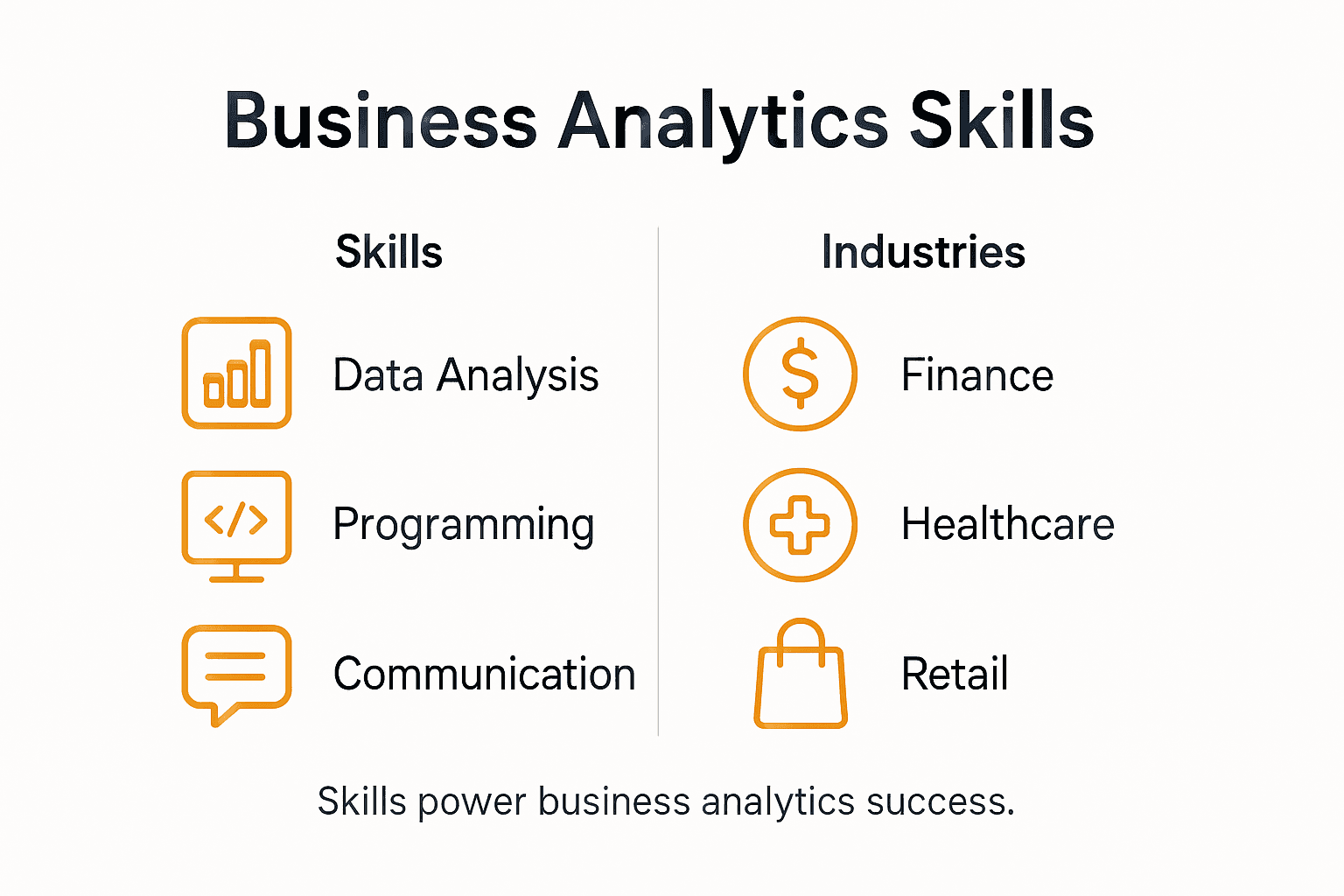
This table summarizes how analytics skills apply differently across industries:
| Industry | Example Analytics Application | Value Delivered |
|---|---|---|
| Finance | Risk modeling for investment strategies | Lower financial losses, smarter investments |
| Healthcare | Predicting patient outcomes from trends | Improved patient care, resource planning |
| Manufacturing | Supply chain and process optimization | Reduced costs, increased productivity |
| Retail | Customer purchasing behavior analysis | Better marketing, increased sales |
| Technology | Product usage and performance tracking | Informed product development and support |
- Finance: Risk assessment and predictive financial modeling
- Healthcare: Patient outcome prediction and operational efficiency analysis
- Manufacturing: Supply chain optimization and process improvement
- Retail: Customer behavior analysis and demand forecasting
- Technology: Performance metrics and product development insights
Pro Tip – Skill Development: Create a personalized learning roadmap that balances technical skill acquisition with industry-specific knowledge, focusing on both advanced computational techniques and strategic business understanding.
Education, Certification, And Regional Trends
The landscape of business analytics education is rapidly evolving, with academic institutions and professional organizations developing comprehensive programs to meet the growing demand for skilled analytics professionals. Business analytics curriculum development in emerging markets highlights the critical need for specialized training that addresses the complex skills required in modern data-driven organizations.
Certification pathways have become increasingly important for professionals seeking to validate their expertise. Key certifications include the Certified Analytics Professional (CAP), IBM Data Science Professional Certificate, and Microsoft Certified: Data Analyst Associate. These credentials demonstrate proficiency in statistical analysis, data manipulation, and advanced analytical techniques. Regional variations in business analytics education reveal significant differences in program content and approach across different geographical markets.
Educational options for aspiring business analytics professionals range from undergraduate degrees to specialized master’s programs and professional certifications. Academic paths typically include:
- Bachelor’s degrees in Business Analytics, Data Science, or related fields
- Master’s programs in Business Analytics or Applied Analytics
- Professional certification programs
- Online specialized courses and micro-credentials
- Corporate training and professional development programs
Regional trends demonstrate varied approaches to business analytics education. North American and European markets tend to have more established, comprehensive programs, while emerging markets in the Middle East and Asia are rapidly developing specialized curricula to meet growing industry demands. The United Arab Emirates, in particular, has been investing heavily in data science and analytics education to support its digital transformation initiatives.
Pro Tip – Strategic Education Planning: Combine academic credentials with practical experience, focusing on programs that offer hands-on projects and industry partnerships to maximize your employability in the competitive business analytics job market.
Common Challenges And Career Pitfalls
Business analytics professionals face numerous challenges that can potentially derail their career progression. Contemporary research on algorithmic fairness highlights the critical ethical considerations that professionals must navigate, emphasizing the importance of understanding the broader implications of data-driven decision making beyond technical competence.
Technical skill obsolescence represents one of the most significant career risks in business analytics. The rapid evolution of technology and analytical tools requires professionals to engage in continuous learning. The dynamic landscape of business intelligence systems demonstrates how quickly technological frameworks can change, making it essential for analysts to remain adaptable and proactively update their skill sets.
Common career challenges in business analytics include:
- Keeping pace with rapidly evolving technological innovations
- Bridging the gap between technical analysis and strategic business communication
- Managing ethical considerations in data interpretation and algorithmic decision making
- Overcoming data quality and integration challenges
- Developing comprehensive storytelling skills to translate complex insights
Professionals must also be vigilant about potential pitfalls such as over-reliance on quantitative metrics, failing to consider contextual nuances, and neglecting the human element in data-driven decision making. Successful business analytics careers require a delicate balance between technical proficiency, strategic thinking, and ethical considerations.
Pro Tip – Career Resilience: Develop a growth mindset that embraces continuous learning, actively seek cross-functional experiences, and cultivate both technical skills and strategic communication abilities to remain competitive in the evolving business analytics landscape.
Elevate Your Business Analytics Career with Expert Training
Navigating the challenges of fast-changing technology and mastering the blend of technical skills with strategic thinking can feel overwhelming. Whether you want to become a Data Scientist, Business Intelligence Analyst, or Predictive Analytics Specialist, building a comprehensive skill set is critical to making data-driven decisions that truly shape business strategy. Our industry-focused programs address these needs head-on by offering hands-on learning in AI, machine learning, and applied analytics to help you transform insights into impactful outcomes.
Unlock your potential today by exploring professional training courses at Ambeone, where practical knowledge meets career advancement. Visit our Uncategorized Archives to discover success stories and student testimonials that prove how effective instructor-led workshops can be. Take the next step in mastering business analytics with a program designed to keep you ahead in the UAE’s competitive market.
Frequently Asked Questions
What skills are essential for a career in business analytics?
The essential skills for a business analytics career include advanced statistical analysis, proficiency in programming languages like Python and R, machine learning techniques, data visualization, and strong communication abilities to translate complex data insights into actionable business strategies.
What are common career paths in business analytics?
Common career paths in business analytics include roles such as data scientist, business intelligence analyst, operations research analyst, and predictive analytics specialist, each requiring a blend of technical skills, statistical knowledge, and strategic thinking.
How can continuing education impact a business analytics career?
Continuing education is crucial for business analytics professionals to stay updated with evolving technologies and analytical tools. Engaging in certification programs, online courses, and hands-on projects helps maintain relevant skills and enhances employability in a competitive job market.
What challenges do business analytics professionals face in their careers?
Business analytics professionals often face challenges such as keeping up with technological advancements, bridging the gap between technical analysis and strategic communication, managing ethical considerations, and overcoming data quality and integration issues.
Recommended
- Business Analytics Definition: Complete Guide and Examples
- What Is Data Analytics? Complete Guide Explained – Ambeone
- The Essential Guide to Why Study Data Analytics – Ambeone
- 7 Key Data Analytics Job Roles Every Professional Should Know – Ambeone
- Comment l’IA révolutionne le marketing digital en 2026 | Growix
- Role of Analytics in Basketball Success Today – Hoop Mentality