
Why learn machine learning for career growth? Discover key concepts, top industry use cases, skill requirements, and risks in finance and healthcare.
Why Learn Machine Learning – Career Growth in Dubai
Why Learn Machine Learning – Career Growth in Dubai
Most advice about machine learning gets it wrong, with nearly half of professionals still believing it is only for tech experts or American data scientists. In Dubai’s finance and healthcare sectors, this misunderstanding can slow your career and hold back innovation. By uncovering the real basics and demystifying common myths, you will see how machine learning skills can open doors to new opportunities and smarter decision making.
Table of Contents
- Machine Learning Basics And Common Myths
- Types Of Machine Learning Approaches
- How Machine Learning Powers Business Sectors
- Essential Skills And Prerequisites For Professionals
- Risks And Challenges In Machine Learning Adoption
Key Takeaways
| Point | Details |
|---|---|
| Understanding Machine Learning | Machine learning, a subset of artificial intelligence, enables systems to learn from data without explicit programming, making it applicable across various industries. |
| Common Myths | Misconceptions such as the need for advanced programming skills deter engagement; many resources now make machine learning accessible to diverse professionals. |
| Essential Skills | A solid foundation in mathematics, programming, and domain-specific knowledge is crucial for success in machine learning careers. |
| Addressing Challenges | Organizations must navigate issues like data quality, algorithmic transparency, and privacy risks when implementing machine learning solutions. |
Machine learning basics and common myths
Machine learning is not just a buzzword — it’s a transformative technology reshaping professional landscapes across industries. In Dubai’s rapidly evolving tech ecosystem, understanding machine learning basics helps professionals navigate complex career opportunities. Common misconceptions about machine learning often prevent talented individuals from exploring this dynamic field.
At its core, machine learning represents a subset of artificial intelligence where computer systems learn and improve from experience without explicit programming. Unlike traditional software that follows rigid instructions, machine learning algorithms adapt and enhance their performance through exposure to data. This adaptive capability makes machine learning powerful in fields ranging from finance to healthcare, enabling predictive analytics, automated decision making, and sophisticated pattern recognition.
Several persistent myths discourage professionals from engaging with machine learning. One prevalent misconception is that machine learning requires advanced programming skills. While technical knowledge helps, many introductory courses and tools now make machine learning accessible to professionals with diverse backgrounds. Another myth suggests machine learning is exclusively a technical domain. In reality, professionals from finance, marketing, healthcare, and other sectors can leverage machine learning techniques to gain strategic insights and drive innovation.
Pro Learning Strategy: Start with online courses and practical projects that match your professional domain. Focus on understanding core concepts before diving deep into complex algorithms.
Pro Exploration Tip: Experiment with user-friendly machine learning platforms that offer drag-and-drop interfaces, allowing professionals to understand core principles without extensive coding knowledge.
Types of machine learning approaches
Machine learning encompasses multiple sophisticated approaches that enable professionals to solve complex problems across various domains. Understanding these different types helps aspiring data scientists and business professionals choose the right strategy for their specific challenges. Deep learning approaches represent just one fascinating segment of this expansive technological landscape.
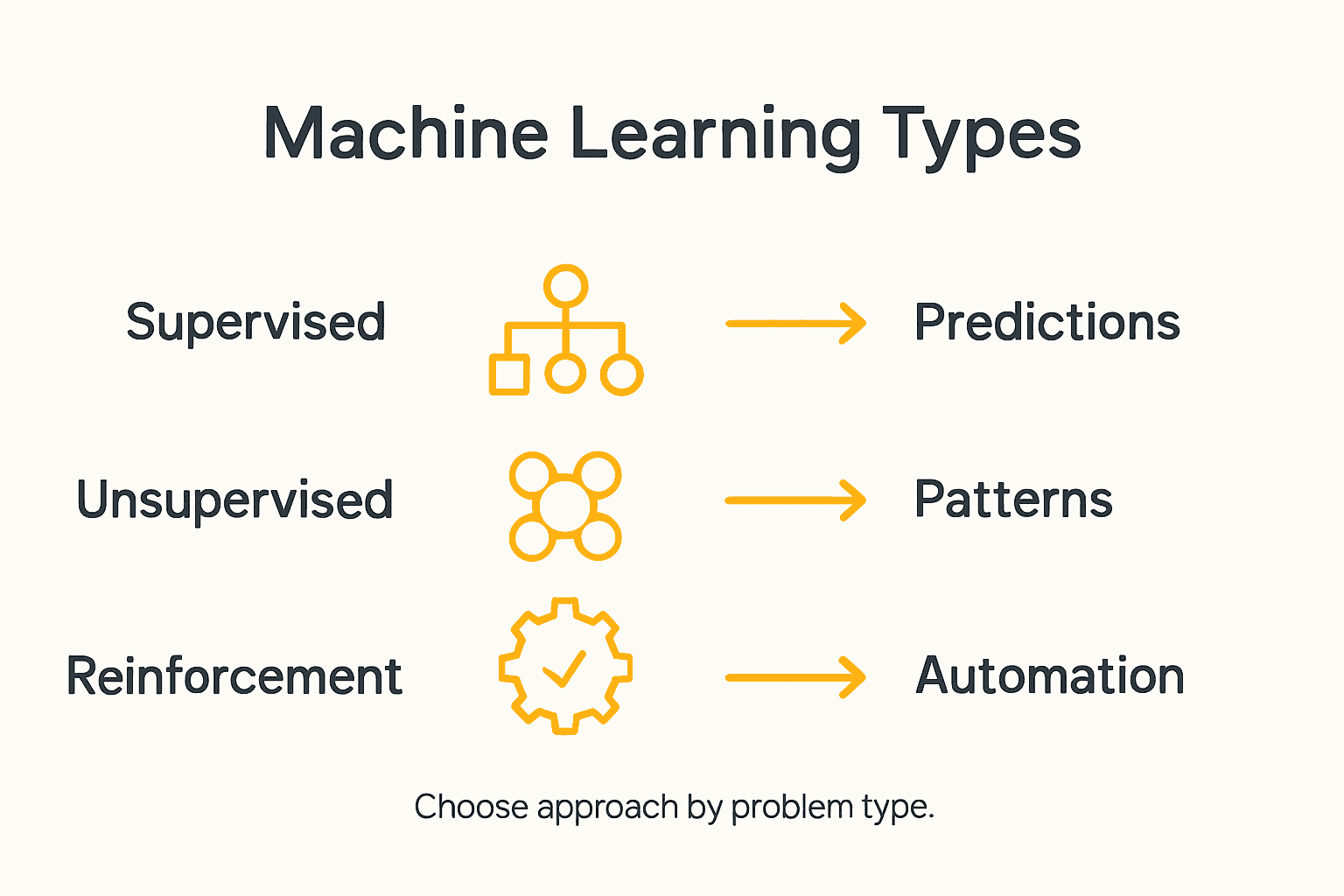
Supervised Learning represents the most traditional machine learning approach where algorithms learn from labeled training data. In this method, input data is paired with known output labels, allowing the algorithm to learn patterns and make predictions. Financial analysts in Dubai might use supervised learning to predict stock market trends, while healthcare professionals could leverage it for diagnostic predictions based on patient data. Common techniques include classification (categorizing data into predefined groups) and regression (predicting continuous numerical values).
In contrast, Unsupervised Learning works with unlabeled data, enabling algorithms to discover hidden patterns independently. These approaches are particularly powerful for clustering and dimensionality reduction. For example, marketing teams can use unsupervised learning to segment customer groups without predefined categories, uncovering natural groupings based on behavioral patterns. Reinforcement Learning represents another fascinating approach where algorithms learn through interaction with an environment, receiving rewards or penalties for specific actions. This method mimics how humans learn through trial and error, making it valuable in complex decision-making scenarios like robotics, game strategy, and autonomous systems.
Pro Learning Strategy: Select machine learning approaches based on your specific problem domain. Experiment with multiple techniques to understand their strengths and limitations in real-world applications.
Pro Exploration Tip: Start with small, controlled datasets when practicing different machine learning approaches to build practical understanding without overwhelming complexity.
Here’s a comparison of key machine learning approaches and their applications:
| Approach | Main Function | Example Application | Benefits |
|---|---|---|---|
| Supervised Learning | Learns from labeled data | Fraud detection in banks | Accurate predictions |
| Unsupervised Learning | Identifies patterns in unlabeled data | Customer segmentation | Uncovers hidden structures |
| Reinforcement Learning | Learns via rewards and penalties | Autonomous robotics | Adapts to complex environments |
How machine learning powers business sectors
Machine learning has become a transformative force across multiple business sectors, revolutionizing traditional approaches to decision making and operational efficiency. Technological advances in machine learning are enabling organizations to unlock unprecedented insights and create competitive advantages in increasingly complex business environments.
Financial Services represent one of the most dynamic sectors leveraging machine learning technologies. Banks and investment firms use advanced algorithms for fraud detection, risk assessment, and personalized financial recommendations. Trading platforms employ predictive models to analyze market trends, while credit institutions develop sophisticated risk scoring systems that can evaluate loan applications with remarkable accuracy. In Dubai’s rapidly growing financial technology landscape, machine learning helps institutions make data-driven decisions faster and more precisely than traditional analytical methods.
Beyond finance, machine learning powers critical transformations in sectors like healthcare, manufacturing, and customer service. Technological integration across industries reveals how sophisticated algorithms can optimize complex operational challenges. Healthcare providers use machine learning for diagnostic predictions, treatment personalization, and medical imaging analysis. Manufacturing companies implement predictive maintenance systems that anticipate equipment failures before they occur, reducing downtime and maintenance costs. Customer service departments deploy intelligent chatbots and personalization engines that can understand and respond to customer needs with increasing sophistication.
Pro Learning Strategy: Focus on understanding domain-specific machine learning applications rather than generic technical skills. Each industry requires nuanced approaches to effectively implement machine learning solutions.
Pro Exploration Tip: Attend industry conferences and workshops to learn how different sectors are practically applying machine learning technologies, gaining insights into real-world implementation strategies.
Essential skills and prerequisites for professionals
Embarking on a machine learning career requires a strategic approach to skill development, blending technical knowledge with practical expertise. Machine learning prerequisites provide a comprehensive roadmap for professionals seeking to excel in this dynamic field, emphasizing the importance of foundational competencies.
Mathematical Foundations form the critical backbone of machine learning proficiency. Professionals need strong skills in linear algebra, calculus, and statistics to understand complex algorithmic processes. Probability theory helps in developing predictive models, while linear algebra enables manipulation of high-dimensional data sets. Professionals in Dubai’s competitive tech landscape should focus on developing mathematical reasoning skills that translate theoretical concepts into practical applications. Key mathematical areas include matrix operations, vector calculus, statistical distributions, and optimization techniques that underpin advanced machine learning algorithms.

Programming skills represent another crucial dimension for machine learning professionals. Python remains the dominant programming language, with libraries like NumPy, Pandas, and Scikit-learn being essential tools. Professionals should develop proficiency in data preprocessing, model implementation, and performance evaluation. Beyond technical skills, domain expertise becomes increasingly important. Understanding specific industry contexts like finance, healthcare, or logistics allows professionals to design more targeted and effective machine learning solutions. Soft skills such as critical thinking, problem solving, and effective communication are equally vital, enabling professionals to translate complex technical insights into actionable business strategies.
Pro Learning Strategy: Create a personalized learning roadmap that balances theoretical knowledge with practical coding experience, focusing on projects that demonstrate real-world problem solving.
Pro Exploration Tip: Participate in online machine learning competitions and open-source projects to gain hands-on experience and build a robust portfolio that showcases your practical skills.
Below is a summary of essential skills for a machine learning professional:
| Skill Area | Why It Matters | Typical Tools/Techniques |
|---|---|---|
| Mathematics | Understanding algorithms | Linear algebra, statistics |
| Programming | Building models | Python, Scikit-learn |
| Domain Knowledge | Tailoring solutions | Finance, healthcare context |
| Soft Skills | Communicate insights | Critical thinking, teamwork |
Risks and challenges in machine learning adoption
Machine learning technologies offer tremendous potential, but their implementation comes with significant complexities and potential pitfalls. Machine learning risk frameworks demonstrate the multifaceted challenges organizations must navigate to ensure responsible and effective deployment.
Data Quality and Bias represent primary challenges in machine learning adoption. Algorithms are fundamentally limited by the datasets they are trained on, meaning imperfect or skewed data can lead to systematically flawed predictions. In Dubai’s diverse professional landscape, this becomes particularly critical. Financial institutions, healthcare providers, and government agencies must rigorously validate data sources, ensuring representation across different demographic groups. Unaddressed biases can result in discriminatory decision making, potentially excluding certain population segments from opportunities or services.
Technical and ethical challenges extend beyond data considerations. Algorithmic Transparency remains a significant concern, as many machine learning models operate as complex “black boxes” where decision making processes are not easily interpretable. This lack of explainability creates potential legal and regulatory risks, especially in sectors like finance and healthcare where understanding decision rationales is crucial. Privacy concerns also emerge, with machine learning systems potentially exposing sensitive personal information if not carefully designed. Organizations must implement robust governance frameworks that balance technological innovation with strict data protection protocols, ensuring individual rights are consistently maintained.
Pro Learning Strategy: Develop a comprehensive risk assessment protocol that evaluates machine learning systems across technical, ethical, and operational dimensions before full implementation.
Pro Exploration Tip: Continuously monitor model performance and establish clear mechanisms for detecting and mitigating unexpected algorithmic behaviors or unintended consequences.
Unlock Your Machine Learning Career in Dubai with Expert Guidance
Navigating the fast-growing field of machine learning can be challenging, especially when confronted with myths and the need for specialized skills like mathematics, programming, and domain expertise. If you want to accelerate your career growth and confidently apply machine learning concepts in real-world business sectors, developing practical skills and industry-relevant knowledge is essential. At Ambeone, we understand your goals and challenges and provide in-depth, instructor-led training programs designed for professionals ready to embrace AI and data science in Dubai’s evolving tech landscape. Explore how our courses address fundamental techniques like supervised and unsupervised learning as well as ethical considerations to prepare you for success.
Take the first step today by visiting our Uncategorized Archives – Ambeone to discover course options and success stories tailored to your ambitions. For detailed program information and certification opportunities, explore our main page to join a community dedicated to transforming careers through applied machine learning. Start building your expertise now and seize the advantage in Dubai’s competitive AI job market.
Frequently Asked Questions
What are the basics of machine learning?
Machine learning is a subset of artificial intelligence that allows computer systems to learn and improve from experience without explicit programming. It adapts and enhances performance through data exposure.
How can machine learning help professionals in various industries?
Machine learning can drive innovation and provide strategic insights across various sectors, including finance, healthcare, and marketing, by enabling predictive analytics and automated decision-making.
What skills do I need to start a career in machine learning?
Essential skills include a strong foundation in mathematics, programming knowledge (especially in Python), domain expertise, and soft skills such as critical thinking and problem-solving.
What are the common myths about machine learning?
Common misconceptions include the idea that machine learning requires advanced programming skills or is exclusively technical. Many accessible courses and tools cater to individuals from diverse backgrounds.