AI Aptitude Test: Unlocking Career Pathways in Dubai
Most American companies now use AI aptitude tests to help identify top talent in the tech industry. As the demand for specialized skills rises, understanding these assessments has become key for anyone aiming to excel in artificial intelligence-related careers. With AI aptitude testing offering insight far beyond traditional methods, readers will discover how these tools measure unique strengths and predict future success in a rapidly evolving digital world.
Table of Contents
- Defining AI Aptitude Tests And Their Purpose
- Common Types Of AI Aptitude Assessments
- Key Skills And Competencies Measured
- How The Testing And Scoring Work
- Practical Uses In Training And Hiring
- Common Pitfalls And How To Avoid Them
Key Takeaways
| Point | Details |
|---|---|
| AI Aptitude Tests Assess Potential | Specialized assessments evaluate cognitive abilities relevant to AI careers, highlighting strengths and revealing skill gaps for targeted development. |
| Diverse Assessment Types Exist | Various AI aptitude tests measure competencies like cognitive reasoning, technical skills, and analytical reasoning, each serving unique purposes in talent evaluation. |
| Objective Scoring Methodologies | Testing uses advanced algorithms for unbiased scoring, offering detailed insights into cognitive strengths and areas for improvement. |
| Practical Applications in Careers | Organizations utilize aptitude tests for recruitment, training, and career planning, ensuring alignment between individual strengths and job roles. |
Defining AI Aptitude Tests and Their Purpose
AI aptitude tests are specialized evaluations designed to assess an individual’s potential and readiness for careers in artificial intelligence and related technological domains. Aptitude assessments measure an individual’s ability to acquire specific skills through future training, revealing unique cognitive capabilities that predict success in complex technological fields.
These assessments go beyond traditional skill evaluations by examining multiple dimensions of cognitive potential. They analyze problem solving skills, logical reasoning, pattern recognition, and computational thinking abilities specifically relevant to AI career pathways. Technological aptitude becomes a critical indicator of an individual’s potential to excel in rapidly evolving artificial intelligence disciplines.
An effective AI aptitude test typically evaluates several key competencies, including:
- Mathematical reasoning and statistical comprehension
- Algorithmic thinking and logical problem solving
- Basic programming concept understanding
- Data interpretation and analytical skills
- Machine learning concept comprehension
- Cognitive flexibility and learning potential
Professionals and career switchers seeking to enter AI fields can leverage these assessments to understand their strengths, identify skill gaps, and create targeted learning strategies. Standardized tests provide critical insights into individuals’ aptitudes within specific technological domains, enabling more strategic career development.
Pro Tip: Research Your Potential: Take multiple AI aptitude assessments from reputable sources to gain a comprehensive understanding of your technological learning capabilities and potential career alignment.
Common Types of AI Aptitude Assessments
AI aptitude assessments encompass a diverse range of evaluative tools designed to measure an individual’s potential for success in artificial intelligence and technological domains. These assessments vary in complexity, focus, and methodology, providing comprehensive insights into candidates’ cognitive capabilities and learning potential.
The primary categories of AI aptitude tests include cognitive reasoning assessments, which measure intelligence through culturally neutral evaluation methods. These specialized tests analyze problem solving skills, logical reasoning, and pattern recognition abilities without relying on specific cultural or linguistic knowledge. Such assessments help identify underlying cognitive strengths essential for AI and technological careers.
Key types of AI aptitude assessments include:
- Computational Thinking Assessments
- Algorithmic problem solving evaluations
- Logical reasoning and pattern recognition tests
- Technical Skills Diagnostics
- Programming concept understanding assessments
- Software engineering aptitude evaluations
- Cognitive Potential Tests
- Abstract reasoning examinations
- Machine learning concept comprehension tests
- Analytical Reasoning Assessments
- Data interpretation skills evaluation
- Statistical reasoning and mathematical logic tests
Professionals interested in AI careers can leverage specialized aptitude tests for data science career pathways to understand their strengths and identify potential skill development areas. These assessments provide strategic insights into an individual’s technological learning potential and career alignment.
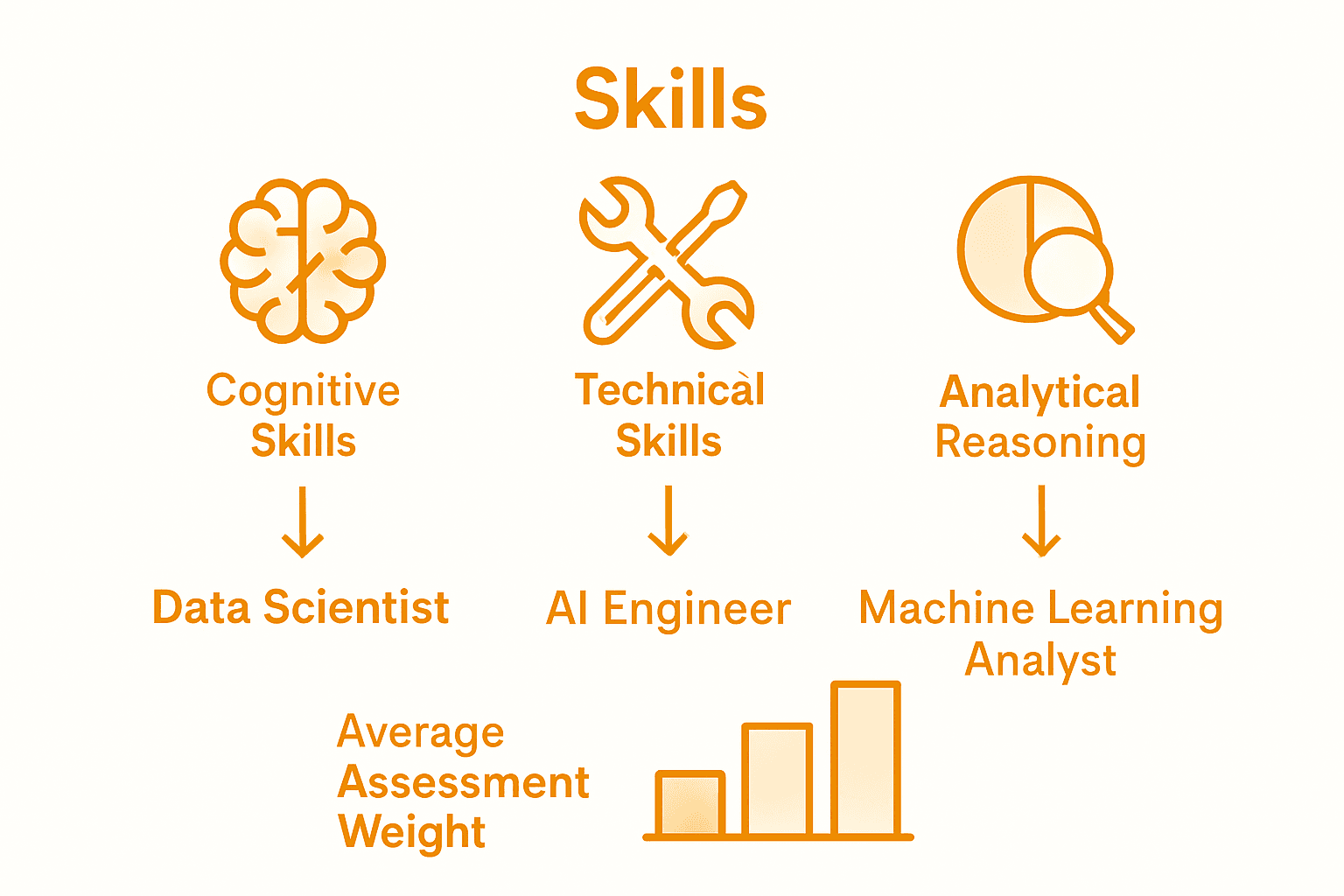
Here’s a summary comparing the main types of AI aptitude assessments and what they uniquely evaluate:
| Assessment Type | Primary Focus | Example Applications |
|---|---|---|
| Cognitive Reasoning | Problem solving and logic | Entry-level talent screening |
| Technical Diagnostics | Programming concepts knowledge | Role-specific technical hiring |
| Analytical Reasoning | Data and math interpretation | Data science candidate filtering |
| Cognitive Potential | Abstract thinking, learning ability | Machine learning suitability reviews |
Pro Tip: Strategic Assessment Selection: Choose multiple assessment types that comprehensively evaluate your cognitive abilities, technical skills, and learning potential to gain a holistic understanding of your AI career readiness.
Key Skills and Competencies Measured
AI aptitude assessments meticulously evaluate a comprehensive range of cognitive and technical skills critical for success in artificial intelligence and technology-driven careers. These specialized tests measure an individual’s core mental abilities through standardized cognitive and aptitude evaluations, providing nuanced insights into potential performance and learning capabilities.

The fundamental competencies measured typically encompass several critical domains of intellectual and technical proficiency. Aptitude tests are designed to assess inherent skills across multiple cognitive dimensions, including problem solving, critical thinking, and specialized reasoning capabilities, enabling a holistic understanding of an individual’s technological potential.
Key skills and competencies typically assessed include:
- Cognitive Reasoning
- Analytical thinking capabilities
- Abstract problem solving skills
- Logical deduction and inference
- Technical Proficiency
- Computational thinking
- Programming concept understanding
- Algorithmic reasoning
- Mathematical Intelligence
- Numerical reasoning
- Statistical comprehension
- Quantitative analysis skills
- Spatial and Pattern Recognition
- Visual reasoning
- Complex pattern interpretation
- Structural thinking abilities
Professionals seeking to understand their technological potential can leverage these comprehensive assessments to identify strengths, target skill development, and align their career trajectories with emerging AI and technological opportunities.
Pro Tip: Skill Mapping Strategy: Document your performance across different assessment domains to create a personalized learning roadmap that systematically addresses your cognitive and technical skill development needs.
How the Testing and Scoring Work
AI aptitude assessments utilize sophisticated testing methodologies designed to provide comprehensive and objective evaluations of an individual’s cognitive potential. These assessments are engineered to measure intelligence through culturally neutral evaluation methods, ensuring that scoring remains unbiased and focuses purely on inherent cognitive capabilities.
The testing process typically involves a structured approach that combines multiple evaluation techniques. Standardized scoring mechanisms break down performance across various cognitive domains, generating a nuanced profile of an individual’s technological learning potential. These assessments use advanced algorithmic scoring that considers not just correct answers, but also the problem-solving approach, logical reasoning, and speed of cognitive processing.
Key aspects of the testing and scoring process include:
- Adaptive Testing Algorithms
- Dynamic difficulty adjustment
- Real-time performance tracking
- Personalized question selection
- Multi-Dimensional Scoring
- Cognitive reasoning score
- Technical skills assessment
- Problem-solving efficiency rating
- Comparative Analysis
- Benchmarking against industry standards
- Peer group performance comparison
- Potential trajectory prediction
- Detailed Performance Breakdown
- Skill strength identification
- Improvement area recommendations
- Learning potential mapping
The scoring methodology goes beyond simple numerical ratings, providing a comprehensive analysis that helps professionals and organizations understand an individual’s true potential in AI and technological domains. Specialized aptitude tests for data science career pathways offer particularly nuanced insights into technological learning capabilities.
Pro Tip: Scoring Insight Strategy: Request a detailed breakdown of your assessment results, focusing on understanding the specific cognitive strengths and potential areas for development rather than just the overall score.
Practical Uses in Training and Hiring
AI aptitude assessments have transformed recruitment and professional development strategies across technology-driven industries. Organizations leverage cognitive assessment tools to evaluate candidates’ ability to think critically, solve problems, and reason quantitatively, providing a sophisticated approach to identifying top talent with exceptional cognitive potential.
Recruitment optimization represents a primary application of these advanced testing methodologies. Cognitive aptitude tests help organizations assess how quickly and accurately candidates can learn, adapt, analyze information, and make critical decisions, making them invaluable for screening entry-level professionals and conducting high-volume hiring processes.
Key practical applications in training and hiring include:
- Talent Acquisition
- Objective candidate screening
- Predictive performance modeling
- Skill potential identification
- Training Program Development
- Personalized learning pathway design
- Skills gap identification
- Targeted skill development strategies
- Career Progression Planning
- Individual potential mapping
- Succession planning support
- Internal mobility optimization
- Organizational Learning
- Workforce capability assessment
- Strategic skill investment
- Continuous learning ecosystem development
Professionals can leverage data science interview preparation strategies to complement their aptitude assessment insights, creating a comprehensive approach to career development in technological domains.
The table below highlights how AI aptitude test results can be applied for professional growth:
| Use Case | Purpose | Resulting Benefit |
|---|---|---|
| Talent Acquisition | Identify top candidates | Stronger workforce potential |
| Skills Development | Map individual gaps | Tailored training investments |
| Career Planning | Align roles to strengths | Improved job satisfaction |
| Succession Planning | Spot future leaders | Internal mobility optimization |
Pro Tip: Strategic Self-Assessment: Regularly take AI aptitude tests to track your cognitive development, identify emerging strengths, and proactively address potential skill limitations in your professional journey.
Common Pitfalls and How to Avoid Them
AI aptitude assessments, while powerful tools for evaluating cognitive potential, are not without significant challenges and potential limitations. These assessments have become controversial due to potential inherent biases and challenges in creating truly objective measurements of cognitive abilities, requiring careful and nuanced implementation.
Cultural and contextual complexities pose significant challenges in developing comprehensive aptitude evaluations. Scholars have consistently noted the immense difficulty in constructing cognitive assessments that remain completely free from experiential and cultural conditioning, highlighting the need for sophisticated, adaptive testing methodologies.
Common pitfalls in AI aptitude testing include:
- Bias and Discrimination
- Unintentional cultural stereotyping
- Narrow definition of intelligence
- Overlooking diverse cognitive strengths
- Overreliance on Standardized Metrics
- Ignoring individual learning variations
- Reducing human potential to numerical scores
- Failing to capture adaptive intelligence
- Technical Limitations
- Incomplete skill representation
- Narrow assessment parameters
- Rapid technological obsolescence
- Psychological Impact
- Test anxiety and performance pressure
- Potential demotivation from limited results
- Reductive self-perception risks
Professionals can enhance their assessment experience by understanding comprehensive data science interview preparation strategies that complement standardized testing approaches.
Pro Tip: Holistic Self-Assessment: Approach aptitude tests as one tool among many for understanding your potential, complementing them with practical experience, continuous learning, and diverse skill development strategies.
Unlock Your AI Career Potential in Dubai with Expert Training
The article highlights the challenge of accurately assessing your AI aptitude to effectively unlock new career pathways in Dubai. If you are seeking to identify your strengths in cognitive reasoning, technical proficiency, and problem-solving for AI roles, it is crucial to complement aptitude testing with practical, industry-relevant learning experiences. Many professionals face uncertainty about bridging skill gaps and preparing strategically for data science and AI careers without guided support.
At Ambeone, we specialize in empowering you with in-person instructor-led training programs designed to enhance your AI, Data Science, and Applied Analytics competencies. Our courses focus on the very skills measured by AI aptitude tests such as algorithmic reasoning, statistical comprehension, and machine learning fundamentals. With KHDA-approved certifications and a strong focus on real-world business applications, we help you transform your aptitude insights into actionable career growth.
Ready to turn your AI aptitude test results into career success in Dubai Take the next step by exploring our comprehensive training offerings at Ambeone. Discover tailored learning pathways, expert faculty, and success stories of professionals who have elevated their careers. Don’t wait to unlock your potential Start your journey now and secure your place in the fast-growing AI field.
Explore more about prepping for your AI career journey with our data science interview preparation tips and check how you can advance through cutting-edge programs to excel in the industry.
Frequently Asked Questions
What are AI aptitude tests?
AI aptitude tests are specialized evaluations that assess an individual’s potential and readiness for careers in artificial intelligence and related technological fields. They measure cognitive capabilities like problem solving, logical reasoning, and pattern recognition.
How do AI aptitude assessments help in career development?
AI aptitude assessments provide insights into an individual’s strengths and skill gaps, which can help professionals create targeted learning strategies and better align their career paths with emerging job opportunities in AI.
What skills are typically measured in AI aptitude tests?
AI aptitude tests typically evaluate competencies such as mathematical reasoning, algorithmic thinking, programming concepts, data interpretation skills, and cognitive flexibility, all of which are crucial for success in AI-related careers.
How often should I take an AI aptitude assessment?
It is recommended to take AI aptitude assessments regularly to track your cognitive development, understand emerging strengths, and proactively address skill limitations as you progress in your professional journey.