Step-by-Step Guide to Business Analytics for Professionals
Nearly every American business leader agrees that data-driven decisions offer a real edge, yet only about 30 percent actually succeed in turning analytics into growth. Setting the right business objectives forms the backbone of this transformation, connecting information with meaningful action. This step-by-step guide reveals how to define clear goals, collect and prepare data, and turn complex analytics into real business solutions for American organizations aiming to advance.
Table of Contents
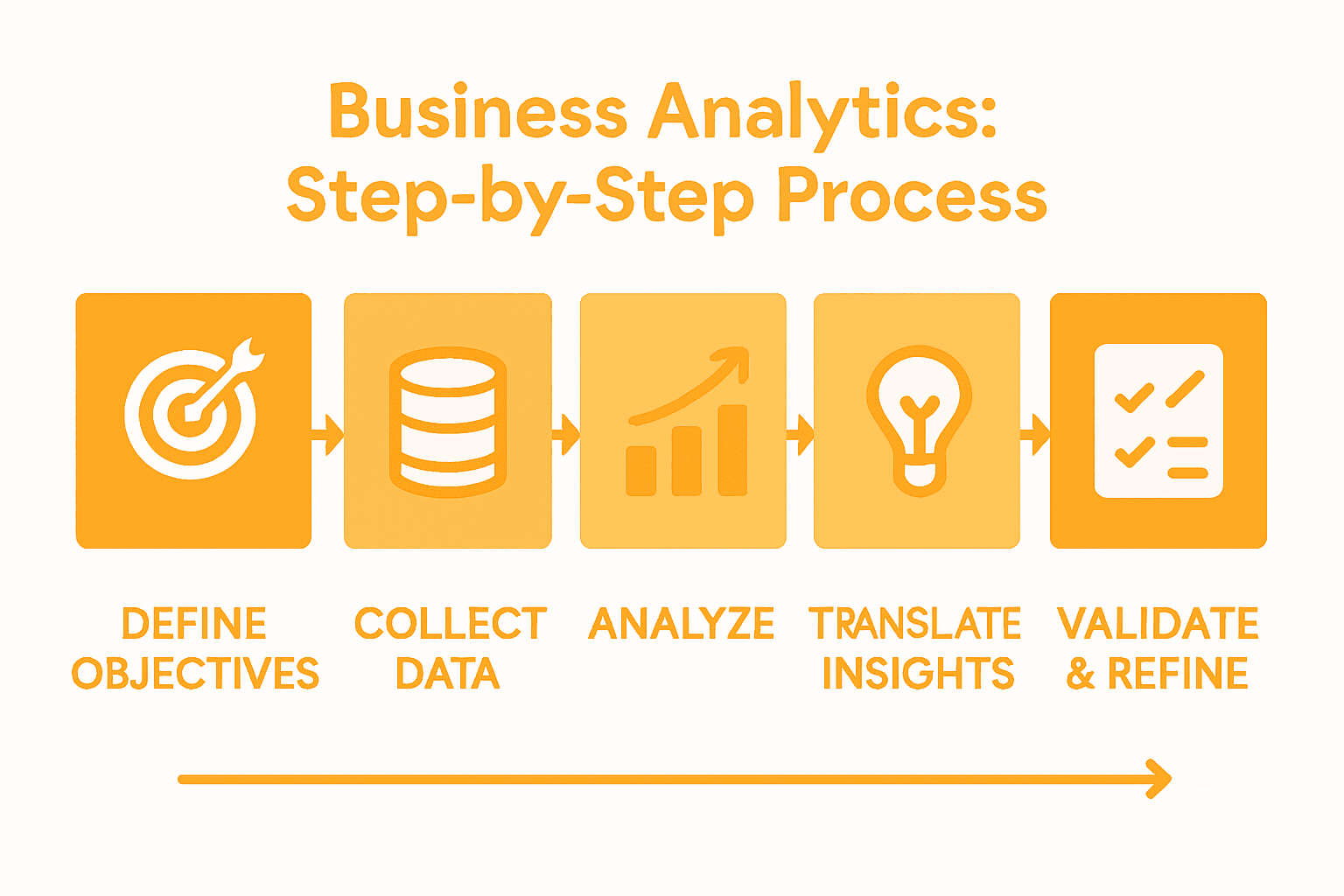
- Step 1: Define Business Objectives and Analytics Goals
- Step 2: Collect and Prepare Relevant Data Sources
- Step 3: Apply Analytical Methods to Uncover Insights
- Step 4: Translate Analytics Results Into Business Actions
- Step 5: Validate Outcomes and Refine Analytics Process
Quick Summary
| Key Insight | Explanation |
|---|---|
| 1. Define Clear Business Objectives | Start with a comprehensive assessment of challenges and priorities to align analytics with goals. |
| 2. Collect Relevant Data Methodically | Gather both internal and external data, ensuring its relevance and quality to generate insights. |
| 3. Apply Appropriate Analytical Techniques | Choose methods like predictive and prescriptive analytics to extract actionable insights from data. |
| 4. Translate Insights into Actions | Clearly present findings using visualizations and recommendations that connect data to specific business strategies. |
| 5. Validate and Refine the Analytics Process | Regularly assess the effectiveness of analytics methods and incorporate feedback for continuous improvement. |
Step 1: Define Business Objectives and Analytics Goals
Defining clear business objectives and analytics goals is the strategic foundation that transforms raw data into actionable insights. This critical first step helps organizations align their data analysis efforts with specific business outcomes and performance targets.
To successfully define your business objectives, start by conducting a comprehensive assessment of your organization’s current challenges and strategic priorities. This involves gathering input from key stakeholders across different departments to understand their specific information needs. The most effective approach involves using the SMART framework for setting goals precise, measurable, achievable, relevant, and time bound objectives that provide clear direction for your analytics initiatives.
When establishing analytics goals, focus on creating objectives that support real time decision making and predictive insights. According to research, successful business analytics strategies aim to provide actionable information that enables proactive customer focused strategies and trend prediction. These goals might include improving operational efficiency, enhancing customer experience, identifying new revenue streams, or reducing operational costs.
Pro tip: Create a collaborative goal setting session that involves representatives from multiple departments to ensure your analytics objectives are comprehensive and aligned with broader organizational strategies.
Step 2: Collect and Prepare Relevant Data Sources
Collecting and preparing relevant data sources is a crucial phase in business analytics that transforms raw information into strategic insights. This step involves systematically identifying, gathering, and organizing data that will help answer your specific business questions and support decision making.

Begin by mapping comprehensive data collection strategies that encompass both internal and external sources. Internal data might include financial records, customer databases, operational logs, and performance metrics. External sources could range from market research reports, industry benchmarks, social media insights, and public datasets. When selecting data sources, carefully evaluate their relevance, reliability, and potential to generate meaningful insights.
The data preparation process requires a strategic approach to prioritizing and maintaining data items while balancing acquisition costs with potential value. This means critically assessing each data source for accuracy, completeness, and alignment with your defined business objectives. Implement rigorous data cleaning techniques such as removing duplicates, handling missing values, standardizing formats, and ensuring consistent data quality across different sources.
Pro tip: Create a data inventory spreadsheet that tracks each data source, its origin, collection date, and potential analytical value to streamline your data management process.
Step 3: Apply Analytical Methods to Uncover Insights
Applying analytical methods is the critical stage where your collected data transforms into meaningful business intelligence. This step involves selecting and implementing appropriate analytical techniques that will reveal hidden patterns, trends, and actionable insights within your organizational data.
Start by understanding the evolution of business intelligence systems that have transformed how organizations extract value from data. Modern analytical approaches require a sophisticated blend of statistical techniques, machine learning algorithms, and domain specific knowledge. Depending on your business objectives, you might employ descriptive analytics to understand what happened, diagnostic analytics to determine why something occurred, predictive analytics to forecast future trends, or prescriptive analytics to recommend specific actions.
To maximize insight generation, embrace a model driven analytics approach that connects data, domain expertise, and advanced learning techniques. This means moving beyond simple data visualization to create comprehensive analytical frameworks that integrate complex data sets and generate nuanced insights. Select analytical methods that align with your specific business goals such as regression analysis for understanding relationships, cluster analysis for identifying customer segments, or time series analysis for tracking performance over time.
Here’s how analytics methods differ by their purpose and business value:
| Method Type | Main Purpose | Typical Techniques | Business Value |
|---|---|---|---|
| Descriptive | Summarize past performance | Reporting, dashboards | Clarifies historical trends |
| Diagnostic | Explain why events occurred | Root cause analysis | Reveals causes of problems |
| Predictive | Forecast future outcomes | Regression, ML models | Anticipates risks and opportunities |
| Prescriptive | Suggest optimal business actions | Optimization, simulation | Improves decisions with actionable steps |
Pro tip: Develop a flexible analytical workflow that allows you to iterate and refine your methods as you uncover new insights, ensuring your analytical approach remains adaptive and responsive to emerging business challenges.
Step 4: Translate Analytics Results Into Business Actions
Translating analytics results into concrete business actions is the critical bridge between data insights and strategic implementation. This transformative step converts complex statistical findings into practical recommendations that drive organizational performance and decision making.
Utilize the BADIR framework as a structured approach to ensuring your analytical insights translate effectively into meaningful business strategies. This framework helps you systematically assess how your statistical analysis and predictive modeling can inform specific organizational actions. Begin by identifying clear patterns and correlations within your data that directly connect to key business objectives. Look for insights that reveal opportunities for cost reduction, revenue enhancement, process optimization, or customer experience improvement.
Effective translation requires collaboration between data analysts and business leaders. Present your findings using clear visualizations, concise narratives, and direct recommendations that explain not just what the data shows, but what specific actions the organization should take. Prioritize insights based on potential business impact, potential implementation complexity, and alignment with overall strategic goals. This means transforming abstract statistical trends into actionable strategies like adjusting marketing campaigns, redesigning product features, reallocating resources, or modifying operational workflows.
Pro tip: Always contextualize your analytical results by explicitly linking each insight to a specific business outcome and potential action plan, making the value of your analysis immediately clear to decision makers.
Step 5: Validate Outcomes and Refine Analytics Process
Validating outcomes and refining your analytics process is a critical stage that ensures the continuous improvement and reliability of your business intelligence efforts. This step transforms your initial analytical work into a dynamic, evolving approach that adapts to changing business needs and emerging insights.
Begin by implementing an iterative goal oriented approach to visualization requirements that systematically evaluates the effectiveness of your analytical outputs. This means critically examining how well your current visualizations and analytical models align with actual business objectives. Develop a comprehensive review process that includes comparing predicted outcomes with actual results, identifying gaps in your analytical methodology, and understanding the root causes of any discrepancies.
Create an analytical base table that serves as a centralized repository for tracking your analytical performance over time. This structured approach allows you to maintain a clear record of your analytical iterations, performance metrics, and continuous improvement efforts. Focus on key validation techniques such as cross validation, sensitivity analysis, and benchmarking against industry standards. Engage stakeholders from different departments to gather qualitative feedback that complements your quantitative analysis, ensuring a holistic approach to refining your analytics process.
This table summarizes key data validation techniques in business analytics:
| Validation Technique | Description | When to Use |
|---|---|---|
| Cross-Validation | Tests model stability using splits | Evaluating predictive models |
| Sensitivity Analysis | Measures impact of variable changes | Assessing model robustness |
| Benchmarking | Compares to industry standards | Ensuring competitive performance |
| Stakeholder Feedback | Gathers expert, user perspectives | Refining insights and priorities |
Pro tip: Implement a quarterly review cycle that includes both statistical performance metrics and stakeholder feedback to create a comprehensive validation framework that drives ongoing analytical excellence.
Unlock the Power of Business Analytics with Expert Training
Struggling to turn complex data into actionable business decisions is a challenge many professionals face. This guide highlights crucial steps like defining clear objectives, gathering quality data, applying the right analytical methods, and translating insights into impactful actions. If you want to overcome these hurdles and master skills such as predictive analytics, model-driven approaches, and effective data visualization, our courses provide the hands-on training you need.
Discover how Ambeone’s instructor-led training programs can help you bridge the gap between theory and real-world application. By enrolling in our AI, Data Science, and Applied Analytics courses, you gain practical expertise aligned with industry demands right here in Dubai and the UAE. Don’t let uncertainty hold you back. Explore our Uncategorized Archives for insights and visit Ambeone to start your data-driven career journey today.
Frequently Asked Questions
What are the first steps in defining business objectives for analytics?
Defining business objectives starts with identifying your organization’s challenges and strategic priorities. Engage key stakeholders to gather insights on their specific information needs and utilize the SMART framework to establish clear, measurable goals.
How do I collect and prepare data sources for analysis?
Begin by mapping out a comprehensive strategy to identify both internal and external data sources. Once collected, prioritize and clean your data to ensure accuracy and relevance to your business objectives, removing duplicates and handling any missing values.
What analytical methods should I consider for uncovering insights?
Choose analytical methods based on your business objectives. Methods such as regression analysis, cluster analysis, and predictive modeling can reveal hidden patterns and insights that directly inform your strategic decisions.
How can I effectively translate analytics results into actionable business strategies?
Present your findings using clear visualizations and concise narratives that connect analytics insights to specific action plans. Collaborate closely with stakeholders to ensure that recommendations are practical and aligned with business goals.
What steps should I take to validate outcomes from my analytics process?
Implement a structured review process to validate your analytical outputs against actual results. Consider using techniques like cross-validation and stakeholder feedback to refine your approach and improve accuracy in decision-making over time.