Why Analytics in Business Drives Growth and Insight
Over eighty percent of American companies now rely on business analytics to guide key decisions every day. With so much at stake, understanding how raw data becomes powerful strategy matters more than ever. Whether you manage a small startup or a large corporation, this guide shows how analytics breaks down barriers, supports smarter decisions, and gives American organizations a true advantage in a data-driven world.
Table of Contents
- Defining Business Analytics And Its Purpose
- Types Of Business Analytics Explained
- How Analytics Improves Decision-Making
- Real-World Applications Across Industries
- Common Pitfalls And How To Avoid Them
Key Takeaways
| Point | Details |
|---|---|
| Importance of Business Analytics | Business analytics transforms raw data into strategic insights, enabling data-driven decision making and fostering proactive planning. |
| Types of Analytics | There are four main types of business analytics: Descriptive, Diagnostic, Predictive, and Prescriptive, each providing unique insights for decision making. |
| Improving Decision-Making | Analytics enhances decision-making by providing quantitative data, reducing bias, and enabling faster responses to market changes. |
| Common Implementation Challenges | Organizations face challenges such as inadequate data quality and technological limitations, emphasizing the need for strong data governance and skilled personnel. |
Defining Business Analytics and Its Purpose
Business analytics represents a sophisticated approach to transforming raw organizational data into strategic insights that drive intelligent decision making. At its core, business analytics uses statistical analysis, predictive modeling, and data mining to uncover critical business trends and opportunities.
The fundamental purpose of business analytics transcends simple number crunching. Modern organizations leverage these methodical techniques to evaluate complex situations, predict potential outcomes, and quantify organizational risks with unprecedented precision. By employing advanced analytical tools and models, businesses can transition from reactive strategies to proactive planning that anticipates market shifts and customer behaviors.
Key components of effective business analytics include:
- Statistical analysis of historical data
- Predictive modeling of future scenarios
- Risk assessment and mitigation strategies
- Performance optimization techniques
- Strategic decision support mechanisms
Pro Tip – Analytics Implementation: Start by identifying your organization’s most critical performance metrics and build your initial analytics framework around understanding and improving those specific areas.
Business analytics ultimately empowers leaders to make data-driven decisions that can significantly enhance organizational performance, reduce operational inefficiencies, and create sustainable competitive advantages in an increasingly complex business landscape.
Types of Business Analytics Explained
Business analytics encompasses four critical analytical approaches that help organizations transform data into actionable intelligence. These types of business analytics range from understanding historical performance to prescribing future strategic actions, enabling businesses to make increasingly sophisticated decisions.
Descriptive Analytics represents the foundational layer, focusing on interpreting historical data to understand what has already occurred. This approach involves summarizing raw data into meaningful insights, typically using visualization techniques like dashboards and reports that help managers comprehend past performance trends.

Diagnostic Analytics digs deeper by investigating why specific events or outcomes happened. By employing advanced statistical techniques and data mining, diagnostic analytics helps organizations uncover the root causes behind performance variations, identifying both positive and negative influencing factors.
Key Types of Business Analytics:
Here’s a comparison of the four main types of business analytics and the unique value each brings:
| Analytics Type | Primary Focus | Example Use Case | Key Business Benefit |
|---|---|---|---|
| Descriptive | Summarizing past events | Sales performance reporting | Identifies patterns and trends |
| Diagnostic | Explaining underlying causes | Analyzing drop in customer retention | Reveals reasons for performance |
| Predictive | Forecasting future scenarios | Anticipating product demand shifts | Enables proactive planning |
| Prescriptive | Recommending optimal actions | Suggesting best marketing strategies | Supports targeted decision making |
- Descriptive Analytics: Understanding past performance
- Diagnostic Analytics: Identifying causative factors
- Predictive Analytics: Forecasting future trends
- Prescriptive Analytics: Recommending optimal actions
Predictive Analytics shifts the focus toward future possibilities, utilizing historical data and machine learning algorithms to forecast potential scenarios. Organizations can anticipate market trends, customer behaviors, and potential risks before they materialize, enabling proactive strategic planning.
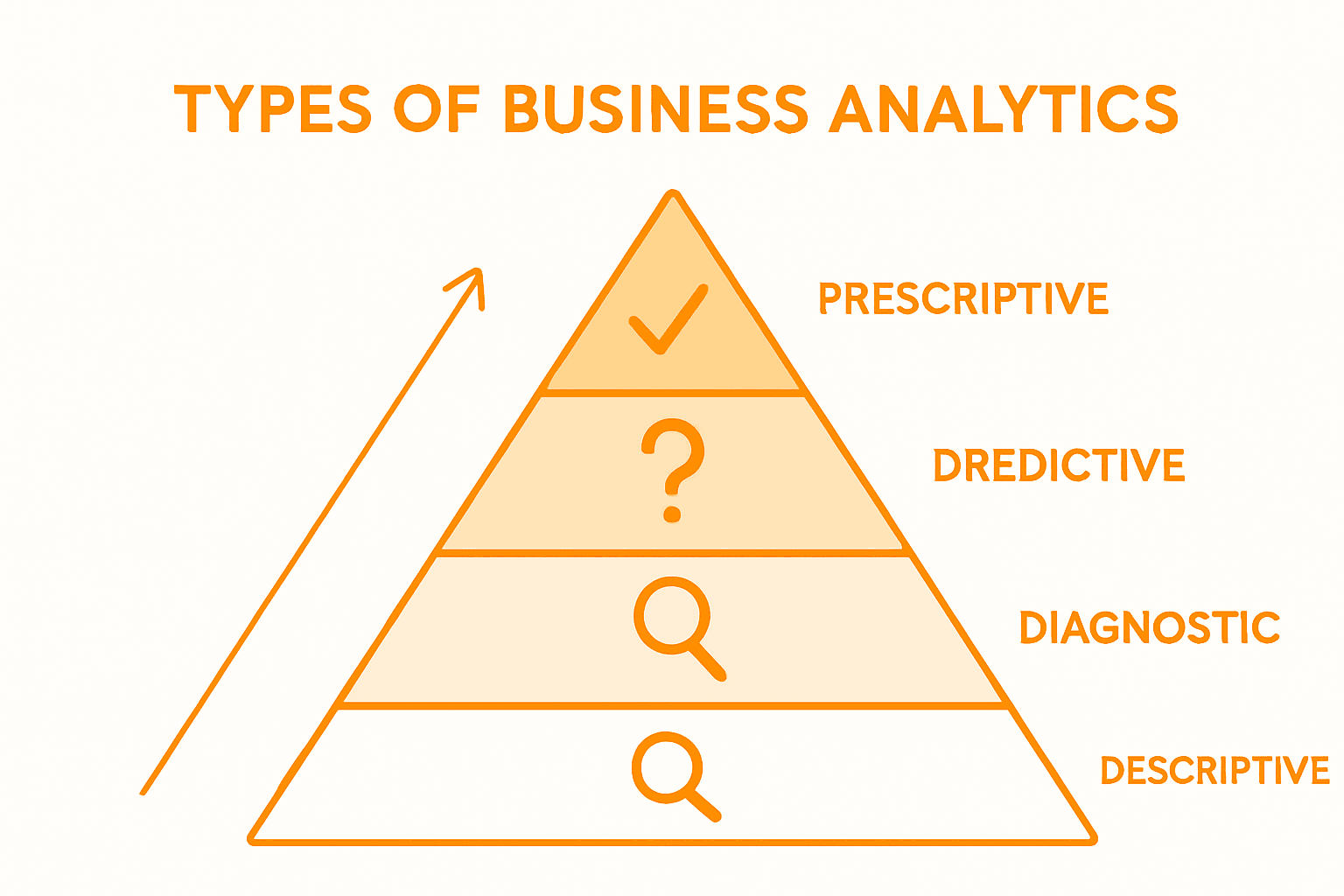
Prescriptive Analytics represents the most advanced analytical approach, not just predicting what might happen but recommending specific actions to achieve desired outcomes. By combining insights from previous analytical stages, prescriptive analytics provides concrete, data-driven recommendations for strategic decision making.
Pro Tip – Analytical Progression: Start with descriptive analytics to understand your current state, then systematically progress through diagnostic and predictive approaches before implementing prescriptive strategies for maximum organizational impact.
How Analytics Improves Decision-Making
Business analytics transforms raw data into strategic insights that dramatically enhance organizational decision-making processes. By providing an objective foundation for understanding performance and setting key performance indicators, analytics enables businesses to track real-time feedback and make more intelligent choices.
The primary mechanism through which analytics improves decision-making involves converting complex data sets into clear, actionable intelligence. Traditional decision-making often relied on intuition and historical precedent, but modern analytics introduces a data-driven approach that minimizes subjective bias. Organizations can now leverage statistical models and predictive algorithms to evaluate potential outcomes with unprecedented precision, reducing uncertainty and mitigating potential risks.
Key Decision-Making Improvements Through Analytics:
- Quantifying potential risks and opportunities
- Reducing subjective decision-making
- Enabling faster strategic responses
- Providing evidence-based recommendations
- Creating measurable performance benchmarks
Advanced analytics techniques allow businesses to develop nuanced understanding of intricate operational dynamics. By analyzing customer behaviors, market trends, and internal performance metrics simultaneously, organizations can create holistic strategies that adapt quickly to changing environments. This approach transforms decision-making from a reactive process to a proactive, strategic methodology.
Competitive intelligence emerges as a significant byproduct of sophisticated analytics. Companies can now anticipate market shifts, understand customer preferences, and develop targeted strategies with remarkable accuracy. The ability to forecast potential scenarios and recommend optimal actions gives businesses a substantial competitive advantage in rapidly evolving markets.
Pro Tip – Analytical Decision Making: Start by identifying your organization’s most critical performance metrics, then gradually implement data-driven decision-making processes that integrate multiple analytical perspectives for comprehensive insights.
Real-World Applications Across Industries
Business analytics has transformed decision-making processes across diverse industrial landscapes, proving its versatility and critical importance. Analytics is utilized extensively by large corporations, consulting firms, e-commerce companies, technology enterprises, insurance providers, and retail organizations to streamline operations and generate data-driven strategic insights.
In the financial sector, analytics enables sophisticated risk management, fraud detection, and investment strategies. Banks and insurance companies leverage predictive models to assess credit risks, identify potential fraudulent transactions, and develop personalized financial products tailored to individual customer profiles. These data-driven approaches dramatically reduce financial uncertainties and enhance overall operational efficiency.
Industry-Specific Analytics Applications:
Below is a summary of industry-specific business analytics applications and their impact:
| Industry | Analytics Application | Resulting Business Impact |
|---|---|---|
| Financial | Fraud detection and risk scoring | Minimizes losses and enhances compliance |
| Healthcare | Predicting patient outcomes | Improves care quality and resource use |
| Retail | Customer segmentation analysis | Increases sales and boosts loyalty |
| Manufacturing | Predictive maintenance optimization | Reduces downtime and saves costs |
| Gaming | Player engagement insights | Drives targeted game design and revenue |
- Financial Services: Risk assessment and fraud prevention
- Healthcare: Patient outcome prediction and resource optimization
- Retail: Customer behavior analysis and inventory management
- Manufacturing: Predictive maintenance and supply chain optimization
- Gaming: Demographic targeting and product development
The technology and gaming industries demonstrate particularly innovative analytics applications. For instance, game developers now use advanced descriptive analytics to analyze age demographics, sales data, and player engagement metrics to design more targeted and successful game productions. This approach transforms product development from a speculative process to a precise, data-informed strategy.
Manufacturing and logistics sectors have also revolutionized their operations through analytics. Predictive maintenance algorithms can now anticipate equipment failures before they occur, reducing downtime and maintenance costs. Supply chain managers utilize complex analytical models to optimize inventory levels, predict demand fluctuations, and enhance overall operational efficiency.
Pro Tip – Cross-Industry Analytics: Begin by identifying your industry’s most critical performance metrics, then gradually implement targeted analytical approaches that address specific operational challenges and opportunities.
Common Pitfalls and How to Avoid Them
Business analytics demands precision and strategic implementation to deliver meaningful insights. Organizations frequently encounter significant challenges when attempting to transform data into actionable intelligence, often resulting from misalignment with business objectives and insufficient analytical tools.
One of the most critical pitfalls involves data quality and interpretation. Many organizations collect massive amounts of data without establishing clear parameters for relevance, accuracy, and strategic utility. This leads to information overload, where decision-makers become overwhelmed by complex datasets that ultimately provide little substantive guidance. The key is developing robust data governance frameworks that prioritize quality over quantity and ensure analytical efforts remain tightly aligned with specific organizational goals.
Common Analytics Implementation Challenges:
- Inadequate data infrastructure
- Poor data quality and inconsistency
- Lack of clear analytical objectives
- Insufficient technical expertise
- Misalignment between analytics and business strategy
Another significant challenge emerges from technological limitations and skill gaps within organizations. Many businesses invest in sophisticated analytical tools without ensuring their teams possess the necessary technical capabilities to leverage these resources effectively. This creates a paradoxical situation where significant financial investments yield minimal returns due to implementation barriers.
Predictive modeling requires sophisticated understanding of statistical techniques and domain-specific knowledge. Without proper training and contextual comprehension, analytics initiatives can generate misleading or superficial insights that fail to address underlying business complexities. Successful implementation demands a holistic approach that combines technological infrastructure, analytical expertise, and strategic vision.
Pro Tip – Analytics Risk Management: Develop a comprehensive analytics strategy that includes continuous skills training, regular performance audits, and adaptive methodologies to ensure your analytical capabilities evolve alongside emerging technological and business landscapes.
Unlock the Power of Analytics to Drive Your Business Growth
The challenges highlighted in this article such as data quality, predictive modeling, and strategic decision-making show why mastering business analytics is essential for professionals aiming to stay ahead. If you are eager to overcome these obstacles and harness concepts like descriptive, diagnostic, predictive, and prescriptive analytics to transform data insights into real-world business impact you need targeted learning from industry experts. Our Uncategorized Archives – Ambeone offers a pathway for you to develop these cutting-edge skills with hands-on training.
Take the next decisive step by exploring professional courses that focus specifically on Artificial Intelligence, Data Science, and Applied Analytics at Ambeone. Gain confidence in using advanced analytics tools and strategies to deliver data-driven results, reduce operational risks, and forecast market trends before they happen. Don’t wait to build the expertise that will propel your career and business forward. Visit our training programs today and start transforming your analytical capabilities into strategic business advantages.
Frequently Asked Questions
What is business analytics?
Business analytics is the process of using statistical analysis, predictive modeling, and data mining to transform raw data into strategic insights that drive data-driven decision making in organizations.
How does analytics improve decision-making in businesses?
Analytics improves decision-making by converting complex data into clear, actionable intelligence, reducing subjective biases, quantifying potential risks, and enabling faster responses to market changes.
What are the types of business analytics?
The four main types of business analytics are descriptive analytics (understanding past data), diagnostic analytics (explaining performance variations), predictive analytics (forecasting future scenarios), and prescriptive analytics (recommending actions based on data insights).
What are common challenges in implementing business analytics?
Common challenges include inadequate data infrastructure, poor data quality, lack of clear analytical objectives, insufficient technical expertise, and misalignment between analytics efforts and business strategy.